

Jordan will implement structural reforms aligned with the International Monetary Fund's recommendations to improve the country's business environment, but persistent regional instability and anti-Western sentiment will likely deter some foreign investment. On July 1, the International Monetary Fund (IMF) disbursed an additional $130 million of its $1.2 billion Extended Fund Facility (EFF) agreement with Jordan that it signed in January following a successful initial review. In announcing the disbursement, the IMF stated that Jordan's EFF-supported program was ''off to a strong start, reflecting the authorities' strong ownership'' of the program.'' The fund further noted that Amman had met all the benchmarks and criteria for the first review, including via its efforts to improve the country's macroeconomic stability, business environment, and the financial viability of the electricity sector. But the IMF also noted that Jordan still faces high unemployment rates and significant expenditure to address the more than 600,000 Syrian refugees the country hosts.
- The IMF adjusted its forecast for Jordan's growth for 2024 from 2.6% to 2.4% but anticipated that economic growth would be higher in 2025, conditional on a reduction of spillover effects from the ongoing Hamas-Israel war in nearby Gaza.
- According to Jordan's Department of Statistics, unemployment stood at 21.4% in the first quarter of 2024, a 0.5% decrease from the first quarter of 2023.
Jordan's macroeconomic reforms and demonstrated resilience when faced with external shocks resulted in inking the EEF to foster additional structural reforms, boost the private sector, and further strengthen the country's economic resiliency. The January 2024 EEF agreement replaced Jordan's previous IMF deal that was set to expire later in the year, after Jordan fulfilled many of its fiscal and monetary obligations from the previous agreement. The previous agreement, signed in 2020, had supported Jordan's fiscal consolidation efforts as the country faced unsustainable public debt and a sluggish private sector, in addition to the global economic fallout from the COVID-19 pandemic. Furthermore, Jordan took action to improve its investment environment through macroeconomic and structural reforms aligning with the IMF, and by adopting the 2022 Investment Environment law, which provided incentives and exemptions for investors. According to the Central Bank of Jordan, in the first half of 2023, Jordan obtained $776 million in inward foreign direct investment flows, a 20.9% increase from the first half of 2022 (per World Bank data, investment inflows into Jordan have been on a general downward trend since peaking in 2006). Despite positive economic signs, Jordan has faced spillover effects from the Hamas-Israel war since the conflict broke out in early October, including decreased tourism, boycotts against Western brands for alleged support of Israel, and overall economic uncertainty. To maintain Jordan's progress and build further resilience, the EEF provided a structural program, with some further fiscal consolidation efforts, to improve private sector job creation and strengthen social services in the country.
- In order to achieve fiscal consolidation, Jordan in 2019 implemented a progressive tax system on individuals and corporations to increase government revenues. Furthermore, Amman adopted legislation to increase business competition, decrease operating costs for businesses, improve labor market flexibility, and increase government transparency. Furthermore, in order to increase investment in Jordan's growing sectors, the Ministry of Investment automated nearly 100 services and launched its ''invest.jo'' platform, which offers 36 different investment opportunities in the country.
- In late January 2024, Jihad Azour, director of the Middle East and Central Asia Department at the IMF, noted that ''any improvement and the resilience of the Jordanian economy through the reforms that were conducted in the past allowed Jordan to overcome these difficult times or to reduce the burden of these difficult times on the Jordanian economy.''
- Jordan's tourism sector, which comprised 14.6% of the country's economy in 2023, took a significant hit shortly after the Gaza war broke out, which prompted people to cancel their trips to Jordan amid the uncertainty over the nearby conflict. However, hotel occupancy rates increased in April, around the Muslim holiday of Eid al-Fitr; and between January and June, Jordan's tourism revenue only dropped by 4.9% compared with the same period in 2023, according to the Central Bank of Jordan, due largely to an influx of Arab tourists, which mostly counteracted the war-induced decline of Western tourists.
- In May 2024, Moody's upgraded Jordan's long-term sovereign credit rating from B1 to Ba3 due to the country's macroeconomic reforms, risk mitigation strategies, and resiliency to global shocks. The upgraded credit rating also signals foreign investors' improved confidence in Jordan's economy.
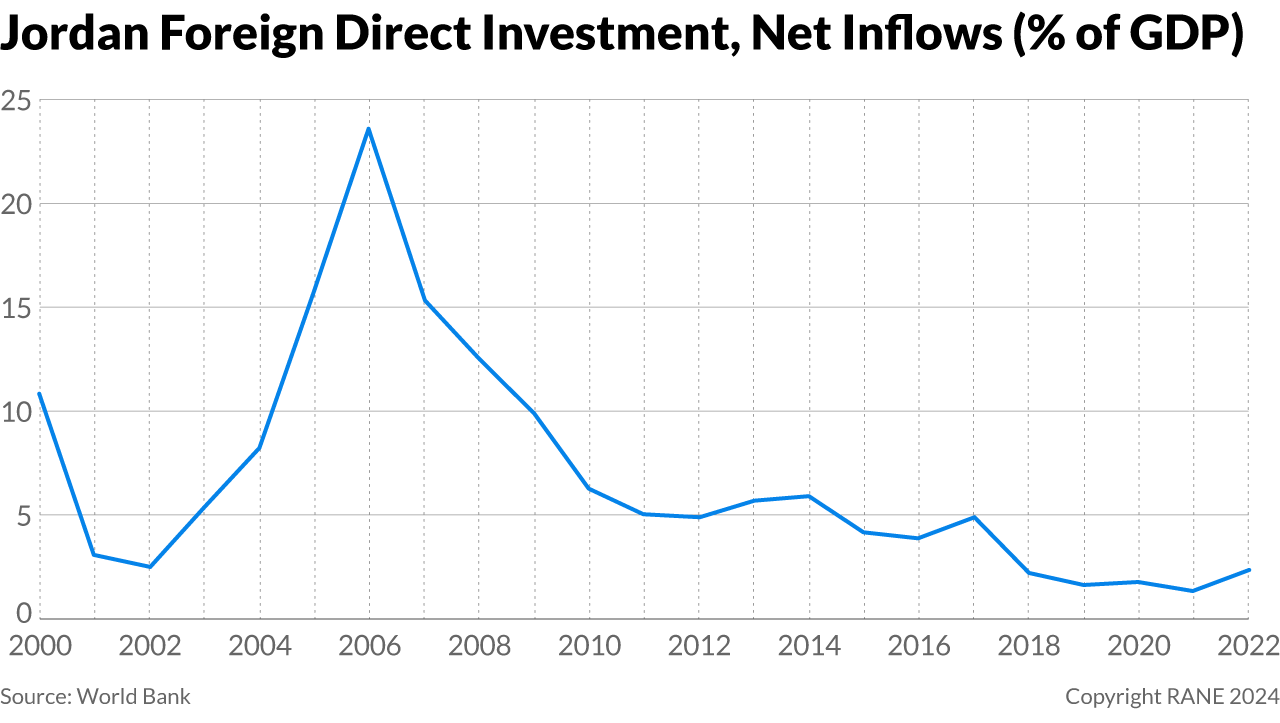
In the coming months, Jordan will implement IMF-recommended structural reforms to improve the country's business environment. Jordan's past precedent of following the IMF's recommendations closely — both in the country's previous IMF deal and ahead of the first review of its new EEF agreement — indicates Amman will very likely take action to incentivize investment over the next 12 months, in alignment with the IMF's recommendations. This will likely see Jordan abolish licensing measures for libraries, cultural and sport activities, as well as scale back licensing measures for food, education and childcare sectors. Such measures will likely improve the business environment for local investors by reducing the barriers to entry for new companies and entrepreneurs, as well as the upfront costs associated with obtaining licenses. Jordan will also take measures to appeal to foreign companies. This will probably include facilitating imports and exports through expedited clearance using a digital licensing hub, which would make it easier and faster for Jordanian-based companies to conduct international commerce by cutting transportation times through customs and reducing logistical barriers to entry. Additionally, Jordan will likely try to revitalize the increasing foreign investment flows it saw before the outbreak of the Gaza war by offering foreign companies tax exemptions and other incentives — like those in the country's 2022 Investment Environment Law, which includes tax breaks for export-focused companies, companies seeking to invest in Jordan's less-developed sectors (such as its agricultural and industrial sectors), and companies that employ more than 250 Jordanians under the law's ''Jordanization'' clause. Jordan will also use established online platforms, such as invest.jo, to direct prospective investors to opportunities in key and emerging sectors, including its growing information and communication technology, healthcare and tourism industries.
- According to a June 2022 report by the Organisation for Economic Co-operation and Development (OECD), the sectors most appealing for foreign direct investment in Jordan — namely, real estate, construction, and oil and gas — are not the ones with the greatest potential to create new jobs and boost economic productivity. Instead, the OECD suggested that Jordan's renewable energy, business services, information and communication technology, and transport sectors have a stronger potential for growth. Jordan's efforts to diversify and incentivize investment opportunities will thus likely target these emerging sectors and boost job creation in them.
Despite the government's efforts, uncertainty regarding an expanded regional conflict near Jordan will likely still deter some investment in the short term. Escalating border clashes between Israeli troops and the Lebanese militant group Hezbollah have fueled fears of an expanded regional war, should Israel decide to launch a military operation along its northern border with Lebanon. The growing specter of another conflict between Israel and Lebanon will likely deter some foreign investors, especially the more risk-averse ones, until they are more confident about the impact such a war would have on Jordan (though the impact would likely be fairly minimal unless the violence sends a surge of refugees into the country). In addition, while Amman remains pro-Western, U.S. and European support for Israel's operations in Gaza will continue to fuel anti-Western sentiments and calls for boycotts among Jordan's Arab citizens, which may deter Western companies from investing or expanding their operations in the country, at least in the short term. Other investors, however — including those from some Gulf Cooperation Council countries like Kuwait and the United Arab Emirates — are more accustomed to conducting business amid waves of regional instability, and will thus likely continue investing in Jordan.
- Fighting between U.S.-backed Israeli troops and Iran-backed Hezbollah fighters has escalated in recent weeks, with both sides striking deeper into each other's territories. Western diplomats worry that failure to reach a diplomatic resolution could lead to a wider confrontation, potentially involving direct participation from the United States and Iran.
- Despite the Jordanian government's efforts to decrease licensing barriers in the food and beverage sector, strong pro-Palestinian sentiment will likely continue to hurt business for Western brands in Jordan, especially those with purported pro-Israel stances. As recently as July 7, during a conference hosted by the Protecting the Homeland and Resisting Normalisation Committee of the Jordanian Engineers Syndicate, Jordanian activists and trade unionists reiterated calls to boycott pro-Israel brands and support Jordanian alternatives.
- In May 2024, Abu Dhabi's sovereign wealth fund ADQ reportedly finalized plans to invest $5 billion in infrastructure development and other projects in Jordan that had been in development following an agreement between the emirates and Jordan in 2023.
