
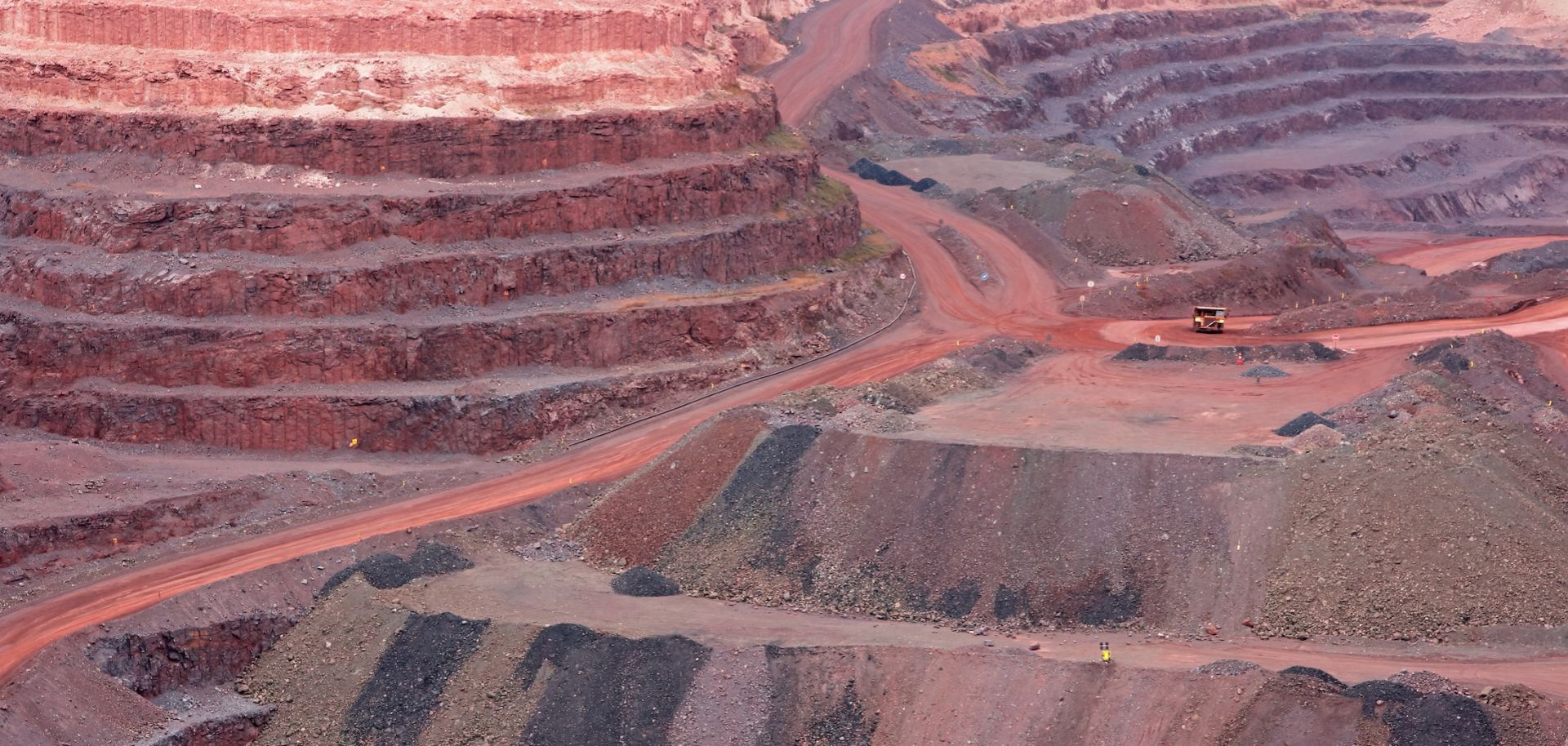
The completion of Guinea's giant Simandou mine would help China diversify its iron ore supply and decarbonize its steel industry, but the project could be derailed by political instability in the West African country. On June 20, China's Baowu Steel confirmed its purchase of an undisclosed stake in the Winning Consortium Simandou (WCS), which manages two of the four blocks of Guinea's $20 billion Simandou iron ore mine, Africa's largest mining project that sits atop the world's largest untapped reserves of high-grade iron ore. This came after Anglo-Australian mining giant Rio Tinto approved a $6.2 billion investment in the project in February. As part of negotiations with Guinea authorities, project participants agreed to invest in the construction of a new deepwater port in the locality of Morebaya, situated to the south of the Guinean capital of Conakry, as well as two railway sections totaling over 620 kilometers that will connect Simandou to the newly-built port. The project is scheduled to begin exporting iron ore in late 2025, with a target annual output of 120 million tons — around 5% of global production.
- The development of the Simandou mine has faced decade-long delays due to political instability in Guinea, lawsuits between different mining companies, and corruption scandals.
- The Simandou project is divided into four blocks. WCS — a consortium that regroups Singapore's Winning International Group, China Hongqiao and Baowu Steel — owns a majority stake in Block 1 and Block 2 of the project, with the Guinean government holding a 10% stake in the two blocks. The Guinean government also holds a 15% stake in Blocks 3 and 4 of the project, with the remaining 85% owned by the Simfer consortium, which regroups Rio Tinto, the Aluminum Corporation of China (Chinalco), Baowu Steel, China Railway Construction Corporation and China Harbour Engineering Company.
Guinean junta leader Mamady Doumbouya's apparent ambition to delay an ongoing transition to civilian rule threatens to undermine Guinea's political stability and delay the project's completion, which could be shelved in the event of a new military coup. According to Rio Tinto, the advancement of construction works linked to the Simandou mine were 30-35% complete as of May 2024, suggesting that the project is currently on track to begin production by the end of 2025. However, ongoing political developments in Guinea could cast doubt on this timeline. Comments made by junta-appointed Prime Minister Bah Oury in March that military rule could be prolonged until 2025, rather than end in 2024 as previously pledged, have prompted opposition groups to threaten to hold demonstrations to demand the organization of elections before the end of 2024. Coupled with rising socioeconomic grievances, a formal announcement by the junta to extend the transition period into 2025 could trigger mass protests, which could disrupt construction works related to the Simandou project and ultimately delay the start of commercial production. Moreover, protracted protests would raise the prospect of a new coup from disgruntled factions within the Guinean military, which would likely temporarily pause work on the Simandou project. Should Guinea's new military leaders seek to renegotiate the project with WCS and Simfer, the consortiums could suspend construction indefinitely — if not exit the project.
- Since September 2021, Guinea has been under military rule following a coup against former President Alpha Conde, who faced large-scale protests due to his decision to run for a controversial third term in the country's 2020 presidential election. In October 2022, Doumbouya agreed to a 24-month timeline for transitioning the country back to civilian rule amid pressure from the Economic Community of West African Countries (ECOWAS).
- Socioeconomic grievances have been rising in Guinea following the December 2023 explosion of the Kaloum fuel depot in Conakry, which killed 24 people and resulted in nationwide fuel shortages and increasingly frequent power cuts.
- In Guinea, anti-government protests generally occur in large population centers, especially in Conakry, which means demonstrations against the junta are unlikely to directly target the Simandou project. However, protests in Conakry could disrupt the supply of building materials — many of which are imported via the capital city's port — to the construction sites, which would risk further delaying the project's completion.
Simandou's completion would help Guinea diversify its economy and help the junta — or future authoritarian regimes — consolidate power, but it would do little to reduce the country's exposure to commodity price fluctuations. Guinea's economy is currently heavily reliant on the export of unprocessed bauxite, which leaves it vulnerable to fluctuations in global aluminum prices and adds little value to the country's economy, as the refining of Guinean bauxite currently takes place abroad. While the junta aims to locally refine some of the iron ore extracted from the Simandou mine, these plans will likely prove difficult to implement given the challenges facing Guinea's power sector, in turn leaving the country vulnerable to a broad drop in global commodity prices for the foreseeable future. But new iron ore exports from Simandou would still help diversify Guinea's exports, and enable the country to position itself in green supply chains given the importance of high-grade iron ore for low-carbon steel production. In addition, the construction of the railway connecting the Simandou range to the Atlantic Ocean will help dynamize the economy of Guinea's interior, which has long struggled from a lack of transport infrastructure. More broadly, the scale of the project means that Simandou's completion would nearly double the size of the Guinean economy in just a few years and provide a major boost to export revenue. This would enable any Guinean government to expand its patronage network, as well as provide it with fiscal space to press ahead with targeted cash transfers to ease socioeconomic grievances, thus helping Doumbouya — or future authoritarian leaders — to consolidate power.
- Around 7-8% of global greenhouse gas emissions are currently produced by the steelmaking industry. Direct reduced iron is one of the technologies currently available to produce low-emission steel, and relies on hydrogen and carbon monoxide to transform the steel into iron rather than coal-based coke. However, the technology requires iron with purity grades in excess of 66%, which is the case for reserves found in Simandou.
- High-grade iron currently represents only 3% of the global iron supply, and Brazilian mining giant Vale forecasted a 70-million-metric ton annual gap in high-grade iron through 2030.
Heavy Chinese investments in the project suggest that the bulk of Simandou's exports would likely be destined for China, which would help Beijing reduce its reliance on Australian iron ore and decarbonize its steelmaking industry. Given the project's scale, the start of commercial production at the Simandou mine would significantly impact global iron ore markets. First, heavy Chinese investments in the project suggest that the bulk of Simandou's ore exports would likely be destined for China, which would help Beijing diversify its supply of iron ore and reduce the country's dependence on Australian iron ore amid tense relations with Canberra in recent years. While Australia is set to remain China's largest iron ore supplier for the foreseeable future due to Australia's geographic proximity and unparalleled scale of production, the Simandou mine's start of production would enable Beijing to reduce imports of Australian iron ore in the event of future trade spats. Moreover, exports from Simandou would boost the global supply of high-grade iron ore needed for the production of low-carbon steel, which would put downward pressure on prices and ease some of the constraints faced by steelmakers seeking to reduce their carbon emissions by shifting away from coal-based blast furnaces to reduce their carbon emissions. But given major shortfalls in the global supply of high-grade iron ore, Beijing's preferential access to Simandou's ore would primarily support China's efforts to decarbonize its steelmaking industry and escape certain tariffs provisions linked to the European Union's Carbon Border Adjustment Mechanism (CBAM) that will enter force in 2026.
- The European Union's CBAM was adopted in April 2023 and will impose tariffs on carbon-intensive products such as steel. The measure, which aims to ensure that the bloc's green policies do not put European manufacturers at a disadvantage with their global competitors, could make Chinese steel exports 11% more expensive by 2030. Simandou thus fits within broader efforts by Beijing to maintain the competitiveness of its steel industry in European markets.
