
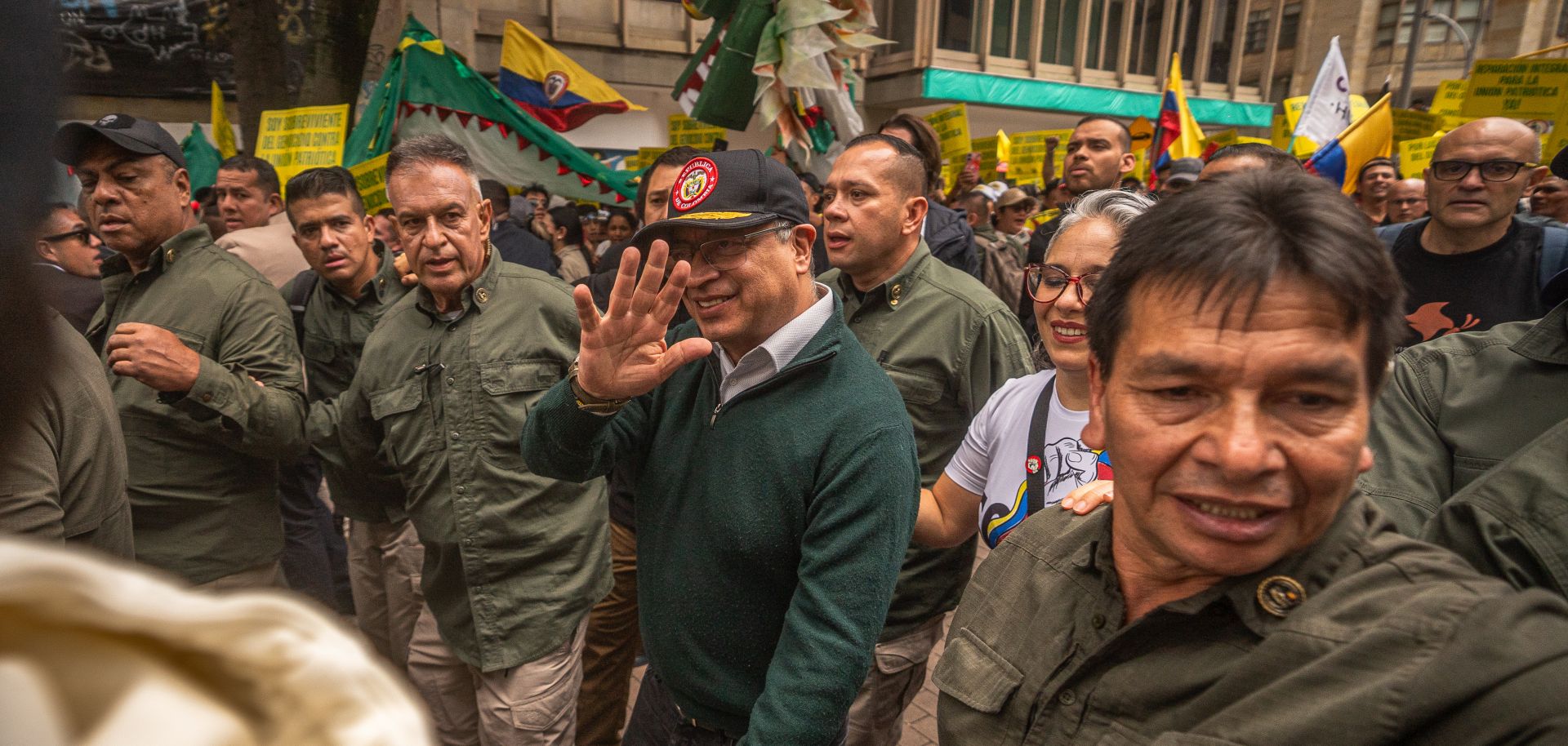
A new corruption scandal in Colombia will further weaken the government's ability to pass structural reforms, while increasing the risk of political volatility and social unrest. On May 6, Colombia's government announced the resignation of regional development adviser Sandra Ortiz amid a corruption scandal involving the alleged embezzlement of disaster relief funds. That same day, two prominent members of the Alianza Verde (AV) party, which supports President Gustavo Petro in parliament, announced their exit from the party over the same issue. The scandal started on May 3, when two senior members of Colombia's National Unit for Disaster Risk Management (UNGRD) denounced that the institution had been using disaster funds to bribe members of Colombia's congress to support legislation promoted by Petro's administration. According to these individuals, the lawmakers that received these bribes include the president of the Senate, Ivan Name, and the president of the Chamber of Deputies, Andres Calle — both of whom belong to the Alianza Verde party. Name and Calle have rejected these accusations.
- On May 3, Petro initially said his government would investigate the corruption accusations involving the UNGRD and punish any potential public officials involved in them. Then on May 6, Petro seemed to change the tone of his rhetoric and denounced an unspecified ''coup attempt'' against his government. Also on May 6, the Colombian government announced that Transparency Secretary Andres Idarraga (who, according to media reports, knew about the misuse of UNGRD funds) will stay in his position, amid rumors that the government had decided on his dismissal.
- The two members of Alianza Verde who left the party on May 6 are Claudia Lopez and Antanas Mockus. Both of them served as mayors of Bogota and were critical of Alianza Verde's support for Petro. Lopez and Mockus said they cannot be members of a party that is involved in corruption investigations.
The UNGRD scandal is only the latest in a series of corruption investigations surrounding Petro's government and undermining his popularity. Since taking over in August 2022, Petro's government has experienced multiple corruption scandals. One of the largest took place in mid-2023, when the president's son, Nicolas Petro, was arrested over accusations that he received money from drug cartels to finance his father's presidential campaign. While Petro himself was not accused in the investigation (which is still ongoing), the episode hurt the image of a president who heavily criticized Colombia's corrupt political elites on the campaign trail. A large segment of Colombia's population (and conservative voters in particular) are also against Petro's ongoing push to negotiate a peace deal with the country's main guerrilla and criminal groups. Against this backdrop, the UNGRD scandal will do little to improve the president's public support, which according to different opinion polls, now hovers at around 30%, down from around 60% in the early weeks of his term.
The ongoing scandals and growing public dissatisfaction with the government will prolong political volatility and policy uncertainty in Colombia, while increasing the risk of social unrest. Petro's political situation means that the Colombian congress is unlikely to approve his flagship healthcare reform, which seeks to expand the role of the state in the healthcare system. On April 3, the Senate blocked the reform, and the government is unlikely to win enough support in the future to resurrect it (though the Petro administration plans to implement parts of the reform via presidential decrees). In the meantime, while the Senate approved on April 24 a pension reform (another one of Petro's main policy priorities), the legislation will now move to the Congress of Deputies, which could block it. Additionally, Colombia's conservative opposition will likely use the corruption allegations to try to destabilize the government. On April 21, a protest against Petro's government drew thousands of protesters to the streets of Bogota and other larger cities, and more protests are likely in the coming months. In March, Petro said that if the legislature fails to approve his proposed reforms, he would seek to implement them through a constitutional reform. To change the constitution, however, the Colombian congress must first approve a law calling for a Constitutional Assembly, which is unlikely given Petro's fragile congressional support. Still, the mere idea of a constitutional reform could become another point of contention between the government (which has accused the opposition of blocking Petro's reforms) and the opposition (which has accused the president of trying to expand his powers by altering the country's constitution), driving social unrest and political volatility.
- Petro's Pacto Historico coalition of left-wing parties does not control enough seats in congress to pass legislation on its own, which means that it needs support from other parties. But Petro's congressional support is fragile, which forces his government to negotiate with lawmakers on a case-by-case basis, increasing policy uncertainty.
- The Alianza Verde party formally supports Petro, with some of its members (such as Ortiz) even taking positions in his government. But its backing of the president has long been a source of internal dispute within the party. The new corruption accusations targeting Alianza Verde, coupled with the resignation of senior figures, will thus further fragment the party and reduce its willingness and ability to continue supporting Petro.
- Opposition parties have demanded that Petro be removed from office since the emergence of the campaign finance scandal involving his son. However, the constitutional process to dismiss a sitting president is long and complex. According to the Colombian constitution, it first requires a simple majority in the Chamber of Deputies to kick off the process, and then a simple majority in the Senate to actually depose the president. Considering the fragmentation of Colombia's congress, this scenario is improbable at this point, though new revelations surrounding Petro's son's alleged links to criminal groups may increase the chances of Petro being impeached or forced to resign. New corruption scandals or new revelations connected to the ongoing investigations into the UNGRD scandal may also force Petro to step down.
- In an effort to improve its popularity, the Colombian government will increase fiscal spending, but this could prove problematic. The government's spending plans for 2024 will take the country's fiscal deficit to 5.3% this year, from 4.2% in 2023. In February, the International Monetary Fund warned that Colombia's spending plan assumes ''ambitious but uncertain'' gains from recent tax reforms and added that if tax revenues fall short of expectations, Colombia may have to implement painful spending cuts that would risk stoking protests and strikes. Colombia's plans for extra spending are also problematic because the country lost its investment-grade status in 2021, which has since resulted in higher borrowing costs.
