
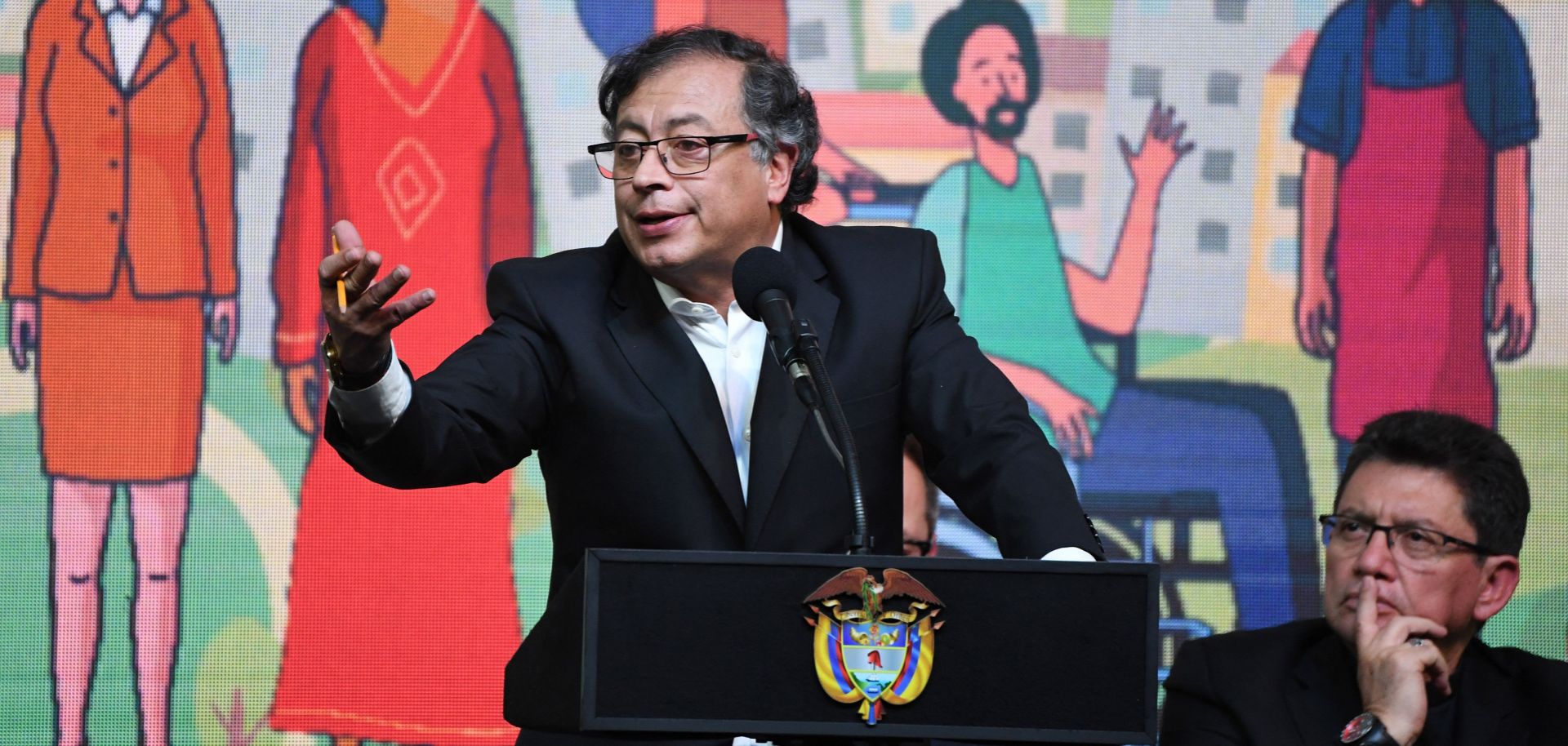
In Colombia, President Gustavo Petro will likely continue to negotiate cease-fires with ideologically motivated armed groups, while also increasing security operations against criminal groups, which will likely result in higher levels of violence, safety concerns, and shipping disruptions in departments where these groups have operations. On Feb. 20, Colombia's defense minister announced that the military would resume aerial bombings targeting criminal actors like the Gulf Clan, a policy that was suspended just two weeks after President Petro took office in August 2022. The announcement marks a break with the president's flagship security policy, ''Paz Total'' (or Total Peace), which has seen Petro — a former member of the M-19 guerilla group himself — engage in simultaneous cease-fire negotiations with Colombia's largest guerilla movements, dissident groups and criminal actors. According to an April 2023 report from the Bogota-based Ideas for Peace Foundation, Petro's Total Peace initiative has been somewhat effective, or at the very least has not led to increased violence in Colombia. During his first year in office, national homicides, attacks on infrastructure, and attacks against state security forces fell by 1.5%, 45%, and 47%, respectively. However, extortions and kidnappings nationwide also increased in frequency — rising by 15% and 77%, respectively — as the government scaled back security forces' operations against armed groups to build goodwill with future negotiating partners. Furthermore, negotiations with criminal groups have been fraught, with some cease-fires being broken just days after their agreement. Against this backdrop, public support of Total Peace — and President Petro — has waned, and congressional opposition forces have been eager to capitalize on perceptions of a toothless security policy that they argue gives undue benefits to criminals.
- According to the polling firm Datexco Opinionometer, Petro's approval rating stood at 35% in a February 2023 poll, down from 50% in November 2022. A June 2023 Invamer survey found that 67% of Colombians reported feeling less secure under Petro's Total Peace strategy.
- Through its Total Peace negotiations, the government broadly hopes to convince criminal groups to demobilize entirely, in turn reducing levels of violence, kidnapping and attacks against security forces throughout the country, especially in rural communities that have been most affected by extortion and child recruitment at the hands of armed groups. In exchange for demobilizing, the government has offered some groups reduced prison sentences, promises that they will not face extradition, and some political concessions, including potential political representation for ideological groups like the National Liberation Army (known by its Spanish abbreviation, ELN).
The sheer number of armed groups in Colombia, combined with their differing aims and unique command structures, have so far complicated the government's peace negotiations. The ELN, the Gulf Clan and the two offshoots of the now-demobilized Revolutionary Armed Forces of Colombia (FARC) guerrillas, Second Marquetalia and the Estado Mayor Central (EMC), are currently the largest armed groups in Colombia. An April 2023 government security report estimated that nearly 18,000 people were either members of these four major groups or the 23 smaller urban gangs in the country. The ELN and the FARC-dissident offshoots are, at least on the surface, ideological; the Gulf Clan and urban gangs are strictly profit-motivated. The Colombian government has experience negotiating successful peaceful settlements with politically-motivated guerilla groups, such as the M-19 and the FARC. A 2016 agreement with the FARC, for example, traded demobilization for congressional seats. But there is little precedent, and less political will, for negotiating with drug-trafficking organizations, making deals with such groups less likely. The atomization of armed groups has also hindered progress toward a peace deal. The ELN, for instance, utilizes a broadly decentralized confederate-style command structure, where local leaders of eight war fronts, separated by geographical location, have operational control of their financial and military assets. This creates coordination challenges between the group's high-level leadership and local outfits when negotiating with the government, often leading to miscommunication and confusion. Finally, armed groups likely view negotiations with the government as a collective action problem: If one group signs a cease-fire agreement with the government and begins the demobilization process, other groups will swiftly move to take advantage of the void, scooping up lucrative drug-trafficking lanes, new communities for extortion and fresh recruits. Such collective action issues, combined with the sheer quantity of armed groups and their differing motivations, have so far been the primary obstacles to the Petro government's efforts to achieve Total Peace.
- Inter-armed group confrontations rose by 85% during Petro's first year in office, according to the Ideas for Peace Foundation.
- In late October, while ELN leadership was negotiating with the government, members of the ELN's Northern War Front kidnapped the parents of a famous soccer player in La Guajira. The international attention embarrassed ELN leaders, who quickly called the detention a ''mistake'' and ordered their release.
Poor communication and mistrust between the government and armed groups, unilateral suspensions of cease-fires by either party, and the possibility of splinter groups forming have also prevented long-term agreements. Poor communication and mutual mistrust between the government and armed groups have plagued peace negotiations since the start. For example, the government announced its first six-month cease-fire agreement with the ELN on Dec. 31, 2022, but just four days later, ELN leadership said it had never agreed to such a deal, embarrassing the Petro administration and resulting in the resumption of military operations against the group. Talks eventually got back on track, resulting in a new six-month cease-fire that was signed in August 2023 and later extended in early February 2024 after the guerilla group promised to end kidnappings for ransom. However, less than three weeks after the extension, ELN leadership declared the deal was in ''open crisis'' and froze future talks after the government supported regional peace dialogues on top of national delegations. Cease-fire interruptions are not isolated to the ELN, and these interruptions to the peace process will likely only exacerbate both the government and armed groups' reluctance to engage in future deals. Finally, the decentralized nature of many of Colombia's armed groups means that certain factions could decide not to abide by the terms of any deal they reach with the government if it does not suit their local goals. Indeed, the existence of the EMC and Second Marquetalia – groups that splintered from the FARC after the historic 2016 peace deal saw the guerilla group's demobilization — demonstrates that even if the Petro administration successfully convinces a specific armed group to disarm, former members of that group may simply decide to break off and start a new organization.
- The government signed six-month bilateral cease-fires with the ELN and EMC in August 2023 and September 2023, respectively.
- The government unilaterally suspended a cease-fire with the Gulf Clan in March 2023 after Petro accused its members of spurring disruptive roadblocks in Antioquia.
Petro's successor is unlikely to maintain his increasingly controversial Total Peace strategy, which casts doubt over the long-term viability of any peace deal Petro reaches with armed groups before the end of his term in 2026. Presidents in Colombia are limited to one four-year term, meaning Petro will leave office in May 2026. If the Petro administration inks a peace deal with one or more of the country's armed groups before then, the deal(s)' successful implementation would thus rely on a future government evaluating verification mechanisms to ensure groups are not recruiting minors, for instance, and delivering government aid and programming to communities that were former armed group strongholds. This, however, seems unlikely given the waning popularity of Petro's Total Peace program, and the fact that power transitions in Colombia often portend sweeping policy changes. If future governments fail to comply with the terms of peace agreements reached between the Petro administration and armed groups, violence could easily erupt again. And with no guarantee that Petro's successors will follow his strategy, armed groups will also be less likely to embrace any deal in the first place.
- Petro's Historic Pact coalition performed poorly in municipal elections held in October 2023, which were largely seen as a referendum on the president's first year in office. In the mayoral race in Bogota (a traditional launchpad to the presidency), opposition candidate Carlos Fernando Galan of the New Liberalism party won the election after running a campaign that specifically criticized Petro's security strategy, saying ''For total peace, we are swimming in drug trafficking.''
- In June 2023, Colombia's congress rejected a bill that would have facilitated negotiations with criminal groups like the Gulf Clan by trading reduced jail sentences for admitting to previous crimes committed and allowing criminal groups to keep a portion of their illicit profits.
- Petro's policy agenda has differed sharply from that of his predecessor Ivan Duque (2018-2022), showcasing how Colombian governments frequently change tactics vis a vis security policy. Duque, for example, employed strategies of forced eradication of coca crops (the agricultural input to make cocaine) through aerial fumigation and militarization of rural producing areas. Petro, by contrast, has implemented a voluntary crop substitution policy and provided more resources to coca-growing communities in the countryside.
The government will not give up on negotiating peace with some of the country's armed groups, but will likely give the military broader authority to conduct operations against others, ultimately leading to an intensification of sporadic and localized violence. Petro is unlikely to fully abandon his flagship policy, but there are signs the government is beginning to reevaluate its broader security posture, as evidenced by the defense minister's recent announcement to restart aerial bombing campaigns targeting criminal groups. While this move may have been designed to compel other armed groups back to the negotiating table, renewed government attacks against criminal groups will likely escalate violence in the near term, as well as intensify clashes between the Gulf Clan and government security forces in the departments of Antioquia and Choco, the group's main strongholds. The uptick in violence will likely create complications for international businesses operating in these areas, including shipping disruptions, especially if the government introduces more security checkpoints on main roads and highways. Elevated levels of violence will similarly pose safety and security risks for companies' employees, as well as bystanders. Petro's government will probably forgo the one-size-fits-all approach, and begin to take a tougher stance toward strictly criminal groups like the Gulf Clan and the urban gangs, while continuing negotiations with ideologically motivated groups like the ELN, EMC and Second Marquetalia. Inking even a single permanent deal with one of these groups would be a victory for Petro — and may well temporarily decrease violence in the specific jurisdiction where that specific group operated. But it would likely fall short of substantially reducing national levels of violence, due to the vast array of groups that would be happy to take the demilitarized group's space and territory, and future governments' likely shaky commitments to the terms of any such deal.
- While referencing paramilitary groups operating in Antioquia (i.e. the Gulf Clan), Petro noted in a Feb. 26 post on X (formerly Twitter) that ''the order given by the government is clear: destroy [them],'' highlighting his administration's shifting approach to Colombia's various armed groups.
