
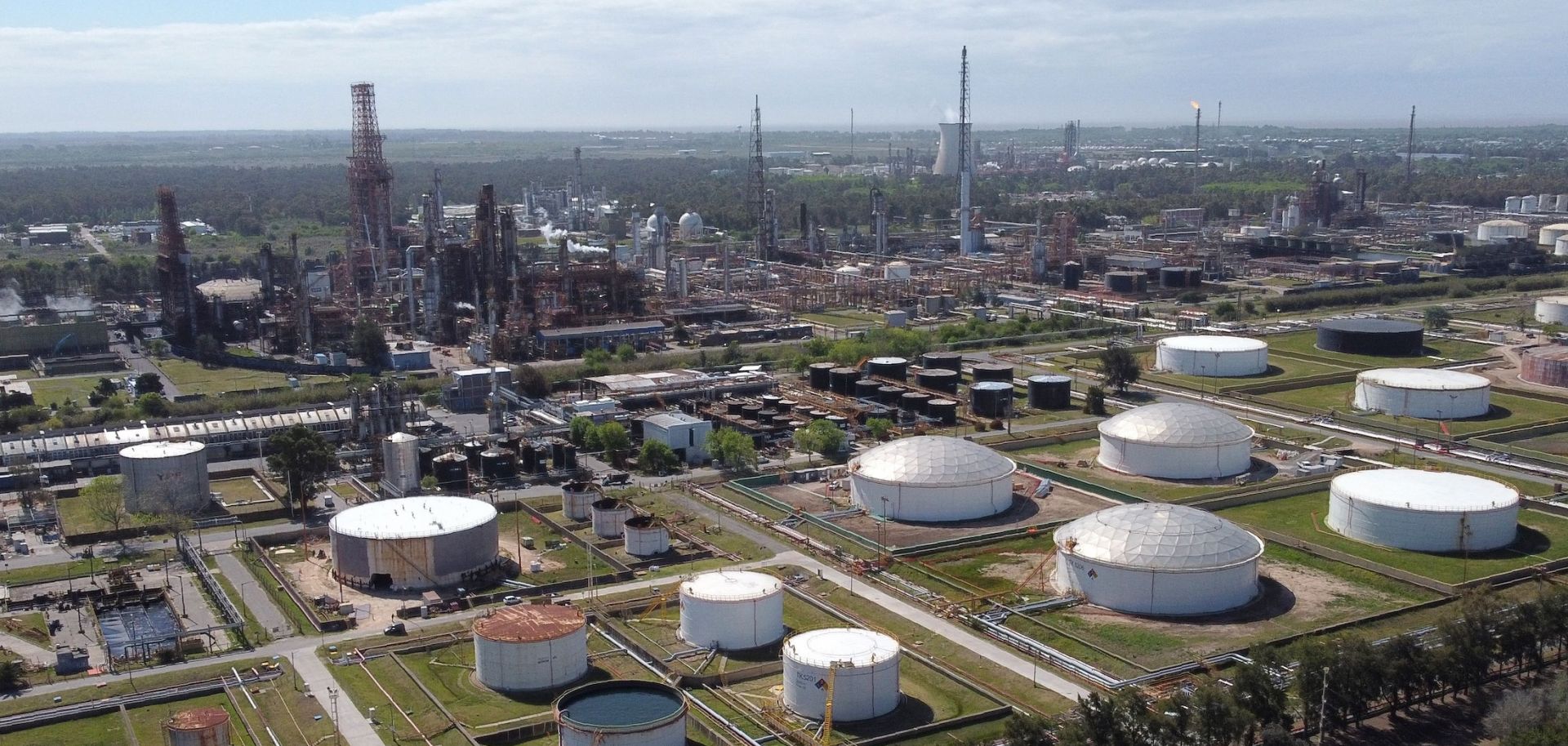
In Argentina, political and economic challenges will impede the government's plans to unleash the Vaca Muerta shale formation and the country's full energy production potential by deregulating the oil and gas sectors, at least in the short term. Three months after the libertarian Javier Milei took over as Argentina's president, his plans to overhaul the country's energy sector remain in limbo. In late December, the Argentine government unveiled a so-called ''omnibus bill'' that included more than 600 changes to the country's laws and regulations, covering multiple areas of the economy. The bill included significant reforms in the energy sector, with the goal of liberalizing it and making it more attractive to foreign investors. However, in late February, the government withdrew the omnibus bill ahead of an almost certain defeat in the Chamber of Deputies. Then on March 14, the Argentine Senate voted against a presidential decree with additional reforms to deregulate the economy, including the lifting of restrictions for energy exports and the removal of state incentives for renewable energies. While the decree will remain in place unless the Chamber of Deputies rejects it (there is still no date for a vote in the lower chamber), the episode highlighted the institutional limitations to Milei's deregulation push in both the energy sector and the broader economy.
- Milei's Freedom Advances party only controls 40 of the 257 seats in the Chamber of Deputies, and only seven of the 72 seats in the Senate. This means that the government cannot pass legislation on its own. While some members of parliament from centrist parties support the government, this is still not enough to pass legislation.
- The proposed energy reforms in Milei's omnibus bill would harmonize domestic and international oil prices (under the current rules, the government has the power to set domestic prices); eliminate restrictions on oil and natural gas exports (under current regulations, Argentine energy producers must first supply the domestic market before they are authorized to export); scrap the rules that give preferential treatment to state-owned companies in oil and gas projects; and authorize the eventual privatization of the state-owned energy companies YPF (which plays a central role in the exploitation of the Vaca Muerta shale formation) and Enarsa (which participates in exploration and production projects for oil and gas and is responsible for importing natural gas and LNG).
- Separately, in a series of announcements between December and January, the Milei administration also lifted subsidies for electricity and natural gas, which immediately increased energy costs for households and businesses. These policies remain in place because they do not require parliamentary ratification and should, over time, result in higher private investment in the electricity and natural gas sectors as prices will no longer be established by the government.
Argentina has significant oil and natural gas reserves, but ramping up production will require additional investment, regulatory changes and economic stability, which the Milei administration is trying to deliver. The development of unconventional hydrocarbon resources, particularly in Argentina's Vaca Muerta formation — which holds the world's second-largest shale gas reserves and the fourth-largest shale oil deposits — has sparked renewed interest and investment in the country's energy sector. However, policy uncertainty, excessive bureaucracy, abnormally high inflation levels, capital controls and export restrictions and infrastructure shortcomings have been sources of concern for foreign and domestic energy companies. This explains why Milei's proposals to deregulate the energy sector (and, more broadly, liberalize the entire Argentine economy to grant a greater role to the private sector) have generated optimism among international energy companies. However, business confidence is unlikely to return to Argentina until the political and economic environment has stabilized and the government can find a working majority in Congress to deliver on its promises.
- According to a 2019 report by the U.S. Energy Information Administration, Vaca Muerta's recoverable hydrocarbons total around 16.2 billion barrels of oil and 308 trillion cubic feet of natural gas. YPF leads development in Vaca Muerta, but major global companies are also active in the area, including Shell, Chevron, Exxon Mobil and others.
- In mid-2023, the Argentine government announced the completion of the first phase of the Nestor Kirchner Gas Pipeline, which connects Vaca Muerta to the province of Buenos Aires, delivering natural gas to nearly 6 million customers in the capital city's metropolitan area. A planned second phase of the project is expected to extend the pipeline to the industrial and agricultural heartland of the Santa Fe province in central Argentina. Argentine officials have also expressed interest in eventually extending the pipeline to Brazil and Bolivia. However, these projects will require substantial foreign investment, which is unlikely to materialize in Argentina's current environment of high economic volatility and significant policy uncertainty.
The government's ability to reform Argentina's energy sector is directly connected to political stability, which in turn is connected to the evolution of inflation in the country. While so far the Argentine government has struggled to pass any meaningful reforms to deregulate the economy, political support for the government should improve by the end of the year if it manages to stabilize Argentina's economic situation. A key signpost for this will be the evolution of inflation. In February, Argentina's inflation rate reached 276% year-on-year, the highest in the world. However, the government's drastic reduction in public spending has brought monthly inflation down from 25.5% in December to 13.2% in February. Meanwhile, the gap between the official and the unofficial exchange rates for the Argentine peso vis-a-vis the U.S. dollar has fallen from more than 200% in October to roughly 20% in March, while dollar reserves in the Argentine Central Bank are growing. Moreover, Buenos Aires is currently negotiating additional financial help from the International Monetary Fund. This means that the government is getting closer to its goal of lifting the capital controls that have long deterred foreign investment in Argentina by restricting the flow of money in and out of the country. As a result, in late 2024 or early 2025, Argentina could have single-digit inflation and no capital controls — a scenario that would help stabilize the economy, while creating a more predictable environment for foreign investment, including in the energy sector. If this happens, political support for Milei would likely increase and some opposition lawmakers would likely also support the president's legislative proposals in Congress, opening the door to the approval of the long-delayed energy sector reforms.
- The Argentine government is currently working on an updated version of the omnibus bill that will likely include many of the same energy sector reforms that were in the original version. The passing of the updated omnibus bill will depend on the evolution of ongoing negotiations between the central government and the provincial governments over federal funding. Even if a modified version of the omnibus bill is passed, privatizing YPF will remain difficult because it would require a two-thirds majority in Congress.
- As part of its effort to cut public spending, the Milei government has frozen pension payments and lifted subsidies for public transportation and energy. But while this helped reduce inflation and clear the way for the lifting of capital controls, the government's focus on reducing public spending has also quickly contracted economic activity and further deteriorated living standards for millions of Argentines. This means that a scenario of high social unrest that results in the collapse of the government cannot be entirely ruled out. A scenario in which the government remains in place but is unable to pass any policy is also possible if economic indicators don't improve by the end of the year. Both scenarios would severely slow down, or even stop, the government's push to reform the energy sector.
