
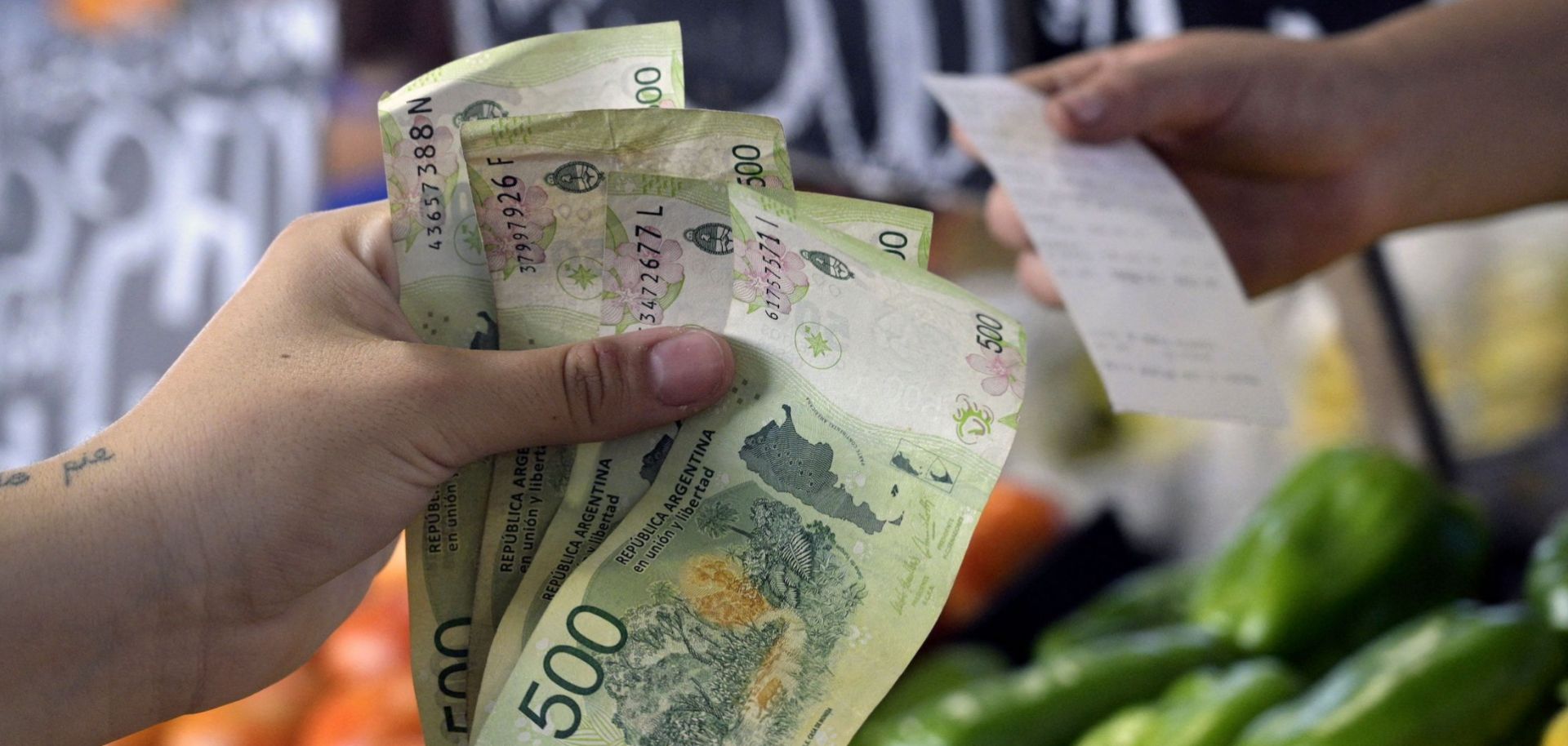
A woman pays for fruits and vegetables in Argentine pesos at a market in Buenos Aires on Feb. 10, 2023.
In Argentina, the risk of hyperinflation will increase in the next six months, as the weak and divided government in Buenos Aires struggles to enact policies that bring prices down and restore public trust in the country's currency. Argentina's macroeconomic environment has deteriorated significantly in recent months. In March, interannual inflation reached 104% (from 102% in February and 98.8% in January), while monthly inflation reached 7.7% (from 6.6% in February and 6% in January). According to early reports, both the interannual and the monthly inflation rates in the country will rise further when the April data is released in early May. Separately, the gap between Argentina's official exchange rate and the unofficial rate also continues to broaden. On April 25, the unofficial exchange rate reached 500 pesos per U.S. dollar, up from roughly 390 pesos per U.S. dollar in late March (by contrast, the official exchange rate is 222 pesos per U.S. dollar). The unofficial exchange rate fell to 474 pesos per U.S. dollar on April 26, but only after Argentina's central bank was forced to sell some $49 million to bring the exchange rate down.
- For years, Argentina has implemented strict capital controls that severely limit public access to U.S. dollars. In addition, the Argentine government has created multiple exchange rates over the years, depending on the activity involved (for example, agricultural exporters, financial operators and Argentines using their credit cards abroad are all imposed different exchange rates).
- These varying capital controls and exchange rates have resulted in the emergence of a very active illegal market where households, businesses and investors purchase dollars to save, spend and invest in a context of very high inflation and an increasingly devalued peso. In fact, many transactions (ranging from real estate to purchasing technology items) are actually conducted in U.S. dollars. As a result, the unofficial exchange rate has become a barometer of the health of the Argentine economy, while also having an impact on inflation as businesses and households update their expectations for the evolution of prices according to fluctuations in the illegal exchange rate.
Argentina's deteriorating economic environment is occurring against the backdrop of an increasingly ineffective government. Since December 2019, Argentina has been governed by the center-left Frente de Todos (FdT), a coalition of three factions of the Peronista party. The leaders of the factions are President Alberto Fernandez, Vice President Cristina Fernandez de Kirchner, and Economy Minister Sergio Massa. Internal disputes have riven these factions from the start, which has severely undermined the government's effectiveness. To further complicate matters, events in recent months have weakened the coalition leaders. In December, a court sentenced Fernandez de Kirchner to six years in prison after finding her guilty in a $1 billion fraud case related to public works (she can still appeal, and will not go to prison in the foreseeable future). In March, higher-than-expected inflation data heavily dented Massa's credibility, as he had taken over the Economy Ministry under the promise of bringing prices down. Then in April, Fernandez announced that he would not seek re-election after facing weeks of pressure from his own party not to run in the October presidential election due to his low popularity. This combination of internal disputes and external factors has prevented the Argentine government from implementing effective measures to fight inflation, reduce poverty and stimulate substantial economic growth, and has fueled popular support for opposition presidential candidates.
- Argentina will hold primary elections in August, where all the parties will elect their candidates for the presidential election in October. If no candidate wins 45% of the vote in the presidential election, or 40% and a ten-point distance from the second candidate, a runoff election between the two top candidates will take place in November.
- According to opinion polls, the conservative Juntos Por el Cambio (JxC) coalition will likely win the presidential election, though the party is internally divided between centrist and right-wing pre-candidates. Polls also show growing support for the Libertarian candidate, Javier Milei, who has promised to overhaul Argentina's economic model by abolishing the central bank and making the U.S. dollar Argentina's legal currency instead of the peso, among other drastic measures. Some polls put the ruling FdT coalition in the third position, which means its candidate may not qualify for the runoff election in November, thus leaving Argentines to choose between a conservative and a Libertarian presidential candidate for the first time in their country's history.
As election day approaches, the Argentine government will struggle to fight inflation, which will increase the risk of hyperinflation that further undermines the country's business environment. In the coming weeks, the Argentine government will implement near-term policies to try to contain inflation as much as possible before the presidential election. But these measures will have a very modest impact on inflation, amid a generalized environment of mistrust in the government's ability to turn things around. The central bank will continue to sell U.S. dollars to try to keep the unofficial exchange rate under control, but this will become increasingly difficult amid extremely low reserves. In addition, Argentina's ongoing drought will continue to negatively impact its agri-food exports and result in a lower-than-anticipated source of foreign exchange reserves for the economy. Moreover, Argentina's massive internal debt (which is denominated in pesos) means that the central bank has to issue millions of pesos every month to face maturities, which contributes to inflation. The government will also seek to reach a deal with trade unions to keep wage growth under control, as well as with large companies, retailers and supermarkets to impose price controls on basic goods and services. But these measures will be ineffective because price controls are seldom enforced on the ground; a significant number of Argentines also make a living by working informal jobs and are not covered by collective bargaining. Finally, the government will refrain from cutting spending on welfare programs and subsidies for energy and public transport in an election year, while some factions will push to actually increase public spending ahead of the election to improve the government's popularity. This means that the high levels of public spending (which contribute to inflation) will probably continue, and the risk of hyperinflation will increase in the months leading up to the presidential election.
- Hyperinflation is a situation in which general prices in an economy increase very quickly and get out of control. While there is no consensus on what separates high inflation from hyperinflation, some academics argue that hyperinflation starts when inflation grows by more than 50% per month. While Argentina is still far from this situation, there are precedents of inflation spiraling out of control very fast. One of the most extreme cases took place in 1989, when monthly inflation jumped from 9% to 79% between January and May and reached 197% in July amid depleting central bank reserves and high levels of public spending. By December 1989, Argentina's year-on-year inflation was almost 5,000%.
- Hyperinflation pulverizes the value of money and, in turn, households' purchasing power. This negatively impacts consumption and therefore risks taking companies and banks out of business. It also negatively impacts tax revenues, which means that governments struggle to provide basic services. Finally, contexts of hyperinflation make it extremely hard for households and businesses to make long-term spending and investment decisions, which negatively impacts economic growth and the overall investment climate of a country.
The risk of a run on Argentine banks and accompanying social unrest is low but cannot be ruled out, especially if Argentines believe dollarization is imminent. Milei's rising popularity has launched a debate in Argentina over whether the country should adopt the U.S. dollar as its currency. While there are heated arguments both in favor and against this policy among political leaders, economists and journalists, the issue is currently at the center of the political and economic debate in the country. JxC — the coalition that, according to polls, will win the presidency — is against dollarization, which means that the probability of this happening after the October elections is low. However, should Milei perform strongly in the primary elections in August, it would send the message that he may win the presidency. And this could result in Argentines withdrawing their pesos from local banks en masse and turning to the black market for U.S. dollars, for fear that the future conversion to U.S. dollars could happen at an unfavorable rate. The likelihood of such a run on Argentine banks will increase if Milei actually becomes president. In response, the Argentine government would have to take measures to limit cash withdrawals, similar to what it did to stop a run on banks in late 2001. This would result in heavy social unrest and severely reduce economic activity (according to the International Monetary Fund, Argentina will only grow by 0.2% in 2023), and make it even harder for the future Argentine government to lift capital controls and implement policies to promote economic growth and investment.
- After three years of recession and amid strong rumors of a devaluation, in late 2001 many Argentinian households and businesses began exchanging their pesos for U.S. dollars and withdrawing their money from banks. The government was forced to freeze all bank accounts and allow very small weekly withdrawals from only peso-dominated accounts. This led to severe social unrest (including strikes, looting and violence) that resulted in then-President Fernando De la Rua's resignation in late December 2001.
