
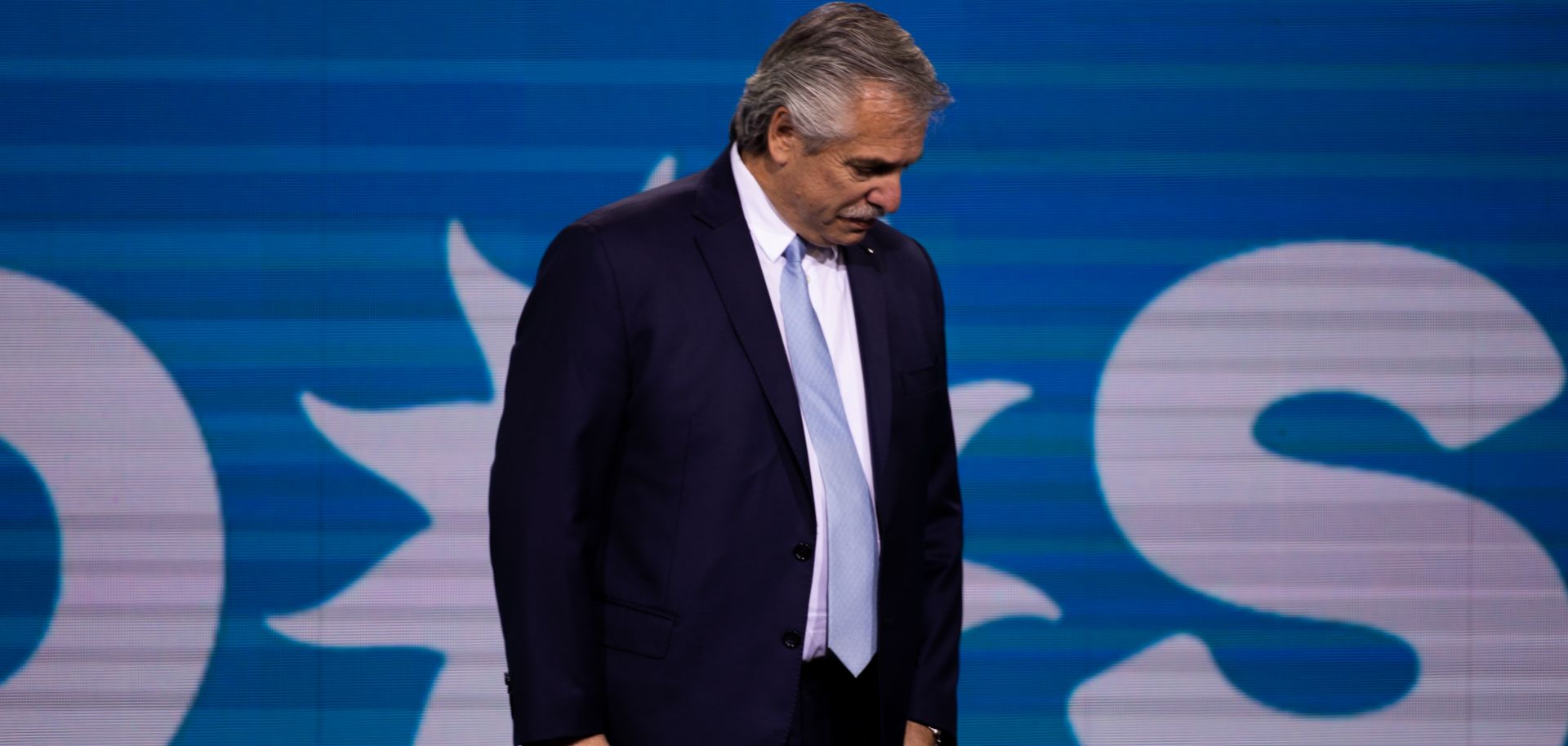
Argentine President Alberto Fernandez looks down from the stage at a Frente de Todos event in Buenos Aires, Argentina, on Nov. 14, 2021.
With Peronists no longer in control of Congress, political tensions within the Argentine government are slated to intensify, which will severely disrupt policymaking for the remainder of President Alberto Fernadez’s current term and prolong the South American country’s debt restructuring talks with the International Monetary Fund (IMF). In legislative midterm elections held on Nov. 14, Argentina’s ruling leftist Peronist coalition, Frente de Todos (FDT), lost its majority in both the Senate and the Chamber of Deputies, while the conservative opposition coalition, Together for Change (JxC), made modest gains. The political upset reflects Argentine voters’ frustration with their country’s poor economic conditions due to pandemic-related shocks, high inflation rates, capital controls and high unemployment.
- Starting in December, the FDT will control 118 of the 257 seats in the Chamber of Deputies, while the center-right JxC coalition will control 116 seats. In the Senate, the FDT will control 35 of the 72 seats while JxC will control 31. As a result, neither the government nor the opposition will be able to pass legislation on its own.
- The libertarian Advance Freedom party will enter Congress for the first time. The far-left Workers’ Left Front-Unity alliance also picked up seats. The strong electoral performance of both parties confirms the growing popularity of anti-establishment forces in Argentina.
- In the first half of 2021, Argentina’s poverty rate reached 40.6%, with 10.7% of the population living in extreme poverty. Inflation is expected to exceed 50% in 2021. The Argentine peso’s official exchange rate against the U.S. dollar has dropped by over 20% so far this year. The peso’s value against the U.S. dollar on the black market, meanwhile — which many Argentinians use to circumvent capital controls — has fallen by over 40%.
A divided Congress will make it hard for the government to pass legislation and decrease the executive branch’s power. No single party or coalition gained a majority in either chamber of Congress. This means the Argentine government will need to negotiate legislation with the opposition, which will hinder its ability to advance its populist agenda. Additionally, internal rifts between the country’s more moderate president Alberto Fernandez, and extreme-leftist vice president, Cristina Fernandez de Kirchner, will further weaken the executive branch’s ability to implement a coherent policy agenda. Should tensions between the two camps in the Pink House grow, so too will the probability of either the president or the vice-president resigning to weaken the other, which would create additional political volatility in Argentina.
- Following the FDT coalition’s poor performance in the midterm primary vote held on Sept. 12, cabinet members and other high-ranking officials close to Fernandez de Kirchner, who governed Argentina from 2007 to 2015, presented their resignation in a bid to weaken President Fernandez. On Sept. 17, she also wrote an open letter blaming the FDT’s waning popularity on Fernandez's economic mismanagement.
- The leftist FDT coalition is ideologically split between those advocating for high levels of welfare spending and economic isolation, and those advocating for moderate levels of welfare spending and global economic integration; Fernandez de Kirchner leads the former faction, while Fernandez leads the latter.
While Buenos Aires will continue debt negotiations with the IMF, political fragmentation will impede the Argentine government’s ability to implement a long-term economic plan to reduce the fiscal deficit and bring inflation under control. After picking up more seats in Congress, economically-conservative parties will likely use their greater influence to push for fiscal adjustment measures that would increase the probability of a deal with the IMF to refinance Argentina’s debt. However, the Fernandez administration is unlikely to introduce significant economic spending cuts that would further reduce the president’s chances of re-election in 2023. Additionally, the more fragmented legislature will likely hinder Fernandez’s ability to implement his promised plan for long-term economic growth and stability, which his administration is expected to release in December, as opposition lawmakers are likely to object to many of the proposals. Without an economic roadmap in place, continued uncertainty regarding regulations and tariffs will risk further dampening investor sentiment in Argentina, including in the country’s lucrative mining and energy sectors, during the second half of Fernandez’s term.
- Negotiations between Argentina and the IMF over the future of its $45 billion debt to the institution have moved slowly since Fernandez took office in 2019. Argentina has repeatedly demanded longer repayment periods and has rejected measures to accelerate a reduction of its fiscal deficit. Failure to reach a deal would further isolate Argentina from financial markets — making it more expensive for Buenos Aires to borrow internationally while further reducing the country’s already weak appeal to foreign investors.
- In early 2021, Argentina promised the Paris Club (which represents wealthy creditor countries) to reach a deal with the IMF in early 2022.
