
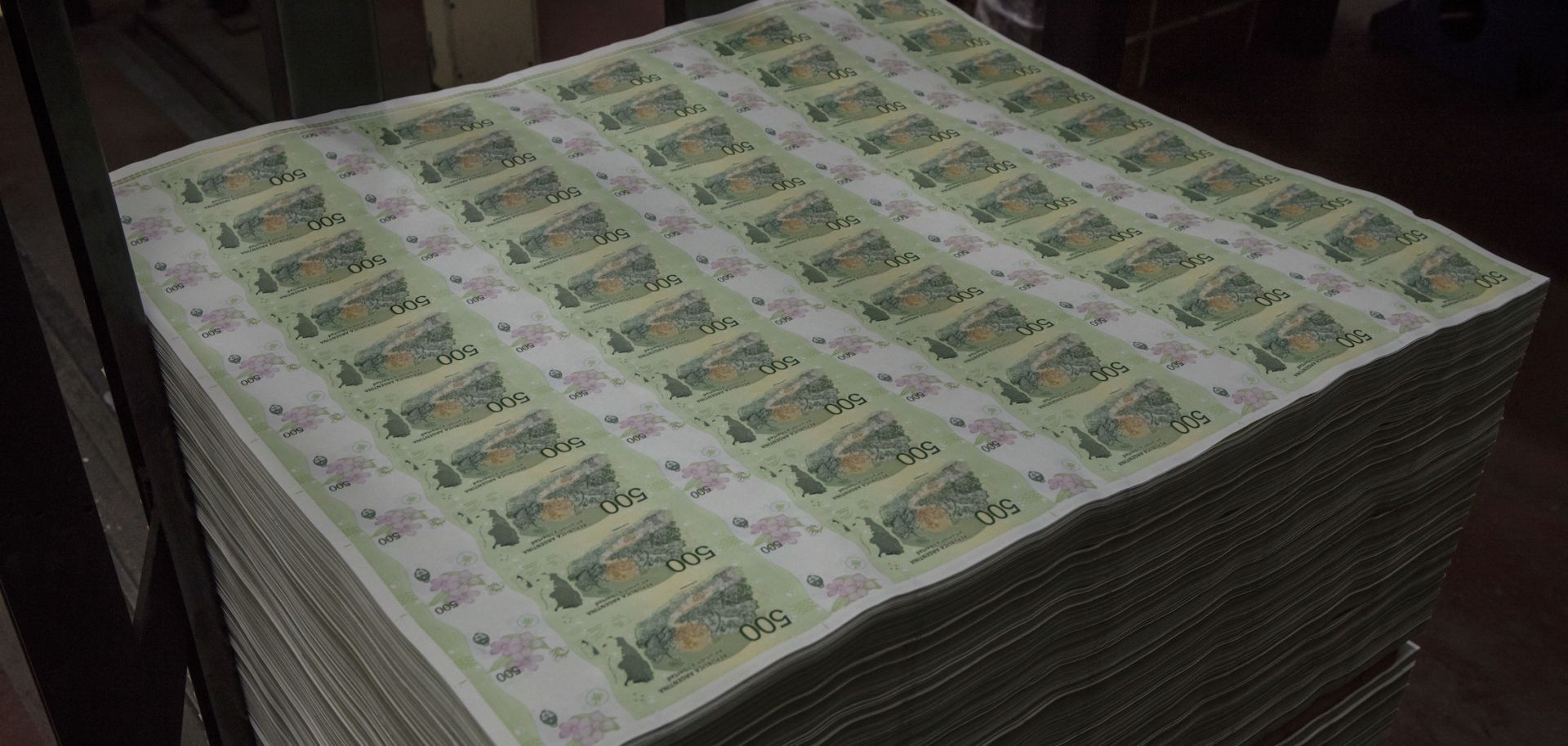
A large pile of uncut 500 Argentine peso notes waits to be sent to the cut and packaging machine at Casa de Moneda on Aug. 14, 2020, in Buenos Aires, Argentina.
Debt restructuring efforts in Argentina’s provinces illustrate a national rift in fiscal policy that will likely decrease investor confidence in the country’s financial security. In September, Argentina’s national government reached an agreement with its private creditors to restructure almost $65 billion of sovereign debt. Once the majority of national debt was restructured, the country’s provinces were freed to restructure their own debts. 12 of Argentina’s 24 provinces entered into negotiations in 2020 to restructure a total of $13 billion in international law bonds. All 12 of those provinces have indicated their reasoning for seeking debt relief is due to an extended national recession and heightened fiscal pressures related to the COVID-19 pandemic. The internal pressure to spend and lack of assistance from national leadership has put significant financial strain on the provinces over the course of 2020.
Two Argentine provinces have so far evaded a default. Eight others have entered into selective default, which they’ve used as a bargaining chip to force their creditors to take losses. This is the strategy that the national government employed in its debt restructuring efforts with private creditors in 2020. While the majority of provinces have fallen in line with this strategy, a select few have refused to default, going directly against the national government’s directive. The southern oil-producing province of Chubut has successfully restructured its debt without defaulting while the northern agriculturally-focused province of Cordoba is now attempting to do the same. This commitment to restructuring without defaulting, combined with export-heavy economies, give both of these provinces the best chance to successfully restructure their debt and pay their coupons through the next few years. As for the other provinces, there are a few possibilities:
- Provinces that have already defaulted, yet have the most likelihood of paying off their debt, are those with strong export sectors, such as the wine-exporting Mendoza and oil-producing Neuquén. These provinces are likely to have the fiscal ability to pay their creditors in time. However, these provinces may default again given their tolerance for keeping deep fiscal deficits and their dependence on global demand, which is rather uncertain in 2021 as the world slowly emerges from the COVID-19 pandemic.
- Other provinces such as Rio Negro, Jujuy and Salta will likely successfully renegotiate their debt, but will first need to restructure again and default within the next two years due to weak industries and mounting political pressure to spend during the pandemic. The province of Buenos Aires, which holds over half of all provincial debt in Argentina, will likely join this group although it is the largest of the provincial economies. The province is already impoverished and its governor has shown that he is inclined to follow the national example of using default as a leverage point in restructuring negotiations.
- Provinces likely to default are those with no significant industries and significant fiscal issues, as exemplified by Entre Rios. Chaco and La Rioja have both selectively defaulted several times and are at high risk of defaulting on their debt in the coming year.
The way in which Chubut and Cordoba sought to restructure their debt symbolizes a domestic challenge to Kirchnerism, the prominent political ideology of Argentina’s federal government. The governors of Cordoba and Chubut both identify with the country’s widespread populist ideology of Peronism and reject the popular faction of Kirchnerism and its tolerance for deep fiscal deficits. Only a minority of Argentines currently support Peronism, but the ideology has the potential to become an influential political movement should Kirchnerism fail to deliver economic stability. The landslide 2019 election showed that the country rejected fiscal austerity measures and more moderate views of former Argentine President Mauricio Macri.
Pursuing populist policies in lieu of fiscal prudence will likely be successful for the provinces that chose to restructure without defaulting, but this strategy cannot be applied more broadly. With a nation-wide recession as a result of COVID-19, the potential for social unrest and midterm elections in October means the majority of provinces will likely be willing to keep high levels of public spending, even if it means keeping a high fiscal deficit and defaulting on debt. The province’s acceptance of fiscal debt and willingness to default, however, will come at the cost of diminished investor confidence, raising interest rates for future provincial debt and making it harder for provinces to secure funding for much-needed development programs.
