
Editor's note: This is the first installment of a two-part series on the impacts of Argentina's potential dollarization under Javier Milei, should he win the country's presidential election. The first part examines the way dollarization affects emerging economies, and the second will analyze challenges specific to Argentina.
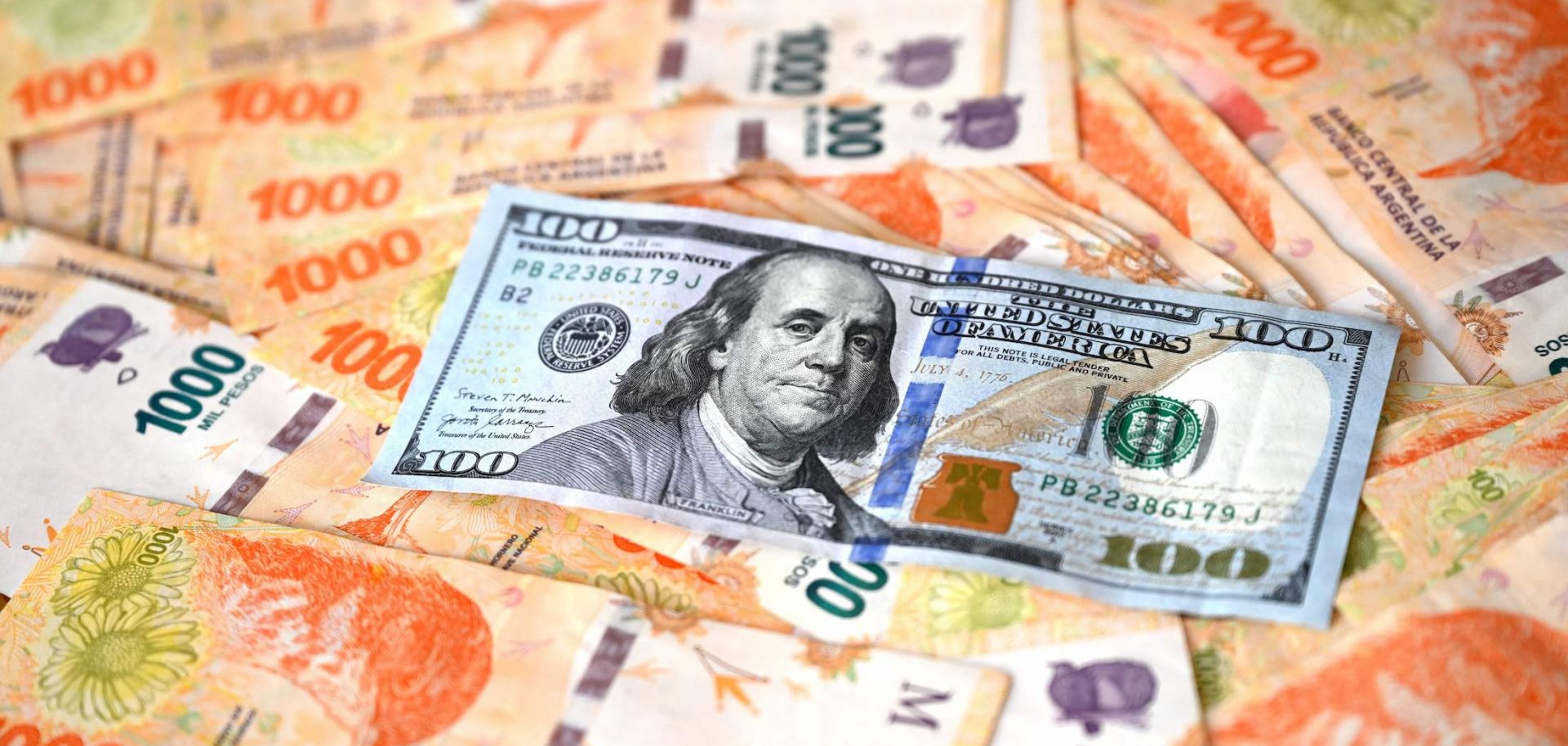
Popular economic frustration has increased sharply in Argentina in recent years against the backdrop of rising inflation and fears of a renewed external default. This sentiment has led Javier Milei, a libertarian who will contest in the first round of the presidential election on Oct. 22, to propose replacing the peso with the U.S. dollar as Argentina's national currency. This "dollarization" is so appealing to voters that polls suggest Milei will win the presidency.
Argentina appears to be coming full circle. A little more than 30 years ago, the government of former Argentine President Carlos Menem established a so-called currency board, which closely tied the peso to the dollar and can be thought of as a lesser form of dollarization. While Argentina abandoned the regime in the wake of its 2001 financial default, Milei appears to have returned to this dollar-forward mindset with a vengeance.
Fixed exchange rates over time
Three decades ago, fixed exchange rates were very popular among emerging economies. They provided a monetary anchor to establish and maintain domestic price stability, and they kept the value of the currency stable vis-a-vis an anchor currency, typically the dollar, thereby facilitating international trade and cross-border capital flows. Fixed-exchange rate pegs — or, in the case of Argentina, a currency board — helped countries overcome high inflation and economic instability following the developing market debt crises of the 1980s when many governments resorted to printing money to manage their financial problems.
Currency pegs have since gone out of fashion, at least among the top-tier emerging economies. Oftentimes, crises forced governments to abandon their rigid exchange rate regimes and embrace more adjustable ones to give policymakers greater macroeconomic flexibility. Most Asian economies were forced off their pegs in the 1997 financial crisis, while Mexico was pushed off its peg in 1994-95, Brazil in 1998-99 and Russia in 1998. Today, most major emerging economies have moved toward more flexible exchange rate arrangements by establishing sufficiently credible institutions, including independent central banks, that enable them to maintain price and general economic stability.
To be sure, there are some outliers. Oil-exporting Gulf countries and many small Caribbean island economies have not loosened their exchange rate regimes due to their economic dependence on the dollar through oil exports or close ties with the U.S. economy. Even so, most of these countries have pursued the sort of stability-oriented macro-policies required to maintain their dollar pegs, unlike Argentina.
Dollarization constrains macroeconomic flexibility
Under a fixed exchange rate system, a country foregoes control over monetary and exchange rate policy. Domestic interest rates must be changed in lockstep with the interest rates of the country to whose currency the local currency is pegged, unless controls limit capital inflows and outflows; if the domestic interest rate is lower than in the anchor country, capital outflows will lead to a loss of foreign exchange reserves and ultimately currency devaluation. Therefore, a fixed exchange rate that is pegged to the dollar under an open capital account forces a country to set its short-term interest rates by the U.S. Federal Reserve, sharply constraining central bank monetary policy. Under dollarization, the policy rate is similarly set by the Federal Reserve, and there is no possibility of adjusting the exchange rate, short of de-dollarizing.
By constraining macroeconomic flexibility and a government's ability to respond to external shocks, fixed exchange rate regimes increase the risk of a loss of investor confidence in times of high debt and slow economic growth. This risk is even higher under full dollarization because the central bank only has a limited amount of dollars to address liquidity crises in case investors are reluctant to finance the government or the financial system comes under pressure. A loss of investor confidence jeopardizes government debt sustainability and the stability of the financial system.
To combat this danger, countries with fixed exchange rate regimes must preserve their fiscal policy flexibility. If, for example, a country suffers an external shock, as Argentina did in the late 1990s following Brazil's currency devaluation and lower export revenues due to lower commodity prices, economic growth slows. Unable to cut interest rates or devalue the currency, an expansionary fiscal policy gives policymakers in a country with a fixed exchange rate the best option to support the economy. But if a high debt burden limits the ability of a country to run an expansionary fiscal policy, the economy will run below potential, at least temporarily. In fact, if public debt is high and investors worry that low growth and high interest rates will lead to a rapid increase in government debt, a country may be forced to pursue a restrictive fiscal policy instead of an expansionary one, further slowing economic activity. Interest rates may even rise as the risk premium demanded by investors increases, even though the economy is in the doldrums. Additionally, political imperatives can make disciplined fiscal policy very difficult to execute, particularly if the government is forced into a pro-cyclical fiscal policy tightening during economic downturns on account of investor concerns about debt and financial stability.
No more printing under dollarization
Under full dollarization, a country loses seigniorage, the income that is generated through currency issuance. Denying the government seigniorage is, of course, a big part of the rationale for dollarizing the economy in the first place, namely to remove policymakers' incentive and ability to generate extra revenue by way of higher inflation. In addition to the ongoing loss of seigniorage, dollarization also generates significant one-off costs. These are tied to the need to acquire the dollars necessary to dollarize the economy and replace the monetary base. One can call this negative seigniorage because it involves repurchasing previously issued currency (peso) with newly acquired dollars.
Finally, dollarization sharply curtails the central bank's ability to act as a lender of last resort. Under dollarization, the central bank cannot "print" money or offer unlimited amounts of liquidity in case of systemic instability. This increases default risk in terms of sovereign debt and the risk of a systemic banking sector crisis. Even if the central bank requires banks to hold a liquidity reserve, the fact that there is a limit to how much the central bank can lend to the sovereign or the banking sector during a crisis will increase the risk of a financial crisis turning systemic. Under a fixed exchange rate regime, the country would be forced off the currency peg if it provides significant amounts of local-currency liquidity. In a dollarized regime, the government and the banking sector would be forced into default in the event of a severe financial shock due to the limited ability of the government to provide liquidity and financial support.
