
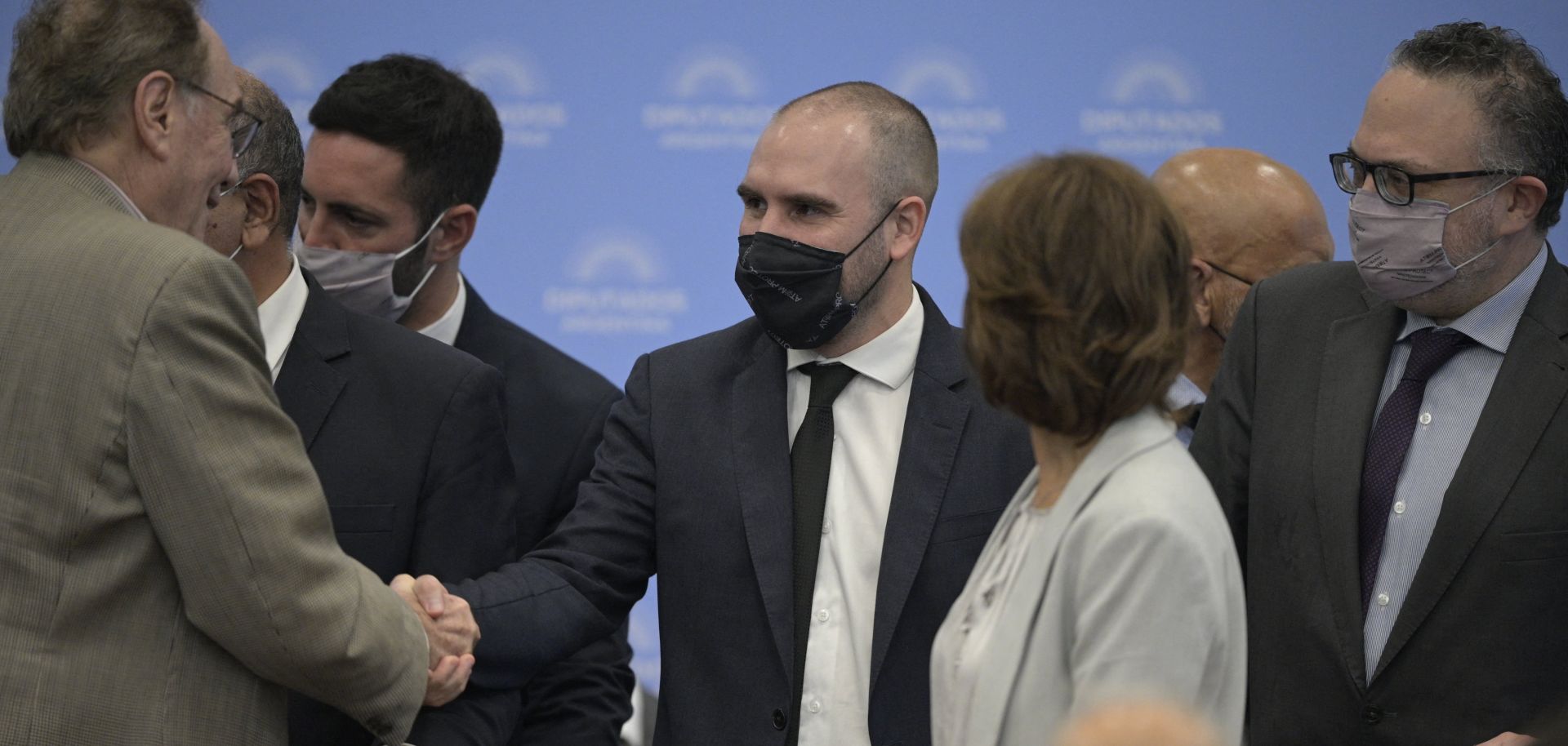
Argentina's finance minister Martin Guzman (center) shakes hands with a member of the country’s Congress in Buenos Aires before briefing legislators on the government’s new deal with the International Monetary Fund on March 7, 2022.
The backloading of payments and fiscal consolidation measures in Argentina's latest agreement with the International Monetary Fund (IMF) will mitigate the immediate risk of political backlash, but it will come at the cost of Buenos Aires likely needing to seek additional negotiations in the future. Argentina and the IMF reached a staff-level agreement on March 3 to restructure the country's $45 billion of debt with the institution. The deal includes a grace period of 4.5 years, implying that the repayment of the debts will span from 2026 until 2034.
- According to the IMF, the staff-level agreement “aims to provide Argentina with balance of payments and budget support to address the country's most pressing economic challenges," including Argentina's persistently high inflation, high fiscal deficit, low central bank reserves, and little domestic savings due to slow growth.
- The new deal also sets out to adjust Argentina's primary fiscal deficit targets to 3.0% of GDP in 2021, followed by 2.5% of GDP in 2022, 1.9% GDP in 2023 and 0.5% of GDP in 2024 before reaching fiscal balance by 2025. As part of the deal, Buenos Aires agreed to reduce central bank financing to Argentina’s Treasury to only 1% of GDP in 2022 as well, followed by a further reduction to 0.6% in 2023, before ultimately ending central bank financing in 2024.
There are obstacles that could still thwart the staff-level agreement's ratification. Upon the deal's approval by Argentina's legislature and the IMF Executive Board, Argentina will receive a disbursement of $10 billion to boost its central bank's weak dollar reserves. But after losing control of Congress to the center-right opposition in November legislative elections, President Alberto Fernandez’s Frente de Todos coalition will likely struggle to convince lawmakers to ratify the new IMF agreement. The program exceeds normal limits on access to IMF resources in exchange for little fiscal consolidation measures and may lead the IMF Executive Board to disapprove of a staff-level agreement, further threatening the implementation of a deal.
If approved, the new deal will not alone put Argentina on a path of sustainable growth because it does not address most of the country's structural economic problems. While the deal will probably prevent a default on Argentina's debt, its terms largely ignore the need for broader structural changes in labor, tax and pension laws, as well as the country's large welfare state. Argentina's high public expenditure — which is currently above 40% of GDP — is one of the main drivers of the country's low growth and financial volatility as the government has implemented high taxes and tariffs on the private sector to pay for the country's expanded welfare state. Without significant structural change on this front, the Argentine economy will likely continue deteriorating. A notable exception, however, is the government’s concession to decrease its energy subsidies in the near term (which totaled $11 billion in 2021) by creating a sliding scale in which the wealthy pay the full price of their energy bill while the poor pay only a portion. The growing tax burden on wealthy households also risks accelerating capital flight as affluent Argentines increasingly seek to store their money abroad.
- During a March 1 address to Congress, President Fernandez appeared to signal the new soon-to-be-announced IMF agreement would not include structural reforms by noting his government had successfully avoided "restrictions that would postpone our development."
- On Feb. 3, IMF Managing Director Kristalina Georgieva said the IMF "had to calibrate [its Argentina program] to be implementable" by maintaining "realistic expectations," likely alluding to the fact that the government was not going to accept broad structural changes.
The Fernandez government will likely avoid pursuing significant fiscal consolidation measures ahead of the 2023 presidential election, portending further debt restructuring later in the decade. The minimal concessions from the government in the new IMF deal will appease the far-left portion of Fernandez's coalition and maintain public support for the leftist Peronist bloc ahead of the election. However, the delayed payment schedule and consolidation measures mean the heavy lifting of fiscal adjustment measures will fall to the country's next government, which will likely face widespread popular backlash as households feel the squeeze of lower public spending on welfare programs. This portends another negotiation process in the latter part of the 2020s, as Argentina faces large repayments in 2026 and the country’s economic situation is unlikely to improve before then.
