
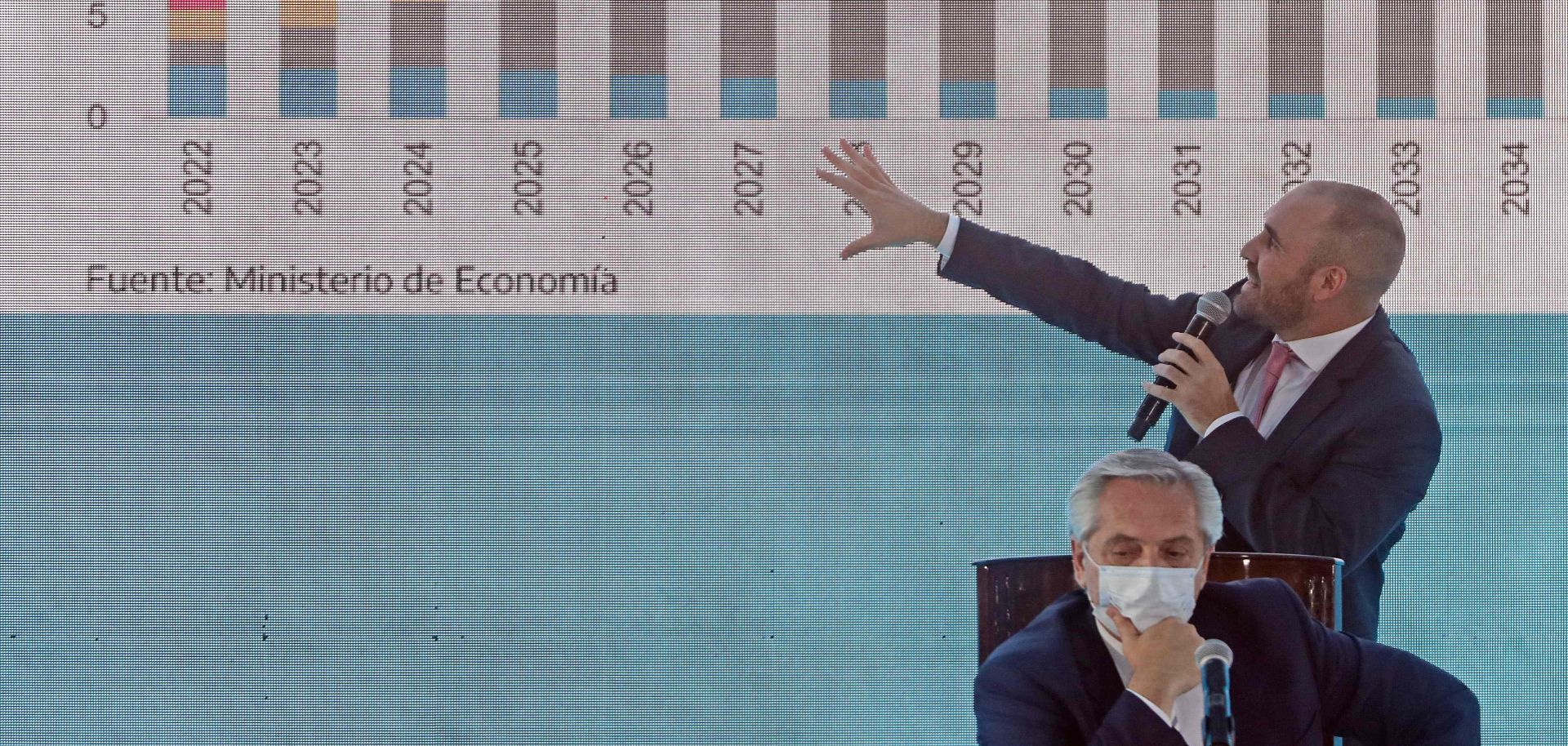
Argentine President Alberto Fernandez listens as the country’s finance minister explains the proposed payment to the International Monetary Fund (IMF) for the debt restructuring during a meeting with government officials and businessmen in Buenos Aires, Argentina, on Jan. 5, 2022.
The announcement of an "understanding" with the International Monetary Fund (IMF) puts Argentina one step closer to inking a deal that unlocks additional financial support. But political calculations in Buenos Aires and internal debates in the IMF could still derail negotiations, which would likely result in an Argentine debt default. On Jan. 28, the Argentine government and the IMF released separate announcements boasting that their negotiation teams reached a general “understanding” on fiscal and monetary policies. While the details of the understanding were not announced, it nonetheless marks a step in the direction of a larger IMF deal that would avoid a default and could reduce Argentina’s isolation in financial markets.
- The new understanding reached with the IMF includes adjusting Argentina’s primary fiscal deficit targets to 3.0% of GDP in 2021; 2.5% of GDP in 2022; 1.9% GDP in 2023; and 0.5% of GDP in 2024. As part of the deal, Buenos Aires also agreed to reduce central bank financing to Argentina’s Treasury to only 1% of GDP in 2022, followed by a further reduction to 0.6% in 2023, before ultimately ending central bank financing in 2024.
- Along with the understanding, the Argentine government confirmed that it paid the capital maturity due Jan. 28 of $718 million, thus avoiding a default. Argentina will not pay $368 million in maturities due Feb. 1.
- Negotiations between Argentina and the IMF over the future of its $45 billion debt to the institution have moved slowly in recent years, as the South American nation has demanded longer repayment periods and has rejected measures to rapidly reduce its generous welfare spending programs and bring government spending more in line with its available resources.
As negotiations continue, the IMF will likely push for fiscal and monetary policy concessions from Argentina as a part of a broader plan to reduce inflation and put Argentina on a path of sustainable growth. The IMF’s main demands will focus on reducing Argentina’s massive fiscal spending (which is one of the reasons behind the country’s high inflation rates) and presenting a multi-year plan for long-term economic growth. To compensate for the slower timeline of fiscal adjustment and monetary policy, the IMF will also likely pressure Argentina to make concessions in other policies, such as aggressive interest rate increases to stem inflation and a possible faster unification of the official and free market exchange rates of the Argentine peso.
Despite today’s announcement, internal disputes within both the Argentine government and the IMF could stall or abort the deal, opening the door to a default. Members within Argentine President Alberto Fernandez’s own administration oppose negotiations with the IMF for fear a debt restructuring deal that forces Buenos Aires to cut spending on popular welfare programs could harm Fernandez’s chances for re-election in 2023. The more leftist factions of his administration, headed by Argentine Vice President Cristina Fernandez de Kirchner, could thus try and boycott the new deal. After losing control of Congress to the center-right opposition in the November legislative elections, Fernandez’s Frente de Todos coalition will also struggle to pass economic reforms. Even if the Argentina-IMF agreement overcomes these obstacles, the deal leaves the bulk of fiscal adjustments to be made in 2024, after Argentina holds general elections that could yield a new government — thus repeating the pattern of postponing the implementation of fiscal adjustment measures that doomed the 2018 standby arrangement. The “backloading” of policies and a program that far exceeds normal limits on access to IMF resources will likely also stir internal debate in the IMF and may lead the Executive Board to disapprove of a staff-level agreement, further threatening the implementation of a deal.
- Argentine Vice President Cristina Fernandez de Kirchner is against fiscal adjustment measures that would accompany an IMF program, going so far as to suggest defaulting in an effort to force the international financial institution to concede to haircuts. Kirchner’s public spats with President Fernandez over economic policy also led to a cabinet reshuffle on Sept. 17, highlighting the influence she wields over his administration.
- The IMF recently published a detailed analysis on the failure of the 2018-2019 standby arrangement, which severely criticized the aborted program for “front-loading” funds while “backloading” policy changes. It included no contingency planning for adverse economic developments and excessively deferred to Argentine economic assumptions. A new program that fully refinances Argentina’s obligations to the IMF without addressing satisfactorily underlying economic imbalances would only again delay an inevitable reckoning with Argentina’s unsustainable growth and balance of payments situations, and carry little credibility in financial markets to end the country’s exile.
