
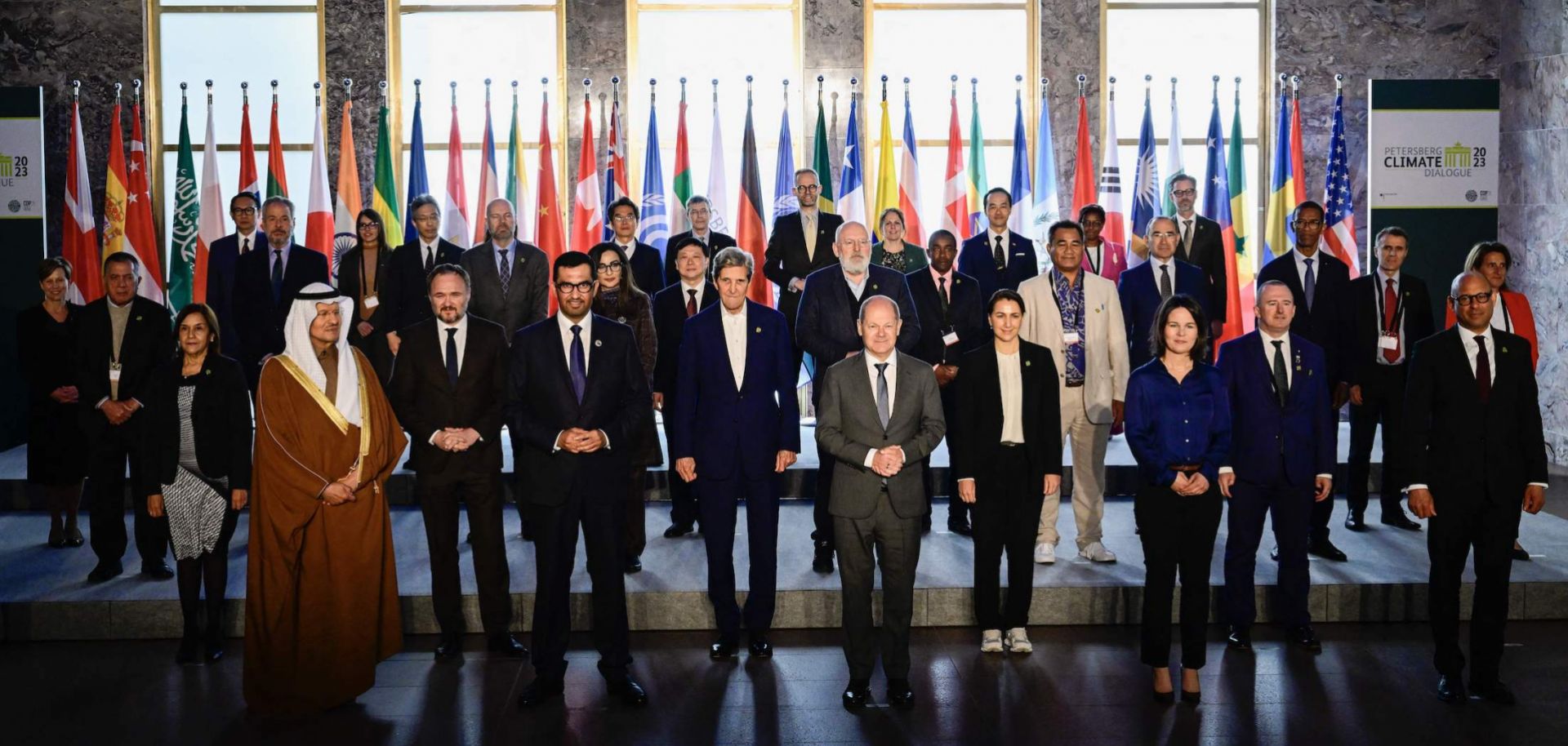
COP28 will highlight disparities between the developed and developing world on climate ambitions, as well as individual countries' differing priorities on what to discuss and how global solutions to climate change and the energy transition should be structured. This year's annual United Nations Climate Change Conference, which runs from Nov. 30 until Dec. 12 in Dubai, comes at what many scientists and climate activists consider a crucial time, with 2023 so far being the warmest year on record. But the lead-up to the conference has been mired by negotiation challenges on issues like the need to drastically reduce greenhouse gas emissions and how much the developed world should help finance the energy transition and help developing countries pay for the consequences of climate change. Moreover, this year's host, the United Arab Emirates, has come under scrutiny as being one of the world's largest oil producers, giving it an incentive to prolong the use of fossil fuels. The wealthy Arab Gulf country even named Sultan al-Jaber — the chief executive of the Abu Dhabi National Oil Company — as the president of the conference, which has only fueled more skepticism among Western negotiators and climate activists about the country's commitment to the energy transition and alleviating climate change pressures.
A number of new initiatives, side deals between countries and corporations, and commitments by a handful of COP28 attendees will be announced at the conference. However, the following eight issues are worth watching closely as negotiators descend on Dubai.
The Paris Agreement's First Global Stocktake
The centerpiece of the conference will be discussions surrounding the Paris Agreement's so-called ''Global Stocktake,'' where the technical findings indicate insufficient global progress toward combating climate change. The global stocktake is a key part of the Paris Agreement that is used to assess its signatories' collective progress in implementing and achieving the goals outlined in the 2015 climate pact. On Sept. 8, the United Nations released a synthesis of its technical dialogue of its first ''global stocktake,'' which unsurprisingly found that although the Paris Agreement had ''significantly'' reduced forecasts of future global warming, the world was ''not on track to meet the long-term goals'' of the international treaty. In the technical report, the United Nations added that current global emissions were not in line with modeled global mitigation and emissions pathways consistent with the Paris Agreement's goal of limiting global warming to 1.5 or 2 degrees Celsius above pre-industrial times. The U.N. report also noted that the ambition of Nationally Determined Contributions (NDCs) — commitments under the Paris Agreement by global governments — needed to increase in order to achieve the treaty's goals. Additionally, the stocktake warned that developing countries' access to climate finance needed to improve. In its annual Emissions Gap Report released earlier this month (which assesses global NDCs and attempts to estimate their impact on climate change), the United Nations also estimated that if current unconditional NDCs were met, climate change would still be projected to reach 2.9 Celsius this century. The U.N. Emissions Gap Report further said that even if the conditional NDCs — which are commitments achievable with enough financing and technology — were met, global warming would still be projected to reach 2.5 Celsius.
Negotiations over the global stocktake will likely reveal wide differences between developing countries, which want more financial support for the green transition, and their developed counterparts, which want large-emitting developing states to strengthen their climate commitments. COP28 will see the final phase of the Global Stocktake, known as the ''consideration of outputs,'' where countries will meet and discuss the technical reports released by the United Nations earlier this year. The political outcome of the stocktake process at this year's conference — and agreements made on how to accelerate or increase global climate ambitions — will then inform the next round of NDCs that are due in 2025. Developed countries have so far faced pressure to set more ambitious NDCs than developing countries, leading to Western countries' NDCs being more detailed and comprehensive than those made by developing countries, including large emitting countries like China, India, Indonesia and Saudi Arabia. At COP28, the West will likely push large emitting countries to increase the comprehensiveness of their future NDCs. However, the Like-Minded Group of Developing Countries (LMDCs) — a block of countries aligning on certain trade and climate issues led by China, India and Saudi Arabia — will probably assert that any increase in climate ambition will need to be accompanied by increases in green finance by the West to help fund the more ambitious commitments.
Reducing Fossil Fuel Consumption and Carbon Emissions
The question of whether to ''phase out'' or ''phase down'' the use of fossil fuels will also be a hot-button issue at COP28. The technical findings in the United Nations' global stocktake and annual emissions gap reports revealed a stark gap between the Paris Agreement's goals and countries' current actions toward combatting climate change. At the upcoming conference, the West — and particularly the European Union — will use this gap to try to justify a global agreement on eventually ending the use of fossil fuels. In October, the European Council released its negotiating position at the COP28, which stressed the need for a ''global phase-out of unabated fossil fuels.'' Most developing countries will likely find such language as hostile, preferring to instead use softer language like ''phasing down,'' which implies countries only need to reduce their ''unabated'' fossil fuel consumption (i.e. consumption that does not have a substantial amount of its emissions captured) as opposed to eventually ending it altogether. Even discussions of a phase-down of fossil fuels may be too toxic for major oil producers to consider, particularly if they view it as a stepping stone to greater ambitions in the future. However, in recent months, COP28 President-designate al-Jaber has reiterated that the world does eventually need to reduce its consumption of fossil fuels. At an October pre-COP summit in Abu Dhabi attended by a number of countries, al-Jaber additionally said that he knew there were ''strong views about the idea of including language on fossil fuels and renewables in the negotiated text,'' and stressed the need for negotiators to ''work together to come forward with solutions that can achieve alignment, common ground and consensus between all parties.'' As head of ADNOC and a major voice in OPEC, Al-Jaber's position may lead to more Emirati pressure on similar oil-producing countries to offer at least some concessions on phasing down unabated fossil fuels. But even if countries ink a deal on reducing fossil fuel consumption at COP23, the final agreed-upon text will almost certainly be extremely narrow and include various caveats.
Relatedly, COP23 attendees will fiercely debate how to reduce fossil fuel emissions as well, including through the use of new carbon capture technologies. The energy industry, as well as several Western governments like the United States and Canada, have eyed carbon capture and storage (CCS) technologies as a crucial way to continue burning fossil fuels while simultaneously reducing emissions. CCS technologies have not yet been widely deployed, as their potential financial benefits are currently less clear than their social and climate benefits, reducing the private sector's desire to adopt such technologies. Climate activists, however, are concerned that discussion of CCS technologies is just a ploy by the fossil fuel industry to slow the global transition to renewable energy, and that such conversations detract from overall climate ambitions because, at the end of the day, hydrocarbons are still being used. Some climate activists also argue that relying heavily on CCS technologies to reduce carbon emissions would risk further widening the gap between countries' climate commitments and action, as many CCS projects will invariably be delayed or abandoned due to cost and/or technological challenges.
Climate Finance Commitments
While the West will be focused on strengthening global climate commitments at COP2, the developing world's priority will be securing more climate financing. The idea that wealthier countries should help finance the energy transition in the developing world is a key principle of both the Paris Agreement and other international climate pacts. Developing countries, however, failed to reach a 2009 commitment to increase global climate finance support to $100 billion by 2020. The West eventually reached that target in 2022. However, the U.N. global stocktake report still identified large gaps in climate financing, which China, India, Saudi Arabia and other members of the so-called Like-Minded Group of Developing Countries (LMDCs) will likely use at COP28 to push for the establishment of a new similar pledge of financing by 2030 or 2035 with a higher annual headline figure. While some European countries will likely be amenable to some negotiations on the matter, the United States will probably try to avoid any binding, concrete commitments, given the White House's domestic political constraints around being able to approve even small amounts of climate finance.
Climate finance is one of the most crucial — and contentious — outlying aspects of the Loss and Damage Fund that countries agreed to establish at COP27 and will be tasked with finalizing at this year's conference. After months of tenuous negotiations, COP27 attendees reached a last-minute, temporary agreement on establishing such a fund as a way to help developing countries pay for the consequences of climate change. The proposal sets up the World Bank as the fund's host for the first four years, but the draft agreement — including the specifics of how the mechanism will be structured and financed— still needs to be approved at COP28. This could prove challenging, as after the agreement was reached last year, a U.S. official said the text did not ''reflect consensus concerning the need for clarity on the voluntary nature of [financial] contributions.'' Egypt — which hosted COP27 and represents Africa in negotiations — also said that a number of its demands around the size of the fund and clear contribution obligations for developed countries were not met. These statements suggest that COP28 attendees will struggle to reach a final agreement on climate finance that doesn't include significant caveats. The United States has wanted to avoid concrete binding financial commitments; Washington has also pushed for wealthy countries technically classified as non-developed countries in climate negotiations, like Saudi Arabia and the United Arab Emirates, to also contribute to the fund. While the European Union reportedly plans to similarly increase pressure on the United Arab Emirates to contribute to the loss and damages fund, the bloc also recently pledged to make its own ''substantial'' contribution to the fund at COP28, suggesting that there is a large gap between Brussels and Washington on the issue.
New Momentum for Nuclear Power
Discussions on nuclear power will be key to monitor as well, with nuclear power coming back in vogue in the West as a way to improve energy security and reduce emissions, despite ongoing financing shortfalls, cost overruns and project delays. The United States is leading an effort for a declaration to be signed on Dec. 1 that aims to triple the world's installed nuclear power generation capacity by 2050. France, Finland, Sweden, South Korea and the United Kingdom are all expected to sign a pledge, calling on the World Bank and other international financial institutions to include nuclear power in their spending policies. A few days after the declaration, the global nuclear industry — which is dominated by French, U.S. and South Korean companies — is expected to make an announcement committing to tripling nuclear generation capacity from 2020 levels. The declaration will cap the West's recent U-turn on nuclear power, which has seen countries like France and the United Kingdom announce new plans to build large nuclear reactors in the coming years; countries like Italy, meanwhile, are now considering building new reactors for the first time in decades. However, despite the political commitment and promise by the nuclear industry to expand capacity, financing for the expensive generation source will likely remain a challenge, as project delays have already led to large multibillion-dollar cost overruns. Although the technology remains decades out, the United States is also expected to outline the world's first international strategy to commercialize nuclear fusion at COP28, following last year's breakthrough where U.S. scientists achieved fusion ignition for the first time.
New Attention on the Agriculture and the Food Industry
COP28 negotiations will also focus on the food and agriculture sector, laying the groundwork for future progress even if no major pledges are announced. Compared with other issues like coal power generation, the food and agricultural sector has largely been neglected in global climate negotiations, despite the sector being both a major contributor to and a victim of climate change. The industry collectively accounts for about a fifth of global emissions and an even higher ratio of methane emissions. It is also uniquely vulnerable to the environmental impacts of climate change (including the growing frequency of droughts and floods), as well as governments' attempts to tackle climate change via mandates that require the agricultural sector (and other industries) to reduce its oil and gas consumption, which risk reducing yields without other technological offsets. As the host of COP28, the United Arab Emirates is leading an effort to sign a declaration at the conference on the need to boost food security and transform food systems due to the challenges that climate change poses to them. After the declaration, the U.N. Food and Agriculture Organization is expected to publish its first-ever roadmap on achieving and improving food security in a climate change scenario where global temperatures reach 1.5 Celsius. COP28 negotiations are unlikely to yield practical plans for improving food security, but they could serve as a crucial starting point.
U.S.-China Cooperation
Reopening climate negotiations was a crucial outcome of U.S. President Joe Biden and Chinese President Xi Jinping's meeting earlier this month, but it remains to be seen how strongly Beijing and Washington will work together toward that end. Following the Xi-Biden summit on Nov. 15, the two countries put out a joint statement saying they would work together on curbing methane emissions and establishing a new global renewables target. At COP28, the United Arab Emirates aims to secure a global commitment to triple renewable capacity from 2022 levels by 2030, which will need significant U.S. and China cooperation to achieve. In addition, progress on a previous global commitment to reduce methane emissions will be a key focus of the conference, as will cooperation between China and the United States on pushing for finance. The World Bank is expected to launch a fund to help detect and clean up methane emissions globally. Earlier this month, China released its long-awaited action plan to reduce emissions over the next five years, though it has many gaps in specifics. The degree to which Beijing and Washington collaborate on climate issues will be crucial in deciphering whether the goals outlined at COP28 can be realistically achieved.
Political Trends in the West Add Urgency to COP28
The rise of climate skepticism and far-right political figures in the West has the potential to undermine future progress in the energy transition, with lawmakers questioning the existence of climate change altogether and the utility of financing the energy transition in developing countries when that money could be used elsewhere. Although COP28's outcomes are unlikely to be affected, the conference comes on the heels of Argentina electing climate skeptic Javier Milei as its next president. It also follows the far-right Freedom Party's victory in the Netherlands' recent parliamentary elections after campaigning on a platform that includes exiting the Paris Agreement, reversing domestic green legislation and reducing climate commitments. In September, the United Kingdom backtracked on several climate change commitments as well, including a delay of its ban on the sale of new gasoline- and diesel-powered cars. While the Dutch election will not have a practical impact on COP28 negotiations, next year's COP29 could face a higher degree of uncertainty due to the far-right's growing political influence in the West, which could see even more backsliding in Western climate commitments akin to London's delayed ban on fossil fuel vehicles. The Freedom Party's victory in the Netherlands' XX DATE elections, as well as a number of other European election outcomes this year, also suggests the far-right parties could perform well in next year's European Parliament elections, which could lead to a European Commission that's less focused on climate issues.In the United States, former President Donald Trump is currently leading the polls ahead of next year's presidential election. If Trump is re-elected in November 2024, he could again withdraw the United States from the Paris Agreement and any agreements around financial commitments made by the Biden administration — particularly as those commitments are highly unlikely to be passed by Congress before the end of Biden's current term, given Republicans' hold of the House of Representatives. The potential election of more climate-skeptic, far-right political figures in both Europe and the United States in the coming years makes progress at COP28 perhaps even more important, as it could lead to less progress in future U.N. climate summits.
The Question of COP29's Location
Conflicting geopolitical priorities have prevented the selection of a host for COP29, which could leave the United Arab Emirates hosting meetings next year. COP29 is supposed to be held in Eastern Europe per the U.N. Framework Convention on Climate Change (UNFCCC), but the 23-country Eastern European group must choose a spot based on consensus. Russia is blocking an EU member from hosting COP29, arguing that such a country wouldn't be impartial in organizing the event. But Bulgaria, which has offered to host the conference, has said that Russia's position is instead retribution for Europe supporting Ukraine and phasing out its consumption of Russian oil and gas via sanctions. While Russia could try to host the meeting, Western countries would oppose this and would not send a high-ranking delegation to Russia to attend the conference. Moreover, Azerbaijan and Armenia are also blocking each other from hosting the conference. If no agreement is found, COP29's location would default to Bonn, the headquarters of the UNFCCC secretariat. But the presidency would still remain with the United Arab Emirates. Negotiators hope to resolve the issue at COP28, but any delay in doing so would add even more stress on top of the far-right and climate change skepticism issue outlined above.
