
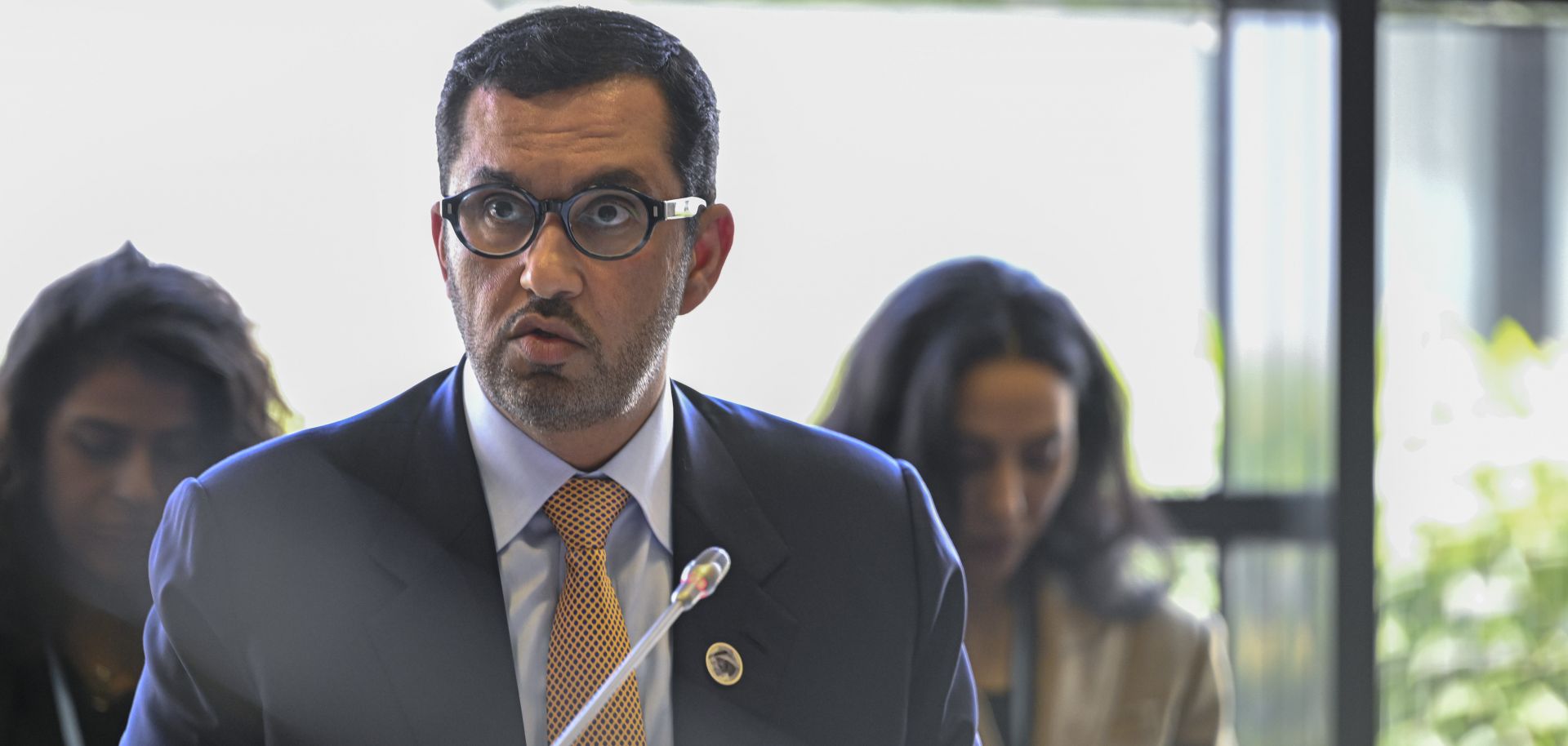
Sultan al-Jaber, the president-designate of the COP28 climate conference and CEO of the Abu Dhabi National Oil Company, speaks at the Bonn Climate Change Conference on June 8, 2023, in Bonn, Germany.
Recent controversies surrounding the United Arab Emirates' hosting of this year's U.N. climate conference will ultimately limit room for progress toward phasing out fossil fuels, even if COP28 negotiators make headway on climate finance and other issues that the Global South and the Emiratis are focused on. Emirati organizers for COP28 have recently been doing damage control in response to the backlash against having one of the world's largest oil producers host this year's U.N. climate summit, which starts in Dubai on Nov. 30. The controversy began in January, when the United Arab Emirates named Sultan al-Jaber, the chairman of the country's state-run Abu Dhabi National Oil Company (ADNOC), as the president-elect of the event. In May, while traveling across Europe to conjure up support for COP28, al-Jaber then drew further criticism after he stressed the need to phase out ''fossil fuel emissions'' instead of fossil fuels themselves — a less ambitious stance than climate activists have called for. On June 8, during the ongoing Bonn Climate Change Conference, al-Jaber tried to walk back his comment by saying that phasing down fossil fuels was ''inevitable.'' But many Western activists and leaders remain opposed to his role in leading the U.N. climate conference, arguing that al-Jaber's company (and country) has a vested interest in ensuring the continued use of the fossil fuels contributing to the climate crisis.
- On June 7, The Guardian reported that ADNOC had the ability to read COP28-related emails, citing how email servers and infrastructure used by COP28 and ADNOC were the same, with an email sent by The Guardian to COP28 on the issue including the text ''Adnoc classification: internal.''
- The United Arab Emirates' lead negotiator on climate-related issues, Majid Al- Suwaidi, said on June 7 that the phasing out of fossil fuels may not be discussed at the upcoming summit due to there not being an agreement to do so.
- On June 2, a researcher on authoritarianism in the Middle East pointed out that there was a large propaganda campaign on social media as fake accounts likely tied to the United Arab Emirates are posting positive messages about al-Jaber and the United Arab Emirates to try to drown out criticism.
- On June 2, a researcher on authoritarianism in the Middle East identified fake social media accounts that have been posting positive messages about the United Arab Emirates and al-Jaber, which he said pointed to a large, likely UAE-linked propaganda campaign aimed at drowning out the backlash against the Arab Gulf country's hosting of COP28.
- On May 23, 133 U.S. and EU lawmakers sent a joint letter to the U.N. leaders, along with U.S. President Joe Biden and European Commission President Ursula von der Leyen, calling for the removal of al-Jaber and other fossil fuel industry-related officials from leadership positions for the conference.
- On May 16, Costa Rican diplomat Christiana Figueres (who headed the UNFCCC when the 2015 Paris Agreement was negotiated) called the United Arab Emirates' approach to the conference ''very dangerous'' and al-Jaber's focus on fossil fuel emissions ''very worrisome.''
- On May 15, Syrian state media announced that Syrian President Bashar al Assad — who visited the United Arab Emirates in March 2023 for the first time since Syria's civil war began 12 years ago — had been invited to attend COP28 in what would be the first major international summit attended by both Assad and Western leaders since the Arab Spring.
In hosting the summit, al-Jaber and the United Arab Emirates are likely to try to steer COP28 discussions away from phasing down fossil fuels toward reducing carbon emissions (and the ways oil and gas companies can help lower those emissions). The United Arab Emirates and many of its oil- and gas-producing peers view Western leaders' plans to eventually eradicate the use of fossil fuels and achieve net-zero carbon emissions as largely unrealistic and idealistic due partially to the significant challenges in phasing out coal and other fossil fuels, which are often cheaper, in the developing world. They also argue the West's vision of an oil- and gas-free future ignores the ways that burning fossil fuels can become cleaner over time, such as through carbon capture and storage/sequestration (CCS) projects. Instead, the United Arab Emirates and others believe international climate efforts should focus on mitigating the impact of rising global temperatures and more strategically reducing carbon emissions by allowing for some flexibility in burning fossil fuels. This difference in priorities between the West and the United Arab Emirates (along with much of the rest of the Global South) suggests there will be little headway made on phasing out fossil fuels at COP28, and that any movement on the issue will primarily be made on the sidelines of the conference, likely among only Western countries.
- Gulf Cooperation Council oil producers (like the United Arab Emirates and Saudi Arabia), as well as a number of major oil and gas companies (like ExxonMobil) are investing heavily in carbon capture and sequestration/storage (CCS) technologies as a way to reduce carbon emissions while still burning fossil fuels. They argue that CCS technology, if commercialized, could enable the world to reduce carbon emissions while still burning fossil fuels, which would also help ensure global energy supplies don't become too reliant on renewable sources that have their own associated challenges.
- Critics of the CCS approach argue that the technology is largely financially unproven (there is just one commercial power plant in the world that currently uses CCS). They also argue there are environmental and climate change risks associated with storing carbon, such as the potential for long-term leakage at CCS sites.
- Those pushing to quickly reduce the use of fossil fuels (and, in turn, carbon emissions) argue that the world needs drastic action now to avoid major climate repercussions that would have a more significant humanitarian and financial impact. In its annual update to its decadal forecast on May 17, the World Meteorological Organization said there was a 66% likelihood that, over the next five years, the annual average near-surface global temperature would breach the 1.5 Celsius threshold, a key global warming benchmark that the Paris Agreement seeks to avoid.
- In a well-publicized regulatory filing, U.S. supermajor ExxonMobil said on May 17 that it did not need to consider the impact of net-zero emissions scenarios on its business model because it was ''highly unlikely that society would accept the degradation in the global standard of living required to permanently achieve'' such scenarios.
- India, the world's third-largest carbon emitter behind China and the United States, currently holds the Group of 20 (G-20) presidency and will host the G-20 summit in September. With the support of China, India has been pushing the G-20 to adopt a ''multiple pathways'' approach to reducing fossil fuel consumption that would see Western countries maintain their more ambitious climate strategies, while also allowing developing countries to phase out fossil fuels more slowly.
The United Arab Emirates will also seek to ensure that phasing out fossil fuels is not included in discussions around the Paris Agreement's first so-called Global Stocktake, which will arguably be the most important item on the COP28's agenda. The global stocktake is a key part of the Paris Agreement that is used to assess its signatories' collective progress in implementing and achieving the goals outlined in the climate pact. It is a two-year process that began at COP26 as a way to enforce the Paris Agreement, as well as evaluate the global fight against climate change more broadly. The next stocktake formally ends at the ongoing Bonn climate conference (which runs through June 15). But it will also be a key agenda item at this year's U.N. climate summit, where negotiators are set to make recommendations that will be laid out in the COP28 final declaration, which countries are then supposed to use as guidance to make updates to their Nationally Determined Contributions (NDCs) over the next few years. The next stocktake is likely to clearly assess that the world has not made enough progress toward lowering carbon emissions, which Western countries will almost certainly try to use to justify a broader agreement on reducing fossil fuels. Ever conscious of its own international image, the United Arab Emirates will try to ensure that the conference does not fail like the 2009 conference in Copenhagen did, where negotiators were forced to iron out a weak final agreement. But the Emiratis and others are still unlikely to support any significant language regarding the phasing out of fossil fuels, and will likely attempt to steer the conversation to other focal points, like reducing emissions and increasing investments in CCS technologies.
Although global COP28 discussions on phasing out fossil fuels will be fruitless, negotiations leading up to and during the summit will likely yield some progress on other issues, like establishing a loss and damage fund and boosting climate finance. COP28 has a number of things on its agenda that are critical beyond the stocktake and will probably not be disrupted by disputes over the use of fossil fuels. Near the top of that list is establishing a loss and damage fund to provide financial support to the countries most vulnerable to the impacts of climate change. Agreeing to establish such a mechanism was one of the major successes of COP27 last year, but specifics over how it will be structured and funded were left to COP28. At this year's U.N. summit in Dubai, the United Arab Emirates will likely also seek to prioritize discussions around helping fund the energy transition in the developing world. At the G-7 summit in May, al-Jaber urged the Western economic bloc to follow through with its long-promised $100 billion in climate funding annually. Ultimately, efforts to hit that target will fall short, but Western governments will continue to negotiate partnerships with developing countries to provide some finance, albeit largely with loans and not grants.
