
Israel-Jordan relations will continue to fray amid the war in Gaza, but Jordan remains unlikely to repeal its peace treaty with Israel. On Nov. 1, Jordan recalled its ambassador to Israel, Rasan al-Majali, in protest of Israeli military operations in the ongoing Israel-Hamas war and the significant number of Palestinian civilian casualties. Jordanian officials also told Israel's ambassador to Jordan, who is currently in Israel, not to return to the country. Jordan's Foreign Minister Ayman Safadi said the decision was "an expression of Jordan's position of rejection and condemnation of the raging Israeli war on Gaza, which is killing innocent people and causing an unprecedented humanitarian catastrophe." These announcements are the latest examples of worsening relations between Israel and Jordan over the Israel-Hamas war.
- The day before Jordan recalled its ambassador to Israel, the Israel Defense Forces conducted a series of Israeli airstrikes on Hamas targets in a Gaza refugee camp. The strikes killed more than 50 people, including civilians.
- Other foreign nations, such as Bolivia and Colombia, also withdrew their ambassadors from Israel in protest of Israel's strikes on the camp and the worsening humanitarian situation in the Gaza Strip.
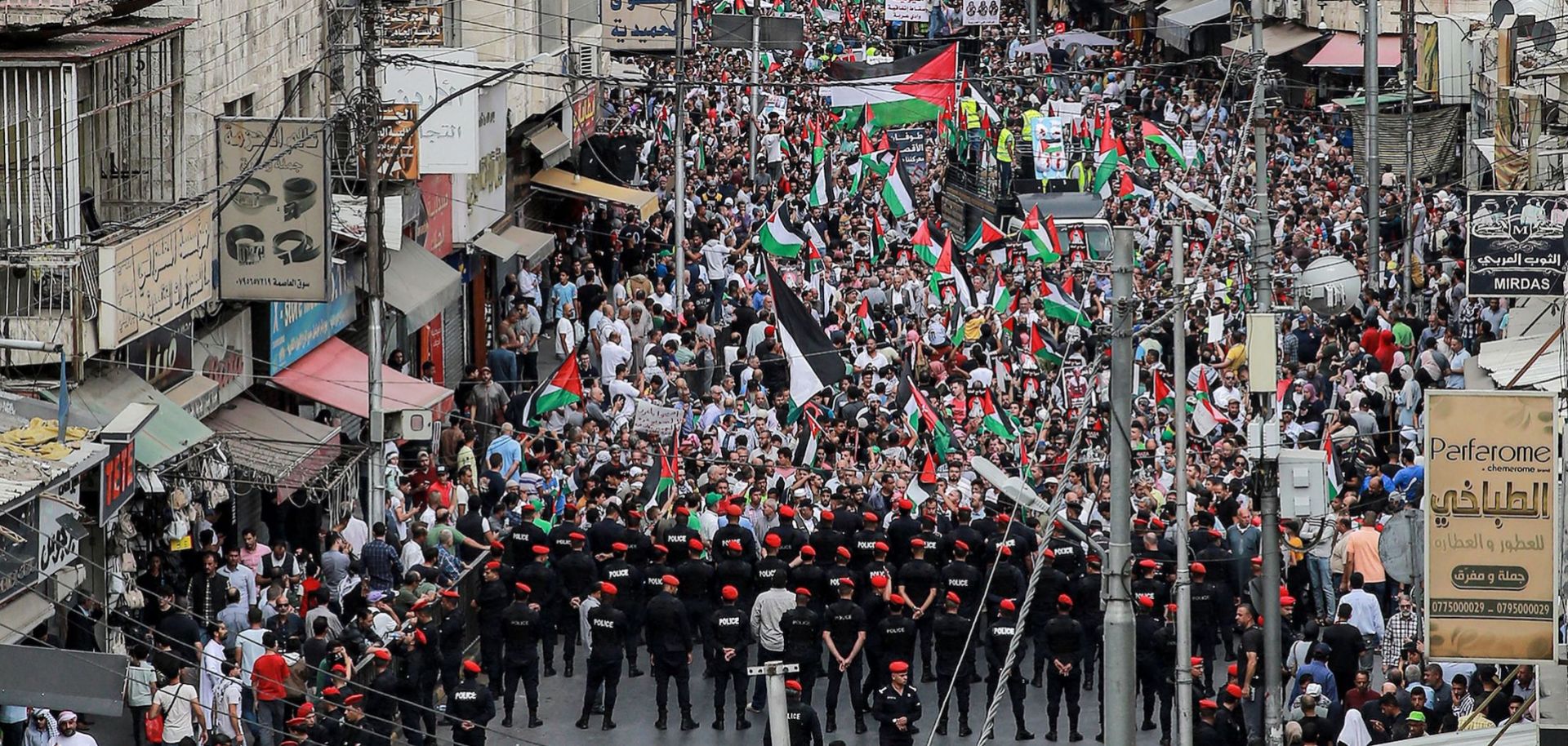
Amman will likely maintain its pro-Palestinian stance to appease its populace, despite the negative impacts on Jordan's relationship with Israel. Around three million people of Palestinian origin live in Jordan, and Jordan has the largest Palestinian refugee population in the world, making the country very sympathetic to the Palestinian cause amid the Israel-Hamas war. To prevent uncontrollable unrest, Jordan's government will continue to call for an end to Israeli attacks in Gaza and sharply criticize the civilian death toll. Amman will also attempt to leverage its relationship with the United States to pressure Israel into implementing humanitarian policies and de-escalating attacks that harm civilians in Gaza and the West Bank. For example, Jordan's King Abdullah II spoke with U.S. President Joe Biden on Oct. 31 and reiterated calls to send more humanitarian aid to Gaza, increase civilian protections and prevent forcible displacement. However, these actions will worsen Jordan's relationship with Israel, as seen in the recall of its ambassador.
- Jordan proposed a U.N. resolution calling for a humanitarian truce to the war. Although the resolution passed on Oct. 27, Israel and Jordan's key ally, the United States, both voted against it, demonstrating their divergent interests.
- Additionally, Jordan, Egypt and the Palestinian Authority — which nominally governs the West Bank — held a summit in Cairo, Egypt, on Oct. 21 calling for an end to the Israel-Hamas war and for efforts to prevent the displacement of Palestinians. The same day, Israel's National Security Council discouraged Israeli citizens from traveling to Jordan amid security concerns following anti-Israel protests there.
- Protesters in Jordan attempted to storm the Israeli Embassy in Amman after a deadly explosion at a Gaza hospital on Oct. 17, but Jordanian police dispersed them with tear gas. Jordan blamed Israel for the hospital attack, though the United States and other Western governments have blamed an errant Palestinian rocket.
- During an Oct. 13 protest in Amman, Jordanian protesters called for the closure of the Israeli Embassy and an end to the 1994 peace treaty with Israel. This follows an April Washington Institute-commissioned survey in which 85% of Jordanians concluded that the Abraham Accords would "somewhat negatively" or "very negatively" impact the region.
Alongside this pro-Palestinian foreign policy, Jordan will increase domestic security to deter violent spillover from the West Bank and isolated extremist attacks at home. Since the Israel-Hamas war began, violence in the West Bank has risen significantly and will only worsen if Israel launches a campaign in the area that significantly escalates the conflict. Jordan is increasing its border security to help prevent this violence from spilling over into its own territory, as well as to stop pro-Palestinian Jordanians from illegally crossing into the West Bank to fight for the Palestinians. Jordan will also increase its domestic security presence via proactive deployments of security forces and counter-extremism initiatives to mitigate the risk that the Israel-Hamas war could radicalize Jordanians. This risk will increase if the Islamic State issues a call to action against countries like Jordan that have normalized relationships with Israel. Even if not inspired by the Islamic State, some pro-Palestinian Jordanians may pose a violent threat, particularly if Israel's military operations result in further mass casualty attacks against Palestinian civilians akin to the Oct. 31 airstrikes. In this scenario, some Jordanians could commit retaliatory violence against Israeli, Western or even Jordanian government targets.
- The United Nations has reported record-high violence in the West Bank since Hamas' initial attack on Oct. 7, with over 100 Palestinians killed by Israeli forces and settlers.
- Amman requested that the United States deploy the advanced air defense Patriot missile system near its border with Israel amid concerns about errant ballistic missiles landing in Jordan's territory.
- Jordanian riot police dispersed a protest on Oct. 13 in which hundreds of Jordanians attempted to cross into Israel.
- The last major terrorist attack in Jordan took place in 2019 when Mustafa Abu Ruwais, a Jordanian citizen of Palestinian descent, stabbed eight individuals, including four tourists, after being radicalized by Islamic State ideology. Since then, Jordanian security forces have periodically arrested individuals and small cells accused of plotting attacks.
Despite the deterioration of the Israel-Jordan relationship, Jordan will work to preserve its 1994 peace treaty with Israel, although Amman will likely permit some smaller-scale retaliation for Israel's actions. Jordan is unlikely to break its peace treaty with Israel over the war in Gaza, as doing so would eliminate cooperation on border security, energy supplies and broader economic ties. Additionally, the United States has implicitly conditioned substantial foreign assistance and military cooperation on Jordan's peacekeeping and stabilizing role in the region. Therefore, absent a highly unlikely direct Israeli attack on Jordan or an extreme amount of spillover violence, Amman will likely continue to abide by the treaty. However, Jordan's government will likely allow citizens to protest Israel's actions in small, nonviolent ways. For example, Jordan's grassroots social media campaign "Support Local," which encourages Jordanians to boycott Western products due to Western governments' support of Israel, will likely continue unabated. Additionally, Jordan will continue to permit anti-Israel protests, though there will be additional protections along the border, as well as around Israeli and Western institutions inside the country. Though boycotts and protests will likely further strain Jordan's relationship with Israel, these actions are unlikely to cause permanent damage that would infringe on the two countries' cooperative endeavors.
- Israel is Jordan's ninth-largest partner for imports, and Jordan relies heavily on Israel for gas and water.
- The United States is Jordan's largest provider of bilateral foreign assistance, giving $1.65 billion in 2023 for military and humanitarian aid, specifically for Jordan's large refugee population.
