
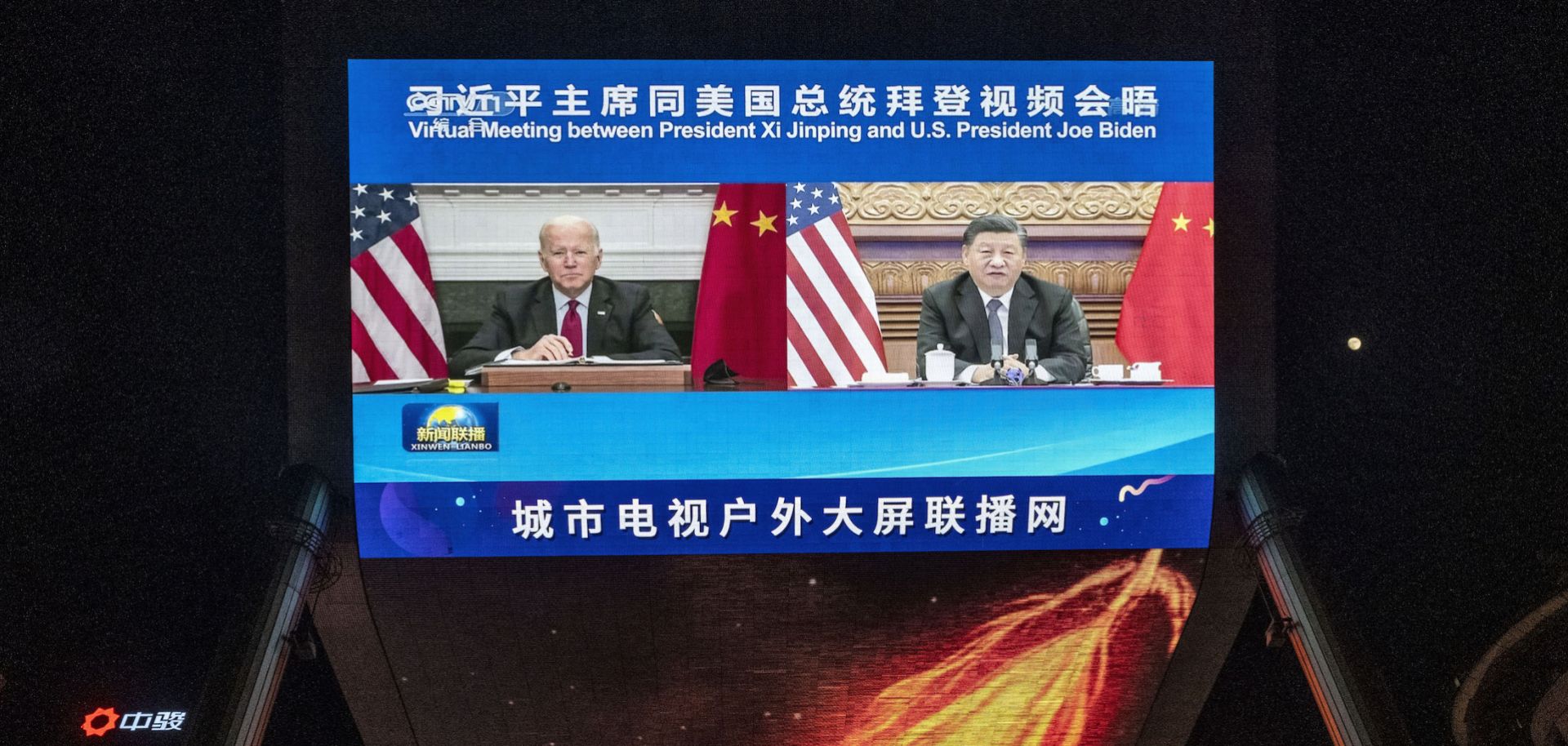
Talks between Chinese and U.S. leaders in mid-November will help to restart working-level dialogues on issues like trade disputes, but they will fail to address the root cause of escalating U.S.-China tensions and augur little progress on key policy disputes, including climate change mitigation. White House press secretary Karine Jean-Pierre confirmed during an Oct. 31 press conference that U.S. President Joe Biden would meet with Chinese President Xi Jinping on the sidelines of the Asia-Pacific Economic Cooperation (APEC) leaders' summit, due to be held in San Francisco, California, from Nov. 15-17. This will be the two leaders' first in-person meeting since they last talked on the sidelines of the Group of 20 (G-20) Summit in Bali, Indonesia, in November 2022. It also follows a series of lower-level bilateral visits, including U.S. Secretary of State Antony Blinken's trip to Beijing in June and his Chinese counterpart Wang Yi's trip to Washington in late October. These visits have been aimed at improving the two countries' diplomatic relations (which have cooled since the United States shot down a Chinese spy balloon in February 2023), as well as their military relations (which took a hit after China cut off defense talks in response to then-U.S. House Speaker Nancy Pelosi's visit to Taiwan in August 2022). Both the spy balloon incident and Pelosi's trip to Taiwan marked two high-profile flashpoints in a more comprehensive deterioration of U.S.-China relations over the last five years, brought on by deepening strategic competition on a growing list of economic and national security issues.
The meeting will likely deepen and broaden working-level dialogues on all manner of U.S.-China issues, absent an unexpected diplomatic spat at APEC. At the sideline meeting, both sides will reiterate old stances, with Biden elaborating on Washington's desire to compete economically without risking conflict, as Xi pitches a return to a pragmatic relationship that eschews political and ideological debates and pursues fruitful trade ties. The leaders will also discuss major world issues, including wars in Ukraine and the Gaza Strip, military tensions around Taiwan and the South China Sea, and climate change. On all of these issues, the Xi-Biden summit is unlikely to produce major policy breakthroughs. Rather, it will serve as a launchpad for future leadership talks and working group discussions where the United States and China will attempt to manage (though not resolve) various trade, military and human rights disputes. These may include discussions on supply chain restrictions, investigations into corporate practices, and cross-border data practices. High-level defense dialogues, too, may slowly resume in the wake of APEC, especially with China's defense minister Li Shangfu — whom the United States sanctioned in 2018 for buying weapons from Russia — now removed from office. There is a low possibility that bilateral talks at APEC devolve into an unproductive shouting match, similar to the Alaska Summit of March 2021. But unlike the Alaska meeting, both Xi and Biden will be present for the APEC talks, which will mitigate against that outcome by raising the bar to the presidential level.
- Amid contentious policy disputes, Chinese delegates could stonewall APEC negotiations on a joint statement, as they did at APEC in Papua New Guinea in 2018, resulting in the first leaders' summit with no joint statement since 1993. This would undermine future U.S.-China cooperation, but the anticipated Xi-Biden talks should mitigate this risk.
- On Sept. 22, the U.S. Treasury Department announced the creation of two working groups with China on financial and economic matters, intended as a follow-up to high-level meetings between U.S. Treasury Secretary Janet Yellen and Chinese Vice Premier He Lifeng in July.
- On Nov. 6, U.S. and Chinese officials will hold talks about nuclear arms control, following the Pentagon's public disclosure in October that China's arsenal of operational nuclear warheads had grown from 400 in 2021 to 500 as of May 2023. However, these talks are unlikely to make significant progress because both sides remain far apart on key issues, as evidenced by the Chinese foreign ministry's global governance proposal unveiled in September, which mentioned nuclear weapons but notably did not mention the ''no first use'' strategy that Beijing has long cited in all of its nuclear policy papers.
Beyond scheduling more talks, however, real progress on key issues in the U.S.-China relationship will be elusive as strategic competition inexorably deepens and myriad geopolitical developments in Asia worsen the severity of policy divergences. The key disagreement at the heart of U.S.-China tensions is the contrast between Washington's commitment to strategic competition as a means of addressing national security concerns and Beijing's desire to return to circa 2016 amicable relations that eschew difficult issues — positions neither side will fundamentally adjust. This disagreement will prevent meaningful progress on key policy issues like U.S. tech restrictions on China and China's retaliatory economic coercion, along with China's expanding data sovereignty policies and scrutiny of Western businesses, Chinese human rights abuses, and direct and indirect U.S.-China military competition in various theaters. Beyond core strategic constraints, many tactical developments will present frequent and significant speedbumps to bilateral efforts to ease tensions, with the most likely disruption being various Chinese military and economic coercion efforts against Taiwan, especially following the latter's January 2024 elections. Amid these many economic, military and political disputes, U.S.-China cooperation even on climate issues will likely be minimal as Beijing rejects Washington's entreaties for China to sign onto international climate commitments and instead pursues the energy transition at its own pace in order to preserve China's energy security. Such high-level disputes on climate issues will also be exacerbated by deepening U.S.-China industrial competition in electric vehicles, solar panels and other new energy technologies.
- Biden's approach to China has focused on addressing mounting U.S. national security concerns while putting ''guardrails'' on the U.S.-China economic competition. But the November 2024 presidential elections will reduce his space for compromise on China, a topic that enjoys bipartisan hawkishness in the United States. Meanwhile, Xi has positioned himself as the only Chinese leader who can triumph over U.S. efforts to contain China's development, which also limits his room for offering concessions to Washington.
- Other potential future developments that could disrupt the prospects of U.S.-China cooperation include U.S. congressional censure for Hong Kong's rigged elections in December 2023; Chinese coast guard clashes with the Philippines, a U.S. ally, in the South China Sea; U.S. tech restrictions on China; U.S. congressional supply chain investigations connected to China's human rights abuses; U.S. congressional visits to Taiwan ahead of U.S. elections in November 2024; the election of a new U.S. president who takes a more hawkish stance on China; and any evidence of Chinese support for Russia's war in Ukraine or North Korean arm sales to Moscow.
- Washington is committed to bolstering relations with Taiwan, including accelerating arms sales to the island nation that asserts its de facto independence from China. But during his visit to Washington last month, Foreign Minister Wang Yi made it clear that respecting Beijing's view on Taiwan was the ''foundation'' of productive U.S.-China ties.
- U.S.-China climate cooperation efforts yielded the Joint Glasgow Declaration in November 2021, in which both sides agreed on climate concerns but failed to follow up with any regular cooperation mechanism or tangible goals. The U.S. state of California signed a memorandum of understanding with China on Oct. 25 to collaborate in various decarbonization efforts, but it again remains to be seen whether this will yield more than just future discussions.
- Future U.S.-China defense dialogues may help facilitate crisis communication lines— useful during aerial or maritime clashes — but China's track record of ignoring such emergency hotlines will limit their utility, and key contradictions in military goals will inhibit progress in broader defense cooperation beyond discussing points of contention.
