
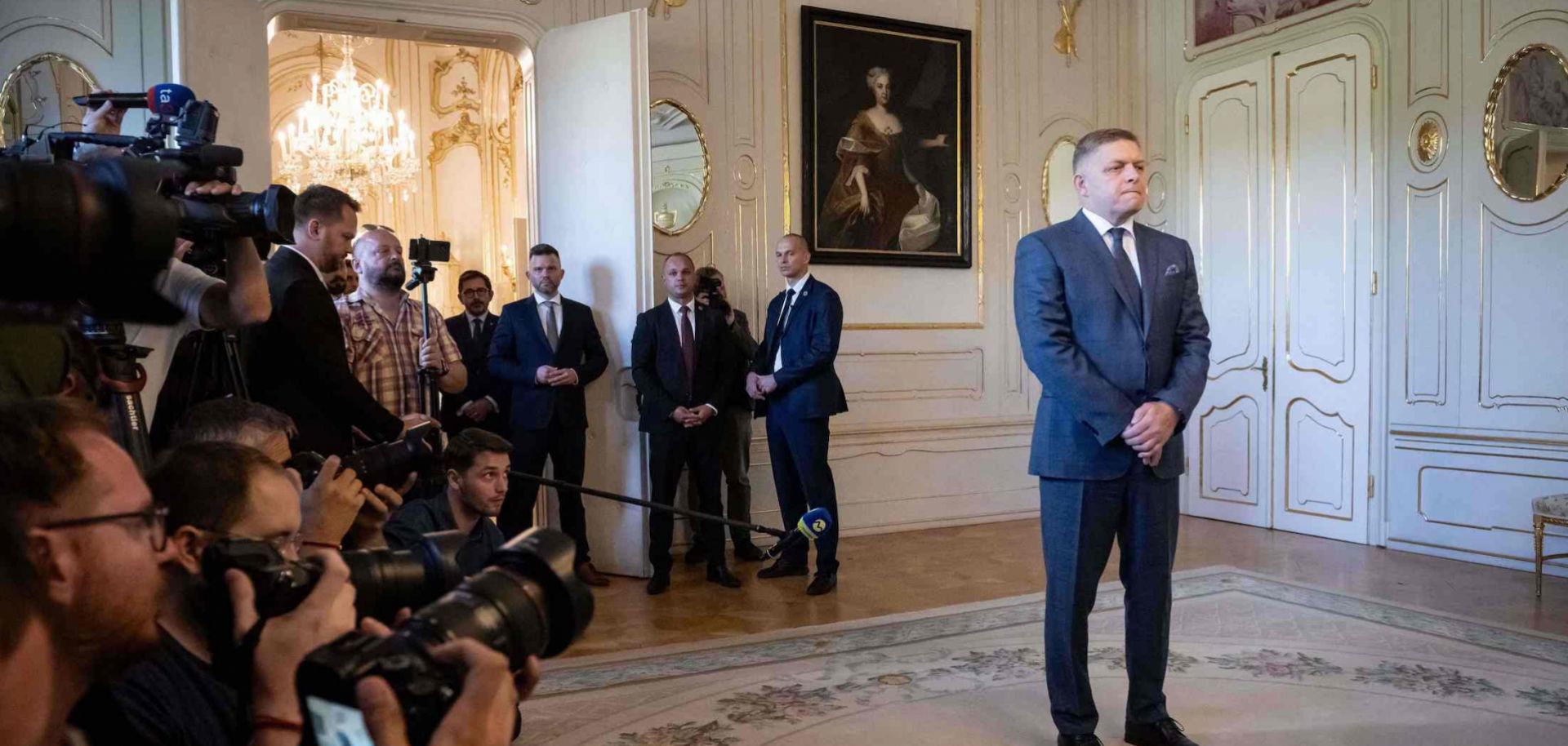
A more Eurosceptic government in Slovakia could reduce the country's political and military support to Ukraine and open limited disputes with Brussels, but major policy divergences with NATO and the European Union remain unlikely. The nationalist-populist Direction-Social Democracy (Smer) party of former Prime Minister Robert Fico won the largest share (22.9%) of votes in Slovakia's early elections on Sept. 30, and is now poised to begin coalition talks to form a government. The Western-oriented, liberal Progressive Slovakia (PS) party came in second with 17.9% of the vote, followed by the moderate, center-left Voice-Social Democracy (Hlas) party of former Prime Minister Peter Pellegrini with 14.7% of the vote. Four other political parties reached the 5% threshold needed to enter the parliament, including the Ordinary People and Independent Personalities (OL'aNO) party, with 9.2% of the vote, along with the Cristian Democrats (with 7%), the liberal Freedom and Solidarity party (with 5.9%), and the nationalist-populist Slovak National Party (with 5.7%). The far-right Republika party narrowly missed out on securing representation in parliament after securing only 4.9% of the vote.
- Slovakia held an early general election on Sept. 30 after a no-confidence vote in December 2022 ousted the conservative government led by outgoing Prime Minister Eduard Heger. A technocratic government has held office in a caretaker capacity since May.
Former Prime Minister Fico's Smer party is expected to form a coalition with its more moderate offshoot Hlas, which has emerged as the potential kingmaker, and the nationalist Slovak National Party (SNS). In light of the heavily fragmented election results, government formation talks will involve multiple players and the process to achieve a workable majority to control Slovakia's 150-seat parliament will likely prove long and complicated. Having secured the most votes, Smer is largely expected to lead coalition negotiations, seeking to assemble a government in partnership with the nationalist party SNS and the social-democratic Hlas party. Hlas, which split off from Smer in 2020, has emerged as the potential kingmaker for any new Slovakian government. The left-wing party could theoretically decide to join an alternative coalition that includes runner-up progressives like Progressive Slovakia or anti-establishment parties like OL'aNO. This, however, appears unlikely due to the significant ideological differences between the several parties involved. Overall, given the ideological similarities between Smer and Hlas and the difficulties in assembling a counter-coalition, a three-party alliance led by Smer and including Hlas and SNS is the most likely outcome.
- Since its formation in 2020, the Hlas party has remained ideologically closer to Smer than to the PS party. Both Hlas and Smer support robust state intervention in the economy and share similar views on social policies. PS, by contrast, is more socially progressive, including on issues like LGBTQ+ rights, and favors a more libertarian economic policy agenda.
- SNS is a socially conservative party that, on paper, differs ideologically from the left-wing Smer and Hlas. But after serving as a coalition party in two Smer-led governments, the party has a history of working with Smer, with which it also shares anti-immigration and Eurosceptic views.
- Based on their shares of the vote, Smer and Hlas alone would still fall short of a majority, accounting together for 69 out of 150 seats in Slovakia's parliament. The inclusion of SNS would add 10 seats to the coalition, enabling it to form a ruling majority.
- Despite its recent surge in popularity and better-than-expected performance in the Sept. 30 ballot, PS lacks large enough like-minded partners to form a coalition government. Even if it convinced Hlas to join forces against Smer, it would still need the support of smaller, socially conservative parties to form a governing bloc, which would be extremely difficult given the PS party's strong liberal, pro-EU outlook.
While a ruling coalition consisting of Smer, Hlas and SNS would likely embrace more Eurosceptic rhetoric and selectively challenge EU decisions, it would probably refrain from any drastic anti-Western move that could excessively impact the country's economic and fiscal situation. Fico and his Smer party's victory has triggered concerns in the United States and the European Union over Slovakia's future political direction — particularly regarding the country's support for Ukraine, given Fico's vocal opposition to sanctioning Moscow and providing Kyiv military aid, which has fueled fears that his return to power in Slovakia could undermine Western unity in support of Kyiv in its war against Russia. A Smer-led alliance that includes SNS would only reinforce such fears, given some of the party's pro-Russian and Eurosceptic views. But should he be re-elected prime minister, Fico would likely tone down his rhetoric and embrace more pragmatic views, as suggested by his previous record in office, during which he alternated Eurosceptic messaging with support for greater European integration. Furthermore, the Hlas party's prospective inclusion in such an alliance would help to moderate its coalition partners' more anti-Western positions as, unlike SNS and Smer, Hlas has vowed to maintain Slovakia's positions with its Western allies and military support for Kyiv. Finally, a Smer-led government would still largely seek to maintain the country's generally pro-business orientation. This means that while it may seek to selectively challenge Brussels on issues ranging from migration to social policies or implement measures that weaken the rule of law, the government would probably still seek to avoid taking any drastic anti-Western move that could disrupt the disbursement of EU funds to Slovakia and endanger the country's fiscal position and investment outlook. Regardless, the highly fragmented parliament that emerged from the election will nonetheless raise the risk of political instability over the next four years.
- The formation of a three-way alliance between Smer, SNS and Hlas would likely only have a modest impact on Slovakia's stance on Ukraine. This is, in part, because Slovakia has already transferred a significant portion of its arms reserves to Ukraine (including Soviet-era MiG-29 fighter jets), which will leave the next government with limited room to visibly reduce its support to Kyiv further.
- Smer embraced anti-NATO/EU positions ahead of the election by calling for an end to military support to Ukraine, criticizing EU sanctions against Russia, vowing to block all Ukrainian grain imports, and opposing Ukraine's bid for NATO membership — likely in a bid to appeal to an increasingly anti-war and Western-skeptic Slovakian electorate. Hlas, by contrast, pledged to maintain military support to Ukraine and has argued that providing commercial ammunition supplies to Kyiv represents a positive for Slovakia's defense industry.
- Slovakia is a net beneficiary of EU funds under the Common Agricultural Policy (CAP) and Cohesion Policy (CP). Since joining the bloc in 2004, the country has received more than 24 billion euros ($25.3 billion) in net total EU funding. The CP funds that Slovakia has received have alone accounted for 1.5% of its GDP, with an estimated multiplier of 2-3% according to the National Bank of Slovakia. Slovakia is also set to receive a total of 6 billion euros in EU pandemic recovery funds.
- Moreover, Slovakia runs one of the European Union's highest budget deficits, which is forecast to reach nearly 6% in 2023. Any move from the government that would risk interrupting or delaying the flow of EU funds into the country would hurt economic growth and increase borrowing costs for the government, further complicating Slovakia's fiscal situation.
