
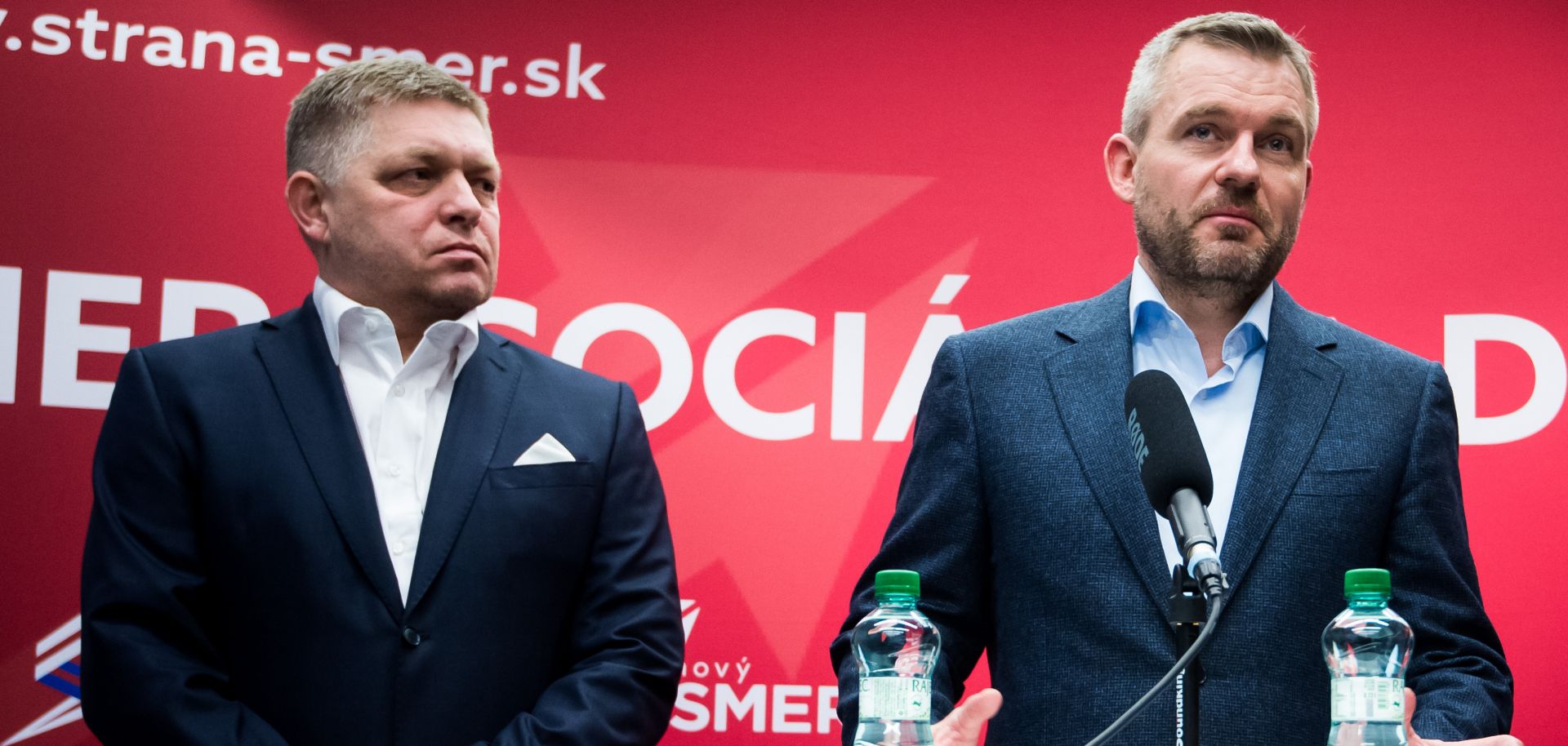
Slovakia's upcoming parliamentary elections could reduce the country's alignment with the European Union and NATO, but any new government will likely avoid drastic anti-Western moves that could excessively endanger the country's fiscal position and foreign investment. Slovakia will hold an early general election on Sept. 30 following the resignation in May of the center-right, pro-NATO government of former Prime Minister Eduard Heger. Opinion polls show two opposition parties — the nationalist-populist Direction-Social Democracy (Smer) party of former Prime Minister Robert Fico and the center-left Voice-Social Democracy (Hlas) party of another former Prime Minister Peter Pellegrini — leading by a wide margin against all four of the parties in the outgoing coalition government. Support for Smer has increased in recent months, while Hlas' popularity has been waning. But the gap between them remains relatively narrow. Against this backdrop, both parties are scouting junior partners for a potential coalition government.
- A technocratic cabinet took office last May following a no-confidence vote in December that ousted a coalition government led by Heger's Ordinary People and Independent Personalities (OL'aNO) party.
- The latest opinion poll by Europe Elects — which combines results from different national opinion polls — shows Smer leading with 19.1%, followed by Hlas with 15.2%, the liberal Progressive Slovakia (PS) party with 14.6%, and the far-right Republika party with 8.7%. OL'aNO is polling at 7.2%, with its former coalition partners Sme Rodina (We Are Family) and Freedom and Solidarity (SaS) both at 6%. Two other far-right parties, the Slovak National Party (SNS, which was in the opposition) and For the People party (L'SNS, which was part of the incumbent's ruling coalition), are also polling at 5% and 2.2%, respectively.
Slovakia's political fragmentation suggests the elections could yield another highly divided parliament, with the center-left Hlas party being the kingmaker in government formation talks. Former Prime Minister Fico's nationalist Smer party has strongly embraced anti-NATO and Eurosceptic positions ahead of the election, calling for Slovakia to end its military support to Ukraine and criticizing EU sanctions against Russia — most likely in an effort to appeal to growing anti-war and Western-skeptic sentiments in the country. Meanwhile, the two far-right parties, Republika and SNS — which together account for almost 14% of voting intentions in the polls — are actively courting Smer to create a far-right anti-Western coalition. By contrast, former Prime Minister Pellegrini's center-left Hlas party has vowed to maintain Slovakia's position within NATO and has so far rejected Fico's proposals to form a coalition with Smer or other anti-NATO/EU opposition parties. Given that Smer (or an eventual Smer-led far-right coalition) and the liberal-conservative camp appear unlikely to secure a majority in the new parliament, Hlas will likely emerge as the kingmaker.
- Fico (who served as prime minister between 2006-2010 and again between 2012-2018) was ousted from office in 2018 following a high-level corruption scandal that resulted in the slayings of his fiancee and an investigative journalist. Since then, he's embraced increasingly anti-Western and populist rhetoric. Pellegrini (who replaced Fico as prime minister and remained in office until 2020) is a former close ally of Fico, as well as a former member of the Smer party. Pellegrini's Hlas party was formed in 2020 by a centrist faction that split off from Smer. Compared with Fico, Pellegrini has since maintained more moderate stances, yet many of his Hlas party's positions still somewhat mirror those of Smer. This — combined with the fact that their two leaders have largely avoided open fighting since their parties split off — means an alliance between the two parties remains politically feasible, despite Pellegrini explicitly ruling out the prospect of forming a coalition with his former ally.
The composition of Slovakia's next ruling coalition will determine whether the country maintains its current pro-Western orientation or embraces more Eurosceptic pro-Russian stances. But the parliament is still poised to be highly fragmented, which will prolong policy uncertainty and political instability in the country regardless. There are three main scenarios that could emerge following the election. Hlas would likely prefer to form a government with other moderate forces in a centrist coalition that includes center-left and -right parties, thus opening the door to a largely pro-EU/NATO executive. But if Hlas and centrist parties fail to secure a parliamentary majority in the election, Pellegrini may accept Fico's proposal to form a coalition between their two parties. A Hlas-Smer coalition would be less committed to the European Union and NATO, though it would also refrain from any actions that could endanger Slovakia's membership in either organization, as Pellegrini's pragmatism would help temper Fico's more radical views. Finally, Fico and his Smer party could opt for an alliance with the decidedly more Eurosceptic and anti-NATO Republika and SNS parties, which would pose a serious threat to EU unity in supporting Ukraine. A far-right coalition would also raise the risk of disputes between Bratislava and Brussels that may disrupt the disbursement of EU funds to Slovakia. Opinion polls suggest that this scenario is the least likely of the three, given that far-right parties would still need support from the more moderate Hlas or other smaller parties to form a coalition. But what appears most certain is that the September election will result in a highly fragmented parliament, which will prolong policy uncertainty and political instability in the country regardless of the makeup of its next governing majority — even if major policy divergences with NATO and the European Union remain unlikely.
- Should far-right Eurosceptic parties successfully form a coalition after the September ballot, it could further complicate decision-making within the European Union. This is because a firmly anti-Western pro-Russian government in Slovakia would likely join Hungary in opposing or disrupting costly EU sanctions against Russia and support for Ukraine. A far-right Slovakian government would also be more likely to enact measures that weaken the rule of law, restrict media freedoms and infringe on minority rights in the country. The resulting tensions with Brussels could also lead to a freeze or delay in EU fund disbursements for Bratislava, with negative economic and fiscal implications for the country.
- Heger, Slovakia's current prime minister, has been leading the country in a caretaker capacity since September 2021 after a political scandal related to the purchase of Russian COVID-19 vaccines forced his predecessor Igor Matovic to resign — highlighting Slovakia's preexisting political instability.
