
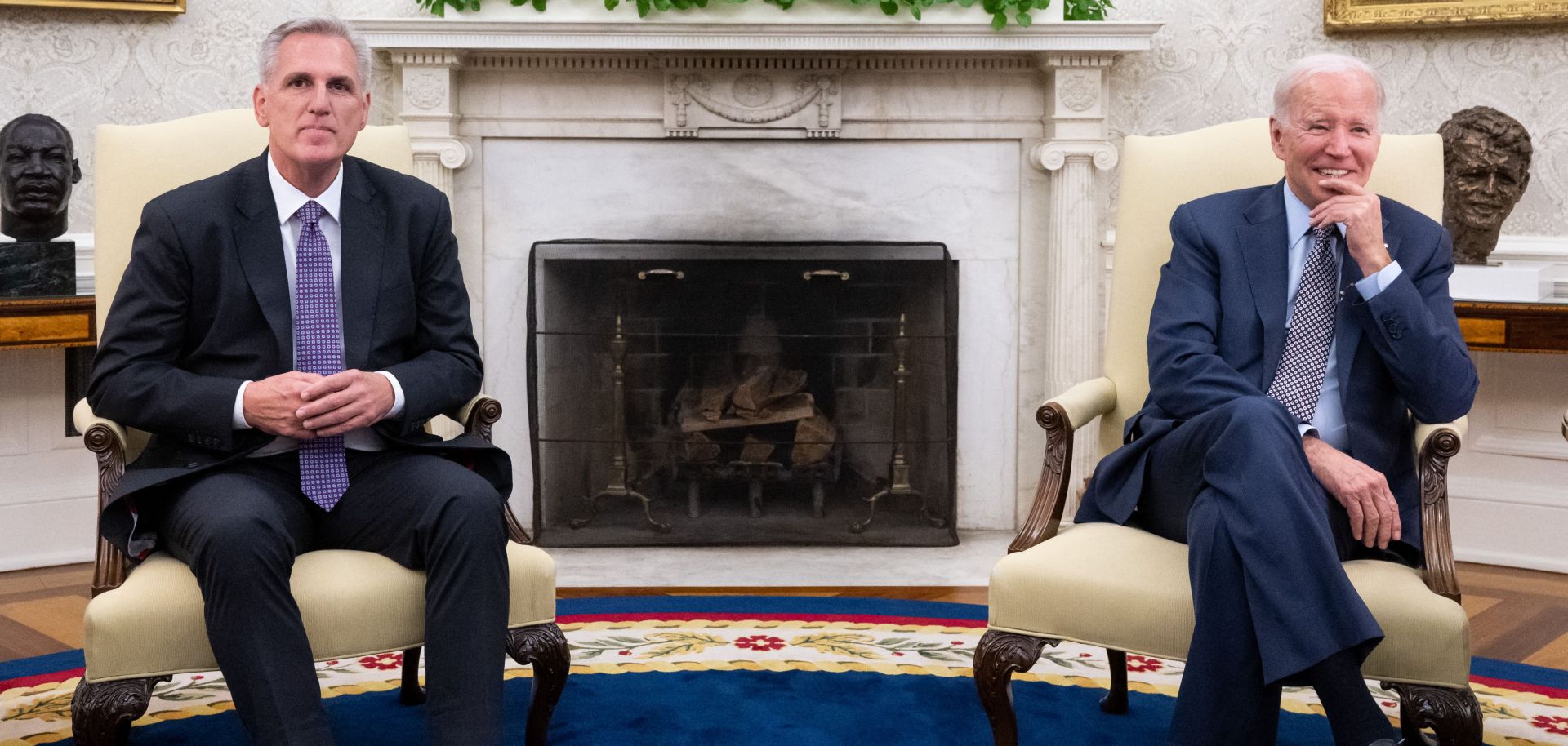
U.S. President Joe Biden (right) meets with U.S. House Speaker Kevin McCarthy to discuss the debt ceiling in the Oval Office of the White House on May 22, 2023.
In the United States, continued large fiscal deficits will significantly increase government debt levels in the coming decades. This, exacerbated by partisan polarization, will translate into intensified conflicts in Congress over how to cut spending and generate more revenue, which in turn will increase the political and economic challenges of preserving debt sustainability. While U.S. lawmakers just raised the debt ceiling and avoided a potential default, the politics surrounding budget policy and policymaking will remain contentious due to both economic and political reasons. U.S. President Joe Biden's expenditure increases and his predecessor's tax cuts have further raised the debt-to-GDP ratio in recent years. While the post-COVID economic recovery and the recent bout of inflation may have temporarily reduced that ratio, it is still set to substantially increase in the medium term.
- On June 1, the U.S. Senate passed a deal reached by President Biden and House Speaker Kevin McCarthy to suspend the debt ceiling until 2025, averting a potential default. As part of the agreement, Congress also passed the Fiscal Responsibility Act, which foresees $1.5 trillion worth of fiscal savings over the next 10 years. The decision came only four days before the U.S. Treasury Department was expected to run out of funds sufficient to service all its financial and non-financial obligations.
- Total U.S. federal government debt stood at 64% of GDP just before the global financial crisis in 2008. By 2019, just before the COVID-19 pandemic, that percentage had ballooned to 105%. At the height of the pandemic in 2020, the U.S. debt-to-GDP ratio peaked at 135%. Since then, it has declined to slightly less than 120% of GDP due to high nominal growth underpinned by unexpectedly high inflation. Today, U.S. gross government debt is roughly comparable to that of its Group of 7 (G-7) peers, including Canada (106%), France (110%), Germany (66%), Italy (145%), Japan (260%) and the United Kingdom (84%).
Modest medium-term economic growth and a large underlying structural deficit — combined with a significant long-term increase in mandatory spending due to the aging U.S. population — will continue to push up federal government debt measured as a share of GDP. Before the COVID-19 pandemic, real interest rates in the United States were negative. This was due to low economic and productivity growth following the 2008 financial crisis, which — along with excess global savings — pushed down demand for investment and hence the real interest rate. If real interest rates increase in the coming years, the upward pressure on the debt ratio would then further intensify, particularly in light of today's much higher debt burden. A real interest rate that is 200 basis points (bps) higher than the levels that prevailed over the past 15 years would roughly add 2% of GDP to the U.S. annual deficit, all other things being equal. In addition, the Biden administration's major legislative packages (such as the Inflation Reduction Act, the Infrastructure Act, and the Chips and Science Act) will further add to government deficits over the next ten years. By comparison, the Fiscal Responsibility Act (which Congress just passed as part of the agreement to suspend the debt ceiling) will do little to change the medium-term trajectory of U.S. government debt.
- The International Monetary Fund (IMF) forecasts U.S. real GDP to average less than 2% between 2023 and 2027. Over the past decade or so, the 10-year real interest rate in the United States averaged significantly less than 1%, while the short-term rate was negative. If real interest rates grew by 200 bps from that level, the related increase in net interest payments would force the U.S. federal government to raise taxes or cut expenditures substantially in order to keep the debt ratio from ballooning beyond its already concerning trajectory.
- The Congressional Budget Office projects U.S. government debt levels to reach an eye-watering 195% of GDP by 2053, driven to a significant extent by increased mandatory spending as Baby Boomers reach retirement age and further strain underfunded government programs (such as Medicare and Medicaid). The office also projects the U.S. deficit to widen from more than 4% of GDP today to 9% of GDP in 2050. In addition, federal debt held by the public is projected to increase from 98% of GDP today to 118% in 2033.
- The spending cuts outlined in the newly passed Fiscal Responsibility Act are slated to reduce total debt by $1.5-2.0 trillion over the next decade relative to the baseline. Given that U.S. GDP is projected to reach $40 trillion by 2023, this reduction will not significantly change fiscal and debt dynamics.
To improve long-term debt dynamics, lawmakers in Congress will be forced to make politically very difficult choices about reforming Social Security (which would risk upsetting both Republican and Democratic voters), reducing non-defense discretionary spending (which would prove very contentious along partisan lines), or limiting defense expenditures (which may prove politically unpalatable given Washington's commitment to check China). Mandatory spending makes up a large share of total U.S. government expenditures, while only about a quarter of federal government spending is discretionary. Defense expenditures comprise almost half of discretionary spending, which is directly subject to the annual budget process. But Congress remains highly unlikely to cut defense spending due to the bipartisan consensus on the need to mitigate threats posed by China. For all intents and purposes, Congress will need to tackle the politically sensitive issue of reforming the Social Security system (by, for example, raising the retirement age or income cap), which both Republican and Democratic lawmakers have been loath to do. As long as this is the case, conflict over discretionary spending will intensify in light of increasing debt levels and the need to rein them in. This will, in turn, further heighten disagreements on Capitol Hill over whether to significantly cut discretionary spending or significantly raise taxes, with Republicans likely pushing for the former and Democrats pushing for the latter. Within this context, Congress is very likely to continue using the debt ceiling as a way to force concessions or reach compromise solutions.
- For the past 20 years, Republicans have generally preferred tax cuts, even if it meant higher federal fiscal deficits, while Democrats have generally preferred spending increases, even if it meant higher fiscal deficits.
- The Congressional Budget Office warned the Social Security fund will become insolvent by 2030, as the program's revenue from payroll taxes decreases and its expenditures on benefits increase due to the United States' aging population. Between now and 2050, the IMF also projects U.S. healthcare spending to increase by a whopping 150% of GDP in net present value terms. Pension spending is expected to increase over the next half-century as well, but by a much more modest 17% of GDP.
Government debt levels could increase even more rapidly if the U.S.-China rivalry drives Washington to ramp up its defense spending. If lawmakers in Congress fail to reach an agreement that either increases taxes or reduces discretionary spending, U.S. government debt will likely increase even faster than currently projected. This is because the escalating strategic competition with China will not only deter U.S. lawmakers from cutting defense spending, but will see them increase such expenditures. Compared with the United States, China's faster underlying economic growth gives it greater room to keep rapidly expanding its defense budget without undermining the Chinese economy. China also has significantly higher savings rates than the United States, which enables Beijing to divert resources to non-productive defense spending with fewer economic repercussions as well. China's military budget is thus poised to continue growing at a faster rate than the United States, which will compel Washington to rapidly increase its defense expenditures to keep up. This will make the various financial tradeoffs all the more economically painful and politically difficult.
- The United States spends about 3% of its GDP on defense, the most of any country in the world. But China is quickly catching up, with the East Asian giant currently spending about 2% of its GDP on defense.
