
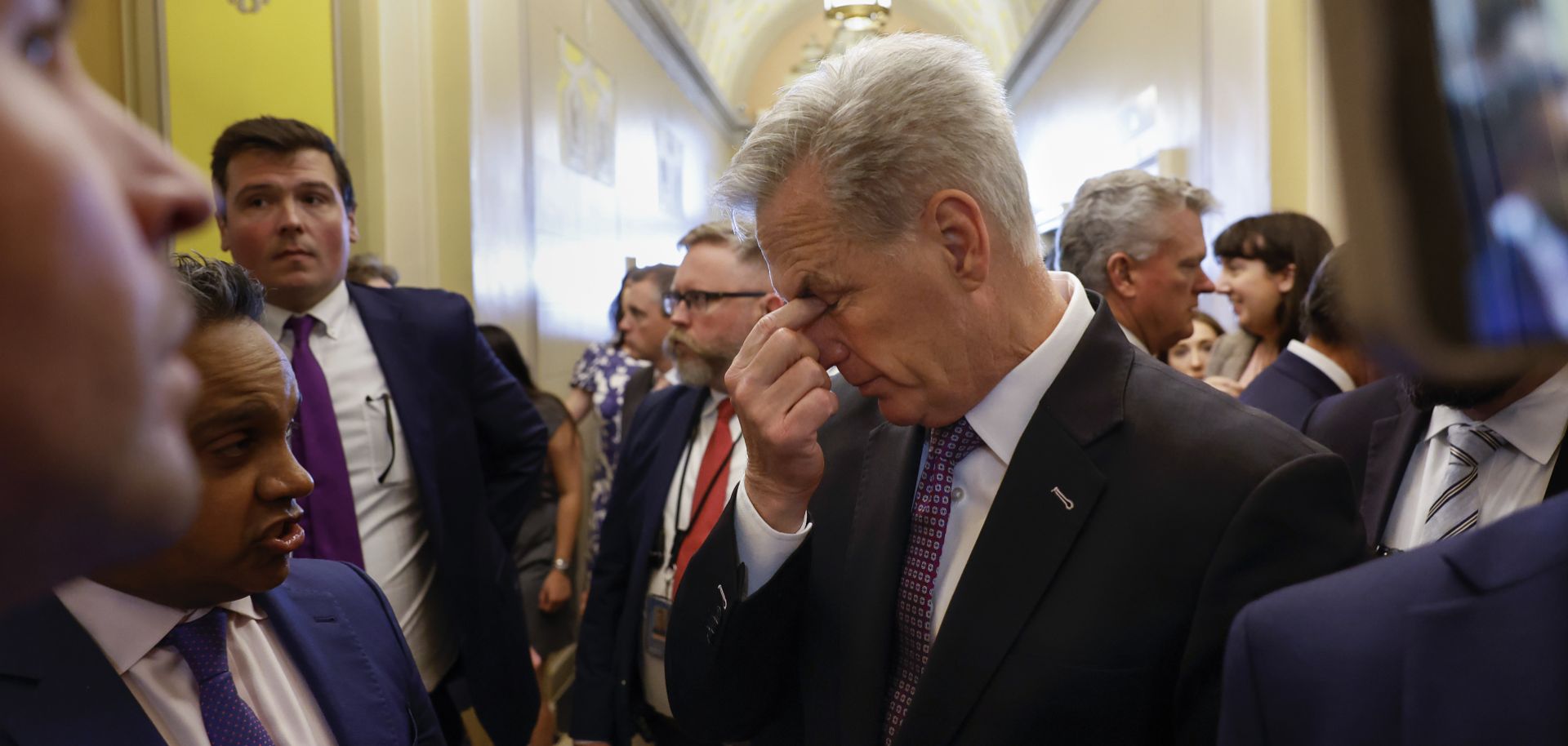
U.S. Speaker of the House Kevin McCarthy talks to reporters at the U.S. Capitol on May 17, 2023, about the current impasse over raising the nation's debt limit.
As June 1 approaches, the day the Treasury is projected to exhaust its so-called extraordinary measures and become unable to meet all its payment obligations, the risk of financial market volatility and a U.S. government default will increase — even if such a scenario would not fundamentally threaten the U.S. dollar's role as an international currency, provided the default proves short-lived. After hitting the debt limit in January, the Treasury has relied on extraordinary measures that allow it to service all its payment obligations without issuing additional debt. But the Treasury may soon exhaust those measures, which could see the U.S. government enter a technical default as early as June 1, unless both chambers of Congress agree to either raise or suspend the debt ceiling. On April 26, the Republican-controlled House of Representatives passed a bill that ties a one-year extension of the debt ceiling to capping budgetary spending and other conditions. On May 9, U.S. President Joe Biden met with congressional leaders to discuss a potential compromise whereby the White House and the Democratic-controlled Senate would agree to some of the demands contained in the Republican-backed House bill, in order to break the impasse and lift the debt ceiling. But with the June 1 deadline now less than two weeks away, time is quickly running out for U.S. lawmakers to find a solution that keeps the world's largest economy from defaulting on its debt.
- The bill the Republicans passed in the House would raise the debt limit by $1.5 trillion, effectively until March 2024. Among other things, the House bill proposes significant spending restraint with respect to discretionary expenditure. It also seeks to rescind unspent pandemic relief funds, as well as roll back energy and tax credits contained in Biden's Inflation Reduction Act that was signed into law in August, before Republicans won control of the House in the November midterm elections.
The severe polarization of Congress, combined with House Speaker Kevin McCarthy's tenuous position, has turned the debt ceiling into a highly charged political fight with little room for compromise. Raising the debt ceiling is often a politically contentious issue in the United States, but rarely has it fueled so much controversy and uncertainty. The severity of the current crisis in Washington is due largely to the ever-increasing polarization of Congress, which has severely disrupted policymaking by limiting room for both interparty and intraparty cooperation. The concessions McCarthy made to be elected as House leader have also added another layer of complexity to the issue by largely leaving him at the mercy of hard-right Republican lawmakers in the so-called Freedom Caucus. House leaders are typically in firm control of the legislative process, but McCarthy's weak position has made it more uncertain that he would be able to force a compromise solution through the House against the will of his party's members, even if congressional leaders are able to find a compromise in the coming days.
- Republican House Speaker Kevin McCarthy is in a weak position due to the concessions he had to make to be elected, particularly to the hard-right Freedom Caucus. Those concessions largely included procedural rules that strengthen individual lawmakers at the expense of the leadership by, for example, offering seats to Freedom Caucus members on the all-important Rules Committee. Republicans' narrow 222-seat majority in the House of Representatives (where Democrats control the remaining 213 seats) further strengthens the influence of individual Republican lawmakers.
If economic agents start to doubt whether the debt ceiling will be lifted or suspended in time, financial market turmoil and an economic downturn could ensue, regardless of whether the Treasury or the U.S. Federal Reserve intervenes to prevent a broader economic and financial crisis. Financial market volatility is likely if there are doubts Congress will act quickly enough to raise the debt ceiling before the June 1 deadline, or if there is a technical default. The most likely scenario is one where equity markets sell off and high-yield credit weakens. But this scenario could, paradoxically, also see long-term government bonds and the U.S. dollar rally, as happened during the last serious debt ceiling standoff in 2011. Neither the Treasury nor the Federal Reserve is likely to intervene forcefully unless (or until) a massive financial market selloff occurs, which would make it easier for both to politically justify their intervention. If the Treasury has the power to prioritize payments from a legal and administrative standpoint (which is currently unclear), it may decide to first pay off its financial obligations once the Treasury runs out of sufficient cash to service all its financial and non-financial obligations. This would avert an immediate default without providing a sustainable, long-term solution. But it would also lead to increased economic uncertainty and reduced government spending — raising the potential for reduced spending on public-sector salaries and programs like Medicaid, which would weigh on the U.S. economy's outlook.
- In the event of a default, the Federal Reserve may intervene to limit financial instability. The most obvious option is to purchase defaulted government debt, possibly at face value, and replace it with debt the U.S. government has not yet defaulted on. Fears of provoking political backlash will make the Federal Reserve reluctant to intervene in a manner that risks exceeding its legal mandate. However, should financial instability get out of hand, the U.S. central bank would likely find a legal loophole that would allow it to take more forceful action, such as buying/lending against defaulted debt.
- The Treasury is also unlikely to resort to unorthodox measures in an attempt to avoid a default, such as minting a one-trillion dollar coin (which the Treasury would then deposit at the Federal Reserve and thereby provide with an additional $1 trillion worth of credit) or invoking the 14th amendment debt clause (which states that the U.S. government shall not be ''questioned''). This is because such measures would be legally and politically very risky with uncertain economic-financial outcomes, as they would be challenged in court and thus likely fail to reassure markets sufficiently and unambiguously. Equally importantly, extraordinary and legally questionable measures would reduce pressure on Congress to find a legally sound solution, which would, in turn, reduce the probability of lawmakers finding a sustainable solution.
A short-term, technical default would likely only have a limited impact on the dollar as an international currency due to the sheer fact that there are no short-term alternatives to the U.S. currency. A short-term technical default would lead central banks to rebalance their portfolios away from U.S. government bonds and especially short-term bills, if much less so from the dollar. But this rebalancing would only go so far, because international trade and financial transactions will continue to be conducted in dollars, limiting the extent to which central banks will want to divest dollar-denominated assets. In practical terms, it is also virtually impossible for the major central banks to buy alternative safe assets (at a reasonable price) as a substitute for the dollar, which is why the dollar share in global reserves would decline only modestly in case of a technical default. Only limited amounts of euro-denominated safe (highly rated) assets exist, and the Chinese yuan's attractiveness will remain limited as long as China's capital controls and underdeveloped domestic financial markets limit access and liquidity. If the U.S. financial default proves short-lived, the economic-financial impact on emerging economies should be limited. But if it does not and Congress fails to raise the debt ceiling, the fallout would hit emerging economies hard by prompting foreign investors to withdraw their funds from those riskier markets. If the world's largest economy enters a prolonged default, the consequent slowdown in U.S. economic growth would also translate into slower growth and likely an outright recession in both emerging and developed economies around the world (as happened in the wake of the U.S.-centered global financial crisis of 2008).
- The limited amount of global safe assets would limit dollar divestment. Global foreign exchange reserves currently amount to $12 trillion. $6.5 trillion (or 60%) of those reserves are denominated in U.S. dollars, mostly in the form of U.S. government bills, notes and bonds. Euro-denominated holdings, by contrast, amount to 20% of global foreign exchange reserves, while yuan-denominated holdings amount to only 3%.
