
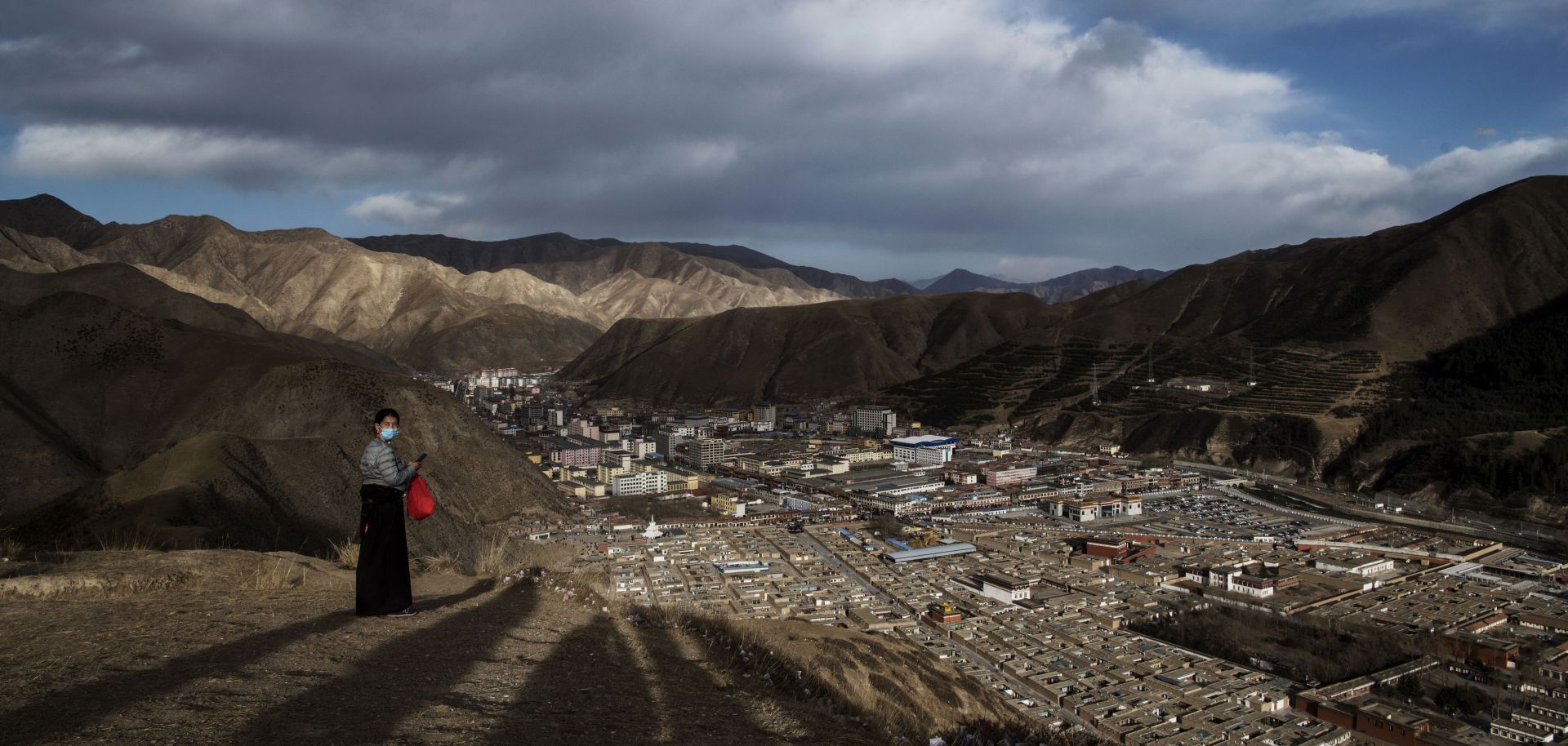
A Tibetan Buddhist woman stands upon a hill overlooking the Labrang Monastery on March 2, 2018, in Gansu, China, the country's poorest province.
Editor's note: This column is part of an ongoing series that explores China's demographic challenges. In parts one, two, three and four we examined China’s retirement, pension, financial and labor systems, as optimizing those systems will likely prove critical to the country’s ability to navigate its middle-income transition and overcome its demographic decline.
In the previous parts of this series, we examined China's retirement, pension and financial systems, as optimizing those systems will likely prove critical to the country's ability to navigate its middle-income transition and sufficiently stave off the ill effects of its irreversible demographic decline that is now in full swing. We also discussed how China's changing population will impact its labor force in the years ahead. But geography will play a complicating factor as well, as China's interior and western regions still lag far behind its eastern coast in terms of economic development.
According to the World Bank's most recent data in 2021, China's per capita GDP remains low by industrialized standards at $12,600 (the United States, by contrast, sits at $69,30). But at the provincial level, China's per-capita GDP in its wealthiest provinces is consistently more than four times higher than that in its poorest provinces with significant variation in between. For example, according to government data, the country's richest province of Beijing had a per capita GDP of $28,511 in 2021, while its poorest province of Gansu had a per capita GDP of $6,361.
These regional disparities could prevent China from fully transitioning to a high-income economy, because while dynamic eastern cities like Beijing may individually be able to escape the middle-income trap, China's heavily populated interior risks being left behind — raising the potential for social turmoil that could impede the country's ability to overcome its demographic decline and ultimately realize its ambition of becoming the world's premier geopolitical power, while also keeping Chinese citizens satisfied in an authoritarian political system.
Natural Barriers
In 1935, a Chinese demographer named Hu Huanyong drew an imaginary diagonal line across a map of China running from modern-day Heihe on the border with Russia to Tengchong on the southern border with Myanmar. Strikingly, the western section — or the area outside the ''geographic demarcation line,'' as Hu called it — composed 64% of China's territory yet only 4% of its population at the time. Despite the many transformational and rapid changes in China in the 90 years since, this fundamental east-west geographic dividing line remains firmly in place (the same area today accounts for around 6% of China's population). While this ''outside'' area requires the most in terms of economic development, China will focus on the hundreds of millions of people in the interior who straddle the line to achieve its middle-income transition.
Much of the issue is simple geography: east of the Hu Line is where most of China's flat and fertile food-producing land can be found; west of the line is typified by mountainous terrain, arid soil and deserts. China's eastern coastal regions are most heavily populated and thoroughly developed, and they are home to the country's major basins, deltas and rivers (including the Yangtze, Yellow and Pearl rivers). These areas also receive most of the country's rainfall and are thus the epicenter for Chinese agricultural activity. For most of China's long history, the exterior regions have functioned as a shell to protect the country's wealthy and fertile east from overland foreign invasion, as well as protect trade routes into China, which geography has rendered relatively isolated from its neighbors. For geographic and strategic reasons, the country's interior (i.e. the space between the tertiary outskirts and the core) is then at a development disadvantage.
As such, the notion among policymakers in Beijing that China must develop not only its lagging central and western regions but fundamentally all areas outside its coastal eastern core is not new. But the country's demographic decline has given the issue new primacy and urgency.
Regionalism as a Risk Factor
In the late 1970s, China's paramount leader at the time, Deng Xiaoping, conceptualized integrating central and western China into the ''opening and reform'' economic program. In 1999, Chinese Communist Party chief Jiang Zemin then initiated the ''Go West'' campaign aimed at integrating China's far western provinces into the national economy. In 2004, with respect to the interior, China identified the Hunan, Hebei, Shanxi, Anhui, Jiangxi and Henan provinces as developmental targets for its ''Rise of Central China'' campaign. All of these efforts, however, were met with difficulty and produced results below expectations. As a result, the country's interior and western tertiary regions remain far behind China's eastern core in terms of economic development.
While it is true that China's far west is sparsely populated, the country's interior contains several enormous urban areas that straddle or even fall east of the Hu Line. This area has a population of well over 500 million people. It is this interior, more so than the non-Han majority outskirts and buffer zones, that is critical to China's economic goals amid its demographic decline. This is because failing to develop the interior would risk regionalism and potentially a consequent national breakdown as eastern coastal cities become richer — a phenomenon that has occurred several times in China's history. Moreover, lagging regions create a financial burden on the country's affluent eastern core, areas needed to spearhead China's economic transition.
Forestalling ethnic separatism and regionalism are among China's chief concerns. The Hu Line's western or ''outside'' area is also where China's ethnic minorities are most heavily concentrated. Around 92% of China's population is Han Chinese, but the vast majority of that remaining 8% live west of the Hu Line. But even among 92% who are Han Chinese, there are still significant regional peculiarities, subcultures and mutually unintelligible dialects of the Chinese language — most commonly exemplified by the national Mandarin dialect originating in the north and regional Cantonese dialect based in the southern Pearl River Delta region. Throughout Chinese history, these dynamics have periodically seen the emergence of strong regional power centers that have degraded central authority and have often led to a national collapse. Given this precedent, unity will remain a top priority as China tries to emerge as a high-income economy.
Cultivating and maintaining unity among the Han, in particular, is China's premier national challenge, as this is not only crucial to agricultural production and distribution throughout the vastness of China's territory, but also a national security concern given China's deeply centralized system that renders it vulnerable to regionalism. Communist revolutionary Mao Zedong, for example, used the glaring socioeconomic imbalance in the interior to rally peasants and ultimately overthrow a weakened central government in 1949, after he failed to rally the rich eastern and coastal elites to his cause. While Mao's revolution ultimately led to its formation, the Chinese Communist Party today remains fearful of being similarly overthrown because this imbalance remains much as it has always been.
Much as they have throughout Chinese history, the ethnic minorities living in China's tertiary regions (like Xinjiang and Tibet) will remain key to protecting China's affluent core by anchoring the country's geography in impassable and harsh geographic features. These peripheral areas will also connect the country to the rest of the continent via infrastructure, as China looks to economically integrate more thoroughly with Eurasia. But compared with minority Uyghurs or Tibetans, stratified Han regional power centers constitute the most immediate threat to Chinese unity. This threat will compel policymakers in Beijing to improve economic conditions in the country's interior — not only to forestall potentially debilitating regionalism, but to drive China's greater transition to a developed economy, which has been made all the more difficult by the country's shrinking population and mismatched labor force.
Development Challenges
The demographic challenge posed by China's rapidly aging population becomes more nuanced at the local level, thanks largely to the country's high levels of internal migration. Regional emigrants from the interior tend to be working-age adults and college students, which creates a brain drain in their home provinces. In order to bring inland regions' development on par with its coastal core, China will look to steer young adults into localities targeted for development via the use of its household registration or hukou system (as touched on in the previous part of this series). The need for this is particularly acute as the eastern core grows even more economically top-heavy, which will make it all the more difficult for China to shepherd internal migrants into inland urban centers — many of whom hail from poorer rural areas and may thus be looking for greener pastures in China's first-tier cities on the coasts.
The eastern core's access to maritime trade routes has helped make it a favored investment destination at the expense of the interior. The vast majority of China's export-based manufacturing and infrastructure are thus east of the Hu Line, particularly concentrated on the coast and made all the more appealing by port access. Central China has, in turn, struggled to attract and keep A-list and high-tech firms, as without sufficient investment, there are few industrial supply chain nodes to connect to in the interior.
To account for these deficiencies, China will look to shepherd migrant workers into localities targeted for development as it seeks to not only integrate the core with the interior, but integrate the interior with itself. But this could prove cumbersome given the geographical distance both between population centers in the interior, and between the interior and the coast. The country's suboptimally balanced provincial economies, which center industry around one or several core cities, will also further complicate matters by leaving the rest of the province to mainly concentrate on localized subsistence farming.
If China is able to successfully transition from a manufacturing-based export economy to a consumption-based one, it would benefit the interior in the longer term. But in achieving that goal, the country still has far to go in terms of base industrial capacity, universities, hospitals and other hallmarks of developed economies that are relatively plentiful in the wealthier eastern provinces.
Into the Future
Central China and the tertiary outskirts have lagged far behind the rest of the country, a complicating factor as China undergoes its transition to a high income economy. But contributing to this disparity has been China's growth model, which is now changing to accommodate the transition. For decades, China relied on a volume-heavy export-based economic model that made the interior an unappealing investment destination due to its isolation and distance from shipping routes along the coast. But as part of its middle-income transition, the country is now seeking to switch to a more high-end manufacturing and consumption-based model, which could benefit central China in the longer term. Eastern coastal cities will still have a leg up, given the need for highly developed supply chains and the advantages offered by proximity to ports (which are faster and cheaper locales for exporting products to market). But shifting away from an export-based economy would mitigate central China's geographic disadvantage by reducing the importance of access to trade.
To ensure the interior isn't left behind in terms of economic development, China is attempting to industrialize rural areas through the Belt and Road Initiative (BRI), which provides economic activity to the interior, and the Common Prosperity initiative, which encourages high-income individuals and businesses to invest in rural and poorer areas and comes with regulatory challenges and crackdowns on targeted sectors. By spreading the wealth (materially at times and symbolically at others), Chinese leadership hopes to drive growth without alienating a large proportion of society.
China's Common Prosperity initiative will likely focus more on the ''prosperity'' half of the equation, given the challenges in raising up the interior. Underscoring this difficulty is the fact that the pilot program was initiated in Zhejiang, a coastal province with several large cities, and not in a province bearing more of the difficult hallmarks of the interior, such as Guizhou. China's switch to a consumption-based economy means that the more affluent consumers in the core will buy more and thus make greater contributions to the economy. But this also implies a partial abandonment of the goal of closing regional disparities because the coastal core will remain a more appealing investment location, and its high-income cities are also best positioned to drive China's middle-income transition. Nonetheless, China will try the ''common'' half of the equation by bringing more people and funding into the interior in order to forestall regionalism as demographic trends further skew the wealth imbalance in favor of the eastern and coastal core.
Tertiary outskirt regions like Xinjiang and Tibet, meanwhile, will continue to serve as strategic buffer zones and trade links to Eurasia. But with relatively tiny populations regarded as troublesome and minuscule per capita GDP, these regions also touch on China's mounting geopolitical issues — another complicating factor as its population declines — and the subject of this series' final installment.
