
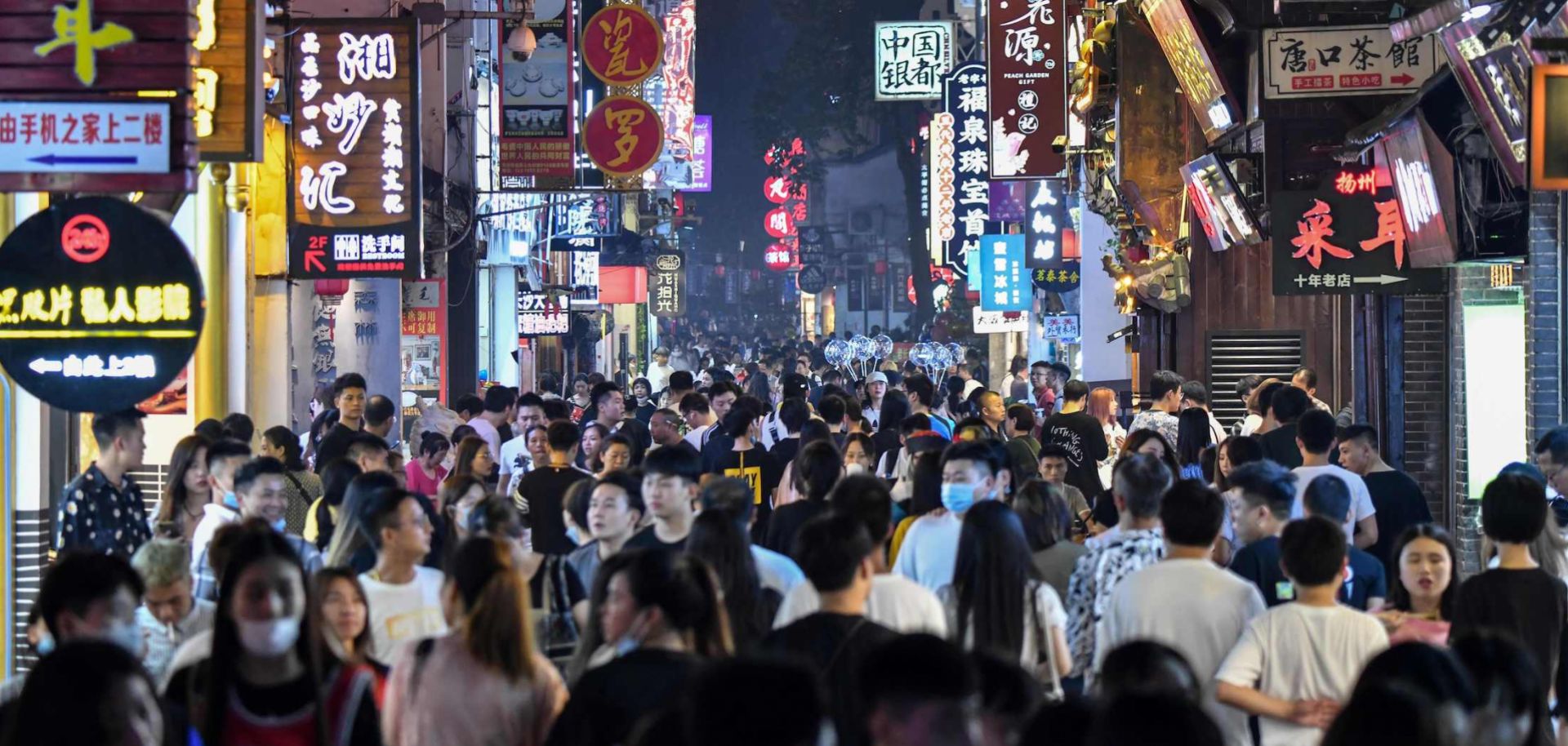
People walk along a pedestrian street surrounded by small shops in Changsha, China, on Sept. 7, 2020.
Editor’s note: This column is part of an ongoing series that explores China's demographic challenges. In parts one, two and three, we examined China’s retirement, pension and financial systems, as optimizing those systems will likely prove critical to the country’s ability to navigate its middle-income transition and overcome its demographic decline. But another critical facet is labor, which is the focus of the fourth part of this series.
China’s shrinking and aging population amid its middle-income transition represents an acute problem in its labor force, which is rapidly changing alongside the country’s demographic makeup. Recent college graduates are finding fewer opportunities suited to their education, and the country’s workforce broadly lacks the skills to make the jump to value-added manufacturing. To emerge as a high-income economy while dealing with a demographic decline, China will need to optimally allocate labor by reducing youth unemployment, reskilling and upskilling its workforce, automating more jobs with robotics and AI, and allowing more fluid labor movement into lower-tier cities. But its success is far from assured.
China’s Changing Workforce
China’s ninth quinquennial National Workforce Survey, which was released in March, showed the workforce shrank from 746.5 million in 2021 to 733.5 million in 2022. Further drops are inevitable as the Chinese population shrinks. The average worker is also now 38.3 years old, up from 37.1 in 2017. The global average is 38.9, but China’s figure puts it well above other developing economies like Vietnam and Mexico, where the average worker is 31.9 and 29.3 years old, respectively. This is most immediately impacting the country’s labor-intensive manufacturing sector. According to the survey, younger generations of workers are forgoing manufacturing work for higher-paid and less labor-intensive service sector jobs, such as food delivery. This has led to a growing demand to upskill existing manufacturing workers as China can no longer rely on new generations to fill conventional roles.
Though a common phenomenon for an economy transitioning from middle- to high-income status, China’s need for labor-intensive manufacturing remains germane during the intervening period. The country’s demographic challenge makes this reality all the more acute. From a manufacturing perspective, this means China’s long-term strategy to realize its middle-income transition with a shrinking and aging workforce will largely depend on transitioning to producing value-added products as opposed to its decades-long reliance on volume. But for individual businesses and factories, running out of labor in the conventional manufacturing sector implies a need for significant capital investment because they can only move up the value chain after securing financing and properly skilled labor.
Despite the demand for workers in the low-value-added manufacturing sector, unemployment (which stood at 5.6% as of March) has proven a consistent problem in recent years — particularly among younger Chinese citizens, with nearly a fifth of people between the ages of 16 and 24 currently out of work. China’s youth unemployment has steadily increased since January 2018, at which time the rate stood at 11%. In July 2022, youth unemployment hit an all-time record of 19.9%. That figure has remained elevated, reaching 19.6% in March 2023. This trend, however, isn’t due to a lack of jobs, but rather a lack of jobs that young Chinese citizens want (and are educated for).
A Labor Mismatch
It will likely be several decades before China’s population crunch results in a labor shortage. The primary challenge the country will instead face in the coming years is a mismatch between the skills employers need and the skills Chinese workers have.
As the economy transitions, demand among households for higher education increases (as higher education represents the conventional means of upward social mobility and serves as a status symbol). But as evidenced by the country’s high youth unemployment, investing in higher education no longer ensures a worthwhile return. Of the over 10 million college graduates that China turns out each year, many are realizing there is little market demand suited to their education upon entering the workforce.
Consequently, nearly a quarter of college graduates undertake employment that has little or no relation to their degrees. While a common phenomenon in developed countries, this is a larger concern for China, as efficient labor allocation will play a deterministic role in terms of whether it successfully transitions to a developed economy. China’s youth cohort aged 10-19 makes up approximately 11.7% of the population, suggesting even more young labor entering the market, even as steps are being taken to keep older cohorts in the labor market, such as raising the retirement age. Moreover, a record 11.58 million college graduates are estimated to join the labor pool in 2023.
China’s labor mismatch is glaringly apparent in the manufacturing sector, which young graduates increasingly eschew. China’s Ministry of Education estimates there will be a shortage of 30 million manufacturing workers by 2025, despite the country’s high youth unemployment. Automation and robotization may help replace factory laborers, but bringing down unemployment for China’s educated youth would require a more advanced labor market in the form of high-tech manufacturing and high-end services jobs. This means there will still be the issue of properly allocating the labor of an increasingly educated population that, as of now, largely lack the skills required for those advanced services and tech jobs, such as familiarity with artificial intelligence (AI) and big data. Though automation will reduce the number of workers needed, manufacturers will still need human labor sufficiently skilled in operating advanced machinery.
Additionally, to forestall social unrest, China keeps unproductive portions of industry operating to buoy employment, mainly through state-owned enterprises (SOEs). As the economy shifts more from industry to services (with the latter overtaking the former in GDP share in 2020), productivity growth will likely occur but slowly. Digitized service jobs, however, remain disproportionately low-skilled, as exemplified by Asia Fact Lab research that demonstrated over 70,000 master's degree holders were employed as food delivery drivers for digital services as of 2019, a number that is likely larger now.
China isn’t the only one in the region facing these labor challenges. Nearby Japan, South Korea and Taiwan similarly have overeducated youth cohorts facing job mismatches. But China’s problems in this respect are unique in both their scale and the fact that they coincide with a comprehensive economic transition. China’s population, while shrinking, is still the second largest in the world, meaning it will have to account for potentially hundreds of millions of dissatisfied educated young workers — all while the country attempts to make the jump from a developing to an advanced economy. Unlike its aforementioned regional peers, China’s state is also responsible for allocating labor, meaning failure to optimally fix job mismatches would risk fueling anti-government sentiment and social unrest. To avoid such political risks and the kind of protests seen in June 1989 and November 2022, Beijing will try to keep its youth cohort gainfully employed as it grapples to mitigate the fallout from the country’s demographic decline. But doing so sustainably will require augmenting workers’ skill sets to suit a changing economic model.
Retraining and Reskilling Workers
To successfully emerge from its middle-income transition, China will focus on innovation and digitization (with particular attention paid to underdeveloped locales). In the 1980s, China began to rely on rapid urbanization and low labor costs to propel its economy. But in the absence of the whirlwind growth seen in the 1990s and 2000s, these conventional economic drivers have diminished in recent years. To sustain consistent per capita GDP growth, China’s economy will instead need to be driven by domestic consumption and high-end services, which will require retooling and upskilling the country’s workforce on a massive scale.
This is spelled out clearly in China’s 14th Five-Year Plan (2021-2025), which heavily stresses the need to digitize the Chinese economy and upskill its workforce accordingly. The government’s Made in China 2025 initiative also focuses on developing the clean energy, information technology and robotics industries. Fundamentally, China's labor market does not need bachelor's or master's degree holders — particularly in the social sciences, economics and finance — in the numbers they exist, as there is far more demand for the mechanically inclined and computer savvy. Workers currently receive most of their training from formal education with little in the way of subsequent skills training, particularly in the high-tech sector.
But despite this apparent need for vocational training, China is facing significant workforce training problems due to low employer investment in such programs. Employers are hesitant to offer such training given the high turnover rate among young mismatched workers, creating a barrier to successful training initiatives. To address this problem and help transform the country’s labor force, the Chinese government could support employers with policies that incentivize training programs.
Chinese college graduates are also entering the workforce without the higher cognitive, interpersonal, leadership and technical skills needed for today’s better-paying, in-demand jobs. This is because China’s education system, including vocational training, instead relies heavily on rote memorization and traditional textbook learning. There is also a cultural element to China’s mismatched labor market, as vocationally skilled workers are in high demand, but such work is typically regarded as lower class and not suited to those who invest in higher education.
The gap between the skills Chinese employers are in need of and the skills Chinese students are being taught has implications for the sustainability of Chinese companies’ business models. 80% of Chinese C-suite executives surveyed by IBM in 2018 believed that their current business models were not sustainable for the future. In 2023, this skills gap has still not been closed.
To drive its economy forward, China must revolutionize its education system to produce sufficient high-skilled graduates with the right mix of technical and soft skills. But doing so will prove no easy feat, with estimates placing the number of needed upskilled workers at 220 million (or 30% of China’s labor force) by 2030. Upskilling lower-tier city workers also does not solve the problem of wealthier first-tier city graduates’ mismatched job prospects.
More Automation and Robotics
Upskilling the labor pool, however, is only half of the equation in resolving China's labor mismatch, with the other half being automation.
In 2022, China’s Ministry of Industry and Trade released its own five-year plan detailing the country’s ambition to become a global leader in robotics. China currently ranks ninth globally in terms of robot density, with 246 units per 10,000 employees. This is a considerable jump up from 49 units per 10,000 employees recorded in 2017, indicating a rapid adjustment toward developing robotic capabilities. With a shrinking population and workforce, successful utilization of robotics and automation could increase aggregate output, despite smaller labor input. This applies not only to China’s traditional manufacturing core but also potentially to white-collar workers through the use of chatbots and other AI technologies.
China has already integrated robotics into several facets of work and daily life, from food delivery to cleaning services. The country moreover has supply chain advantages needed to remain a leader in this area, with China already making up sizable portions of the global market share for AI technology, batteries, sensors and servo motors. Consequently, China will likely double and triple down on its automation, robotization and AI capabilities in order to account for the understaffed manufacturing sector, mismatched graduates that eschew traditional manufacturing and vocational work, and impending labor shortage brought on by a rapidly aging and shrinking population.
Yet automation also has potentially severe implications for China’s hundreds of millions of low-skilled migrant workers. According to a 2021 McKinsey report, 22-40% of migrant workers’ jobs are susceptible to automation, and China’s rigid internal migration system further complicates their future outlook.
Increasing Worker Mobility
Internal migration from China’s countryside to the cities continues. This has labor implications inherent to the country’s household registration, or hukou, system. Adopted in 1958, the hukou system divides Chinese citizens broadly into rural and urban categories and ties citizens to a specific place of origin, creating a further divide between first-tier cities and China’s other urban centers. It was originally designed to limit migration from rural to urban areas to preempt losses to agricultural output. But today, China is seeking to ramp up urbanization to combat the economic impacts of a shrinking population. About 60% of China’s population currently lives in cities. According to its 14th Five-Year Plan, the government is seeking to increase that urbanization rate to 75-80% by 2035, but only for lower-tier cities as China hopes to develop these areas and the country’s interior.
Today, the hukou system seeks to achieve three purposes: manage internal migration, provide social protection and ensure social stability. In practice, however, the system leads to different treatment by authorities depending on a Chinese citizen’s local origin. In 2022, there were around 293 million migrant workers (who relocated from rural to urban areas and sent remittances back home) in China. Most seek employment, and the total population of urban dwellers increased to an estimated 920 million people, or 65%, of the population (though this is not reflective of natural migration patterns but rather Beijing’s intentional relocation policies). Today, migrant workers — or workers living in a given locality but holding a hukou of another — constitute around a third of China’s workforce.
But despite consistent mass internal migration, China’s hukou system still heavily constricts workers’ mobility, as the system is designed to keep people working in the places where they were born. Those wishing to stay in a locality other than that tied to their hukou status, for example, must first secure a temporary residence permit, and changing one’s hukou designation can be quite difficult.
For migrant workers, this has stark implications, as those who reside in a locality that does not match their hukou designation cannot receive health insurance or welfare benefits, nor can they access public education for their children and other public services. At least 250 million migrant workers lack such benefits, as well as worker and legal protections, and are thus rendered a floating remittance population vulnerable to mistreatment and an arbitrary cap on personal and professional development.
To support its labor ambitions, China may look to reform the hukou system, as it did several times between 1984 and 2014. In line with China’s urbanization goals, the latest round of hukou reforms in 2014 made it easier for migrants to move to fourth-tier cities, though less so for higher-tier locales (like Beijing and Shanghai). But businesses and local governments in urban areas remain largely opposed to scrapping or drastically modifying the hukou system. This is because should migrant workers be granted legal status in the cities they reside in, the local government will have to pay out the social services that Chinese citizens are entitled to, which would quickly overburden their budgets. Businesses would likewise be required to start paying into the pension system for these formerly undocumented workers, eating into their bottom lines. Amid this pushback, the Chinese government thus remains unlikely to overhaul or outright abandon the hukou system.
While China hopes to avoid migrant workers streaming into first-tier cities, its development plans depend on this occurring in underdeveloped lower-tier cities. But third- and fourth-tier cities often lack sufficient industrial chains and may, in turn, lack the job opportunities needed to attract labor flows. This will be further constrained by migrant labor ossification patterns, in which migrant workers tend to follow the beaten path to the larger cities established by earlier generations, even if labor demand is no longer suited for it. China thus has an oversupply of migrant workers in some cities and not enough in others. This migrant worker floating population, more than any other demographic, will have the most difficulty acquiring new skills because the hukou system makes it implausible to establish roots and thus a years-long commitment to a single employer who may offer training.
Limiting the movement of factory labor keeps down the costs for factories because undocumented migrant workers do not require corresponding payments into China’s social safety net systems. But amid China’s simultaneous middle-income transition and shrinking workforce, this configuration is no longer advantageous. Restricted labor movement constrains the growth of China’s consumer base, a key component to the services economy China wants to cultivate because migrant workers are saddled with additional costs.
Minimizing (though not eliminating) restrictions on labor mobility is in Beijing’s plans with respect to augmenting the well-entrenched system, but the depth of reform will be constrained by objections from interest groups, such as local governments and businesses. Nevertheless, in the interest of optimally allocating labor for a transitioning economy and shrinking population, hukou reform with an eye toward directing migrants toward China’s locales with the most need for economic development is one policy area that Beijing will likely focus on to mitigate the disappearance of its demographic dividend — even if this reform is not radically transformative.
The hukou system ties in intimately with China’s urban-rural divide, and the constraints inherent to the country’s geography. In the next installment of this series, we’ll explore how those geographic constraints will also impede China’s ability to overcome its middle-income transition amid a shrinking workforce and population decline.
