
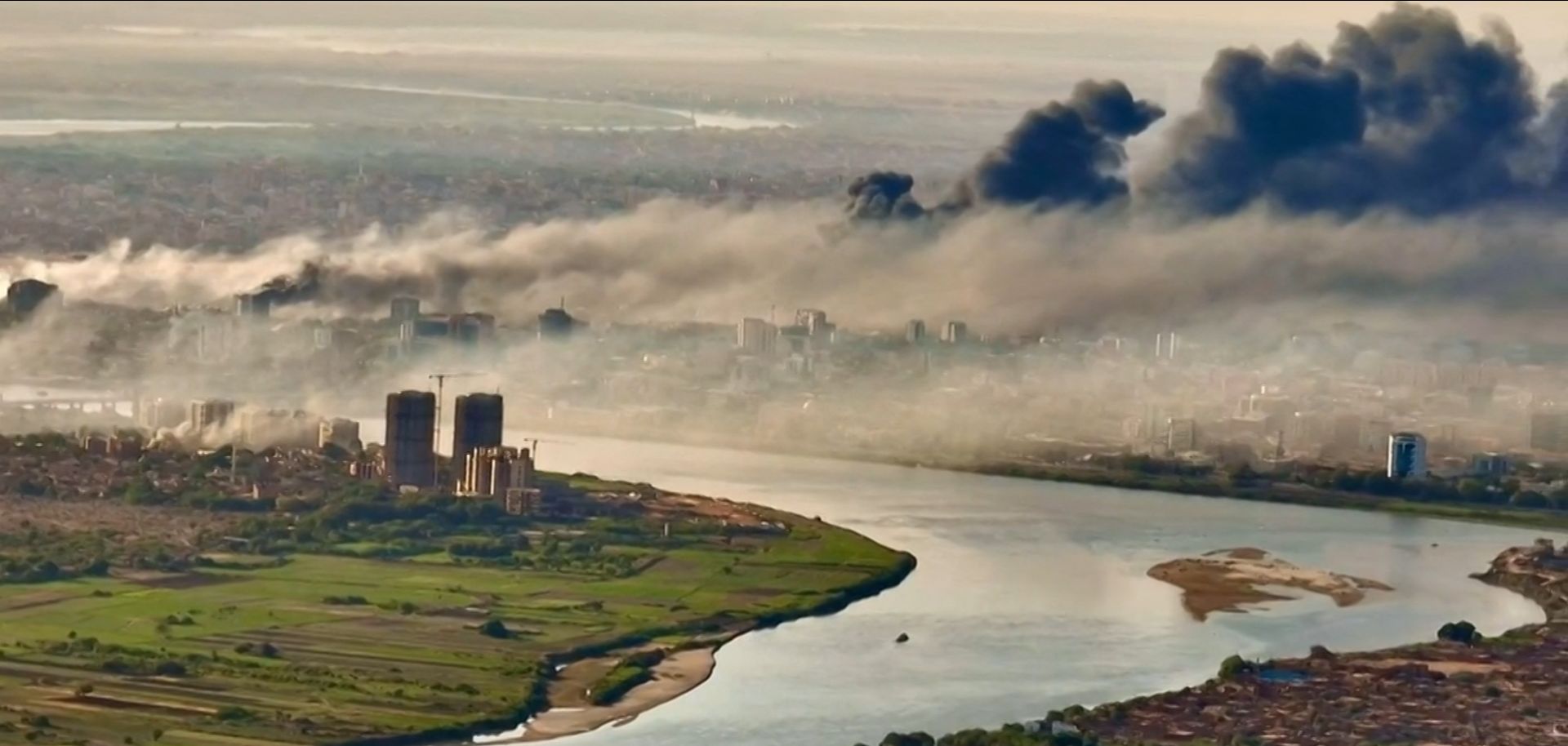
Black smoke covers the sky above Khartoum, Sudan, on April 19, 2023, amid ongoing clashes between rival armed forces in the capital city.
Intense combat in Sudan's major cities will likely persist, although temporary pauses in fighting over the coming days could allow for the evacuation of foreign nationals. As Sudan enters day seven of clashes between the Sudanese Armed Forces (SAF) and the paramilitary Rapid Support Forces (RSF), the situation in Khartoum, Omdurman and other cities across the country remains fluid and rapidly evolving. As of April 21, the fighting has so far killed over 400 people and injured 3,551. While some reports indicate that the SAF has taken back control of the airports in the capital of Khartoum and the northern town of Merowe, artillery fire and airstrikes persist and continue to obscure a clear picture of what's happening on the ground and which side has the upper hand. While there are no indications that the government or the RSF are intentionally disrupting the internet or telecommunications, the degradation of these services due to bombing and infrastructure damage is further limiting the flow of information. This has left foreign governments and humanitarian organizations to prepare for several potential scenarios in the coming days and weeks, even as most foreign nationals and humanitarian workers remain hunkered down in the capital with quickly dwindling food, water and medical supplies. The most likely scenario appears to be a continuation of intense urban warfare, though mounting pressure from the United States, Saudi Arabia and others may result in a brief pause for evacuation.
- Fighting broke out between the SAF and RSF on April 14 in Khartoum following a breakdown in negotiations to integrate the latter into Sudan's broader state security structure.
- The SAF is led by the president of Sudan's ruling Transitional Military Council, Abdel Fattah Burhan, who has served as the country's de facto ruler since the 2019 revolution. The RSF is headed by the deputy chairman of the Transitional Military Council, Mohamed Hamdan Dagalo.
- U.N. Secretary-General Antonio Guterres called for a three-day humanitarian cease-fire over the Islamic holiday of Eid al-Fitr, which begins on April 21, to allow foreign nationals to evacuate the country and Sudanese citizens to receive medical treatment and supplies. But three prior attempts at cease-fires have fallen through since the clashes began a week ago.
What to Watch for
In the coming days and weeks, the fighting in Sudan could evolve in at least four different ways.
Scenario #1 (Most Likely): The SAF and/or RSF agree to periodic cease-fires, but intermittent fighting persists in urban centers.
At this point, a permanent or indefinite cease-fire is improbable, but international pressure to allow for evacuations could prompt either or both of the warring sides to briefly pause fighting. In addition to the United Nations, Arab states like Egypt, Saudi Arabia and the United Arab Emirates are also reportedly pressuring the SAF and RSF to at least temporarily stop fighting. Dissent and factionalism within Sudan's military are key constraints on even temporary truces to provide people in battle zones with humanitarian supplies and medical attention, with hard-liners in the SAF (including Burhan himself) advocating for a complete victory over the RSF. But RSF leader Dagalo has agreed to the U.N. secretary's proposed cease-fire over Eid al-Fitr, and additional pressure to allow for evacuations — likely in Khartoum — may prompt Burhan to agree to a temporary cessation of hostilities during the religious holiday as well. However, given the numerous factions involved in the fighting and the RSF's apparent willingness to attack foreign contingents, the risk to humanitarian workers en route to evacuation sites would remain high — especially in peripheral areas like Darfur. Miscalculations, poor information and desire to gain the upper hand when fighting resumes would also risk disrupting evacuation periods before their official end.
- On April 19, Reuters reported that the military and RSF had agreed to a U.S.-brokered 24-hour cease-fire to allow residents trapped by the fighting to receive supplies and medical attention, and for the evacuation of foreign citizens. However, fighting only briefly paused, and Bloomberg reported in regard to an earlier attempt at a cease-fire that while the RSF had agreed to halt fighting, disagreement within the ranks of the SAF prevented it from taking hold. The SAF then released a statement emphasizing its resolve to continue fighting, claiming it was ''not aware of any coordination with mediators and the international community about a truce,'' and that the RSF had only declared a 24-hour cease-fire in an effort to ''cover up the crushing defeat'' it would soon receive.
- In recent days, fighters in Khartoum attacked a U.S. Embassy convoy and raided the residence of an EU official. The warring parties' apparent willingness to attack diplomatic targets — combined with the closure of the Khartoum airport and ongoing airstrikes — has prompted aid organizations and foreign governments to advise their personnel and citizens to take shelter until a lull in fighting enables the formulation of evacuation plans.
- The United States has deployed additional troops to its base in the nearby country of Djibouti, in case greater military power is needed to evacuate U.S. citizens still in Sudan. Hundreds of U.S. marines are already stationed at Camp Lemonnier in Djibouti, including one aviation combat element called Crisis Response Africa. Spain, Japan, Korea and other foreign countries have taken similar actions in preparation for rescue operations.
Scenario #2 (Likely): Intense urban fighting continues with no cease-fires.
The SAF and RSF are relatively evenly matched in terms of personnel and equipment, especially given reports that the Sudanese military has been weakened by factionalism. This, on top of both sides' apparent strong resolve to ''fight to the death'' — with Burhan saying on April 20 that the only way the conflict will end is with complete victory — suggest that intense fighting in urban areas could persist for weeks, without any breaks or cease-fires. Local reporting indicates that RSF contingents are attempting to use civilian populations for cover, which has seen the military carry out airstrikes on hospitals and civilian residential areas in Khartoum, Omdurman, Merowe and other cities. Without the implementation of even temporary cease-fires, constant heavy fighting and continued SAF attacks on civilian infrastructure would likely prevent humanitarian organizations and foreign governments from evacuating their personnel and citizens. In this scenario, foreign militaries may still try to extricate their citizens, but doing so amid continued airstrikes would carry an extremely high risk of casualties. Most foreign partners will likely keep calling for a peaceful resolution to the conflict in the short term, as an all-out war in Sudan is incompatible with their political and commercial interests. But as the fighting continues, there is a risk that countries like Egypt, Saudi Arabia and the United Arab Emirates may start to back their preferred actor with money, weapons and other forms of military support as they become more concerned over long-term power and influence in Sudan. Such external involvement would further increase the probability of the conflict persisting. Indeed, the RSF is reportedly already receiving support from Russian mercenaries, which will likely extend the duration of fighting in Khartoum.
- The Wall Street Journal reported on April 20 that Russia's paramilitary Wagner Group offered to supply arms to the RSF. The next day, CNN then reported that Wagner's surface-to-air missiles have significantly buttressed the RSF's capabilities.
Scenario #3 (Somewhat Likely): The SAF or the RSF gain control of Khartoum, forcing their opponent to carry out attacks from peripheral areas.
In this scenario, one side defeats the other and the losing side takes refuge in more peripheral, rural areas of the country. Between the two sides, the SAF appears more likely to win control of the capital than the RSF in the coming days due to a marginally larger number of forces and materiel, superior airpower and the potential backing of Egypt. But allegations of Russian support for the RSF may degrade this advantage. If either side were to take sustained control of Khartoum, Omdurman, Port Sudan and/or other key cities, the losing side would likely continue to conduct intermittent strikes on security, government and civilian targets. While the security situation in Sudan would remain critical, the lower intensity of urban fighting would also enable humanitarian and diplomatic evacuations to go forward, likely out of the Khartoum international airport. Evacuations from rural areas, however, would likely remain extremely dangerous — especially from Darfur, given the region's historical connection to the RSF (the paramilitary group emerged out of the Arab janjaweed, one of the key forces in the 2003 Darfur war) and recent spikes in tribal clashes and army and RSF recruitment over the past weeks. Compared with the previous two, this scenario is relatively less likely to unfold over the next week. But one side (likely the SAF) will likely eventually claim victory over Khartoum, making this a probable medium-term scenario.
Scenario #4 (Unlikely): The SAF and RSF agree to a permanent cease-fire, but the risk of future violence persists.
There is a chance, albeit very slim, that international (especially Arab) pressure gives way to an indefinite cease-fire between the warring Sudanese forces in the coming days or weeks. In this unlikely scenario, splintering within the rival organizations and unwillingness among some contingents to accept such a deal would likely still prompt continued — if intermittent — violence. But a permanent cease-fire would nonetheless allow for the resumption of humanitarian assistance and evacuation of personnel. Humanitarian groups would also have more options for evacuation routes, including domestic land crossing to the Khartoum international airport and maritime crossings from Port Sudan. An indefinite truce, however, remains a distant prospect. Both RSF and SAF appear to view the current outbreak of violence as their best opportunity to gain control of the government for the immediate future. And this — combined with the long-standing animosity between the two sides' leaders, and the fact that they're relatively evenly matched — means the SAF and RSF army are highly unlikely to reach a lasting peace deal in the coming weeks, even amid even sustained pressure from Sudan's most important regional partners (Egypt, Saudi Arabia and the United Arab Emirates).
