
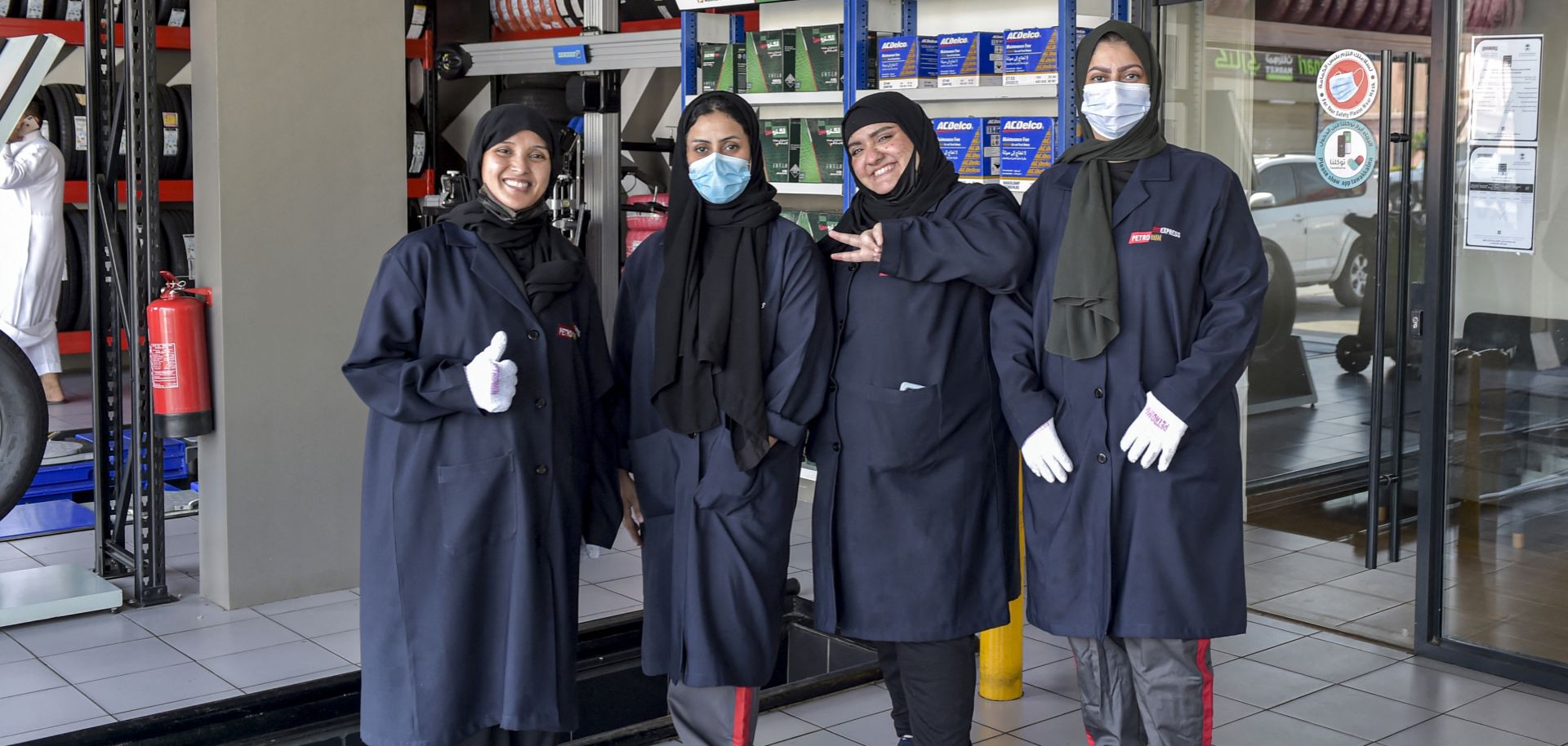
Women mechanics pose for a photo at a car repair and service shop in Jeddah, Saudi Arabia, on Dec. 27, 2021.
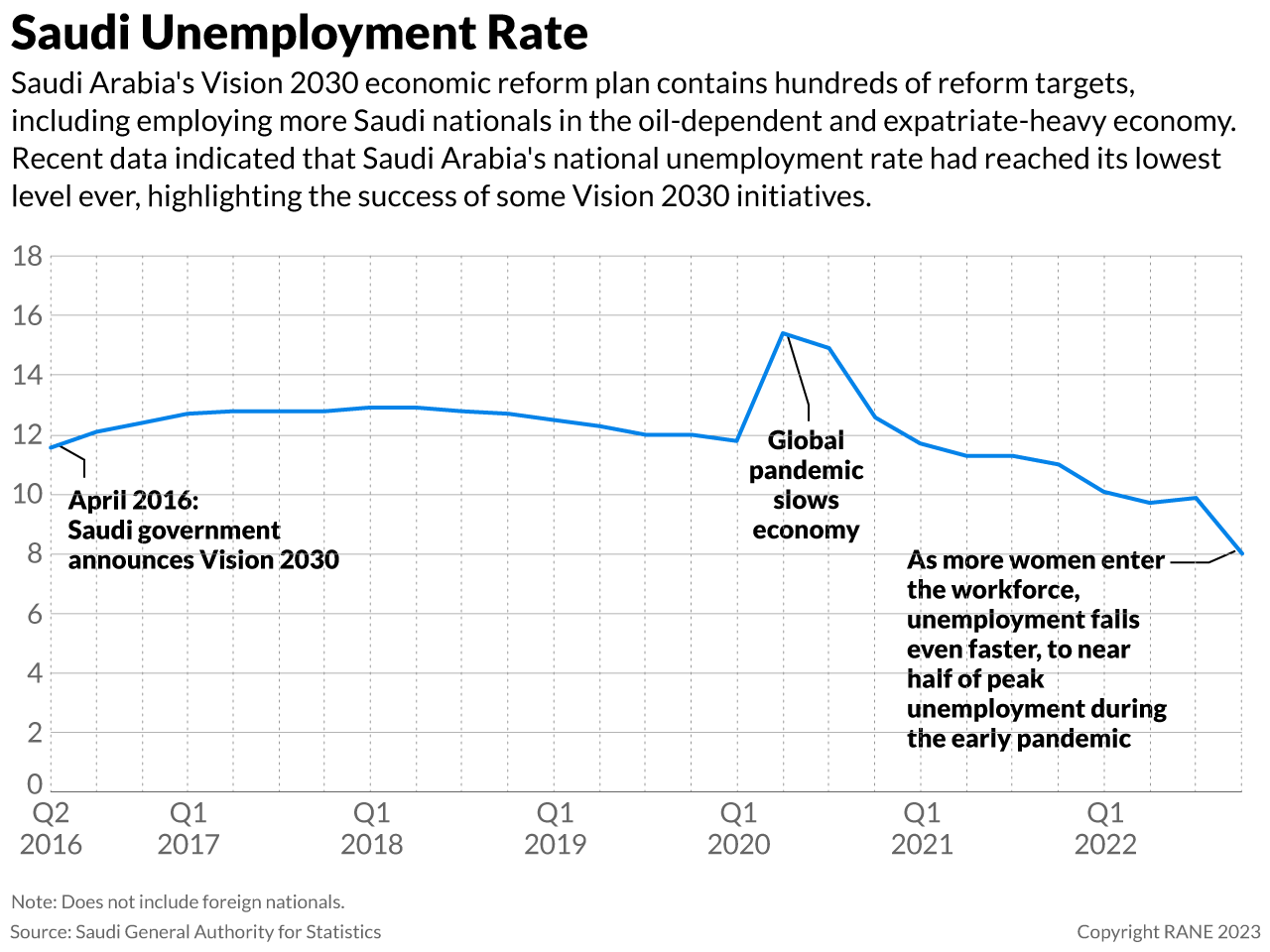
Although the social shifts within Saudi Arabia's Vision 2030 reform program have opened up the country's economy, the kingdom's repressive and centralized political environment is unlikely to change, presenting significant business and investment risks. On March 30, the Saudi government released data showing that unemployment in the kingdom fell to a historic low of 8% in the last quarter of 2022 — a mere percentage point away from the goal outlined in Riyadh's ambitious Vision 2030 diversification plan, which aims to hit 7% unemployment by the end of the decade. In an accompanying report, the government's statistics authority cited the inclusion of more women in the workforce — another key Vision 2030 goal — as the main driver of the country's recent uptick in employment. The unemployment data is the latest in several recent announcements highlighting the Saudi economy's remarkable progress toward meeting some of Riyadh's main reform goals, as well as the government's continued commitment to implementing its ambitious Vision 2030 economic diversification program.
- Saudi Crown Prince Mohammed bin Salman (commonly known as MbS) introduced Vision 2030 in 2016 as a strategic framework to diversify the kingdom's economy away from oil. One of the main economic reform goals included in the program was ensuring all Saudis (including women) are employed and participating in the kingdom's workforce.
- In recent months, the Saudi government has announced its first budget surplus in a decade, estimates that the kingdom is on track to achieve U.N. sustainable development goals by 2030, and a handful of new public-private partnerships. In March, Riyadh also announced the launch of a new airline intended to serve the increase in travelers the kingdom expects to see in the coming years as a result of the government's Vision 2030-related efforts to turn Saudi Arabia into a top tourism destination and global business hub.
The kingdom's pursuit of social reforms as part of its Vision 2030 plan has helped make Saudi Arabia more appealing to tourists, businesses and investors from around the world. The main purpose of Vision 2030 is to reduce the Saudi economy's reliance on oil and gas exports as the world increasingly transitions to clean energy sources. But as part of this diversification push, the government has also introduced many social reforms aimed at making the kingdom an overall better place to live, visit and do business as a way to bring in more revenue. In recent years, for example, Riyadh has sought to make it easier for foreign investors to enter the Saudi market, and for foreign workers and businesspeople to live in the kingdom, by easing the country's tax and visa regulations. Eased social restrictions — combined with the building of movie theaters, performing art centers, amusement parks and museums — have opened up new opportunities for entertainment, hospitality and tourism businesses. For Saudi women in particular, legal changes allowing them to drive and work have made them viable customers for new products and services by granting them more mobility and financial independence. Combined, these efforts to promote a more open and inclusive economy have generated interest among foreigners who might have otherwise avoided investing in or traveling to Saudi Arabia — a country that for decades had been viewed as hostile to outsiders.
- The Saudi crown prince said he sought to build a ''vibrant society'' via vague social benchmarks when he first unveiled Vision 2030 in 2016. Since then, the Saudi government has made notable progress toward achieving those social reforms, which also indirectly benefit its economic diversification goal. The ability to drive, for example, has opened women up to new career opportunities by enabling them to independently commute to their jobs. Bringing more women into the labor force also has the added benefit of reducing the Saudi economy's reliance on expatriate workers — another Vision 2030 goal — because it means employing more Saudi nationals.
- Boosting religious tourism is another major goal of Vision 2030, with Riyadh aiming to attract some 30 million pilgrims for hajj by the end of that year. From a strategic standpoint, attracting more religious tourists also helps Saudi Arabia cultivate its soft power by defending the kingdom's Islamic leadership to both Saudis at home and to non-Saudi Muslims abroad.
- Vision 2030 also includes massive infrastructure projects like NEOM, the $500 billion megacity being built in Saudi Arabia's northwest. Once it opens (likely sometime in 2024), the coastal Red Sea city will observe liberal social mores and practices within its boundaries to help entice foreign businesses and visitors.
- In 2016, the Saudi government announced new health benchmarks aimed at decreasing bureaucratic red tape and waiting times to see a medical specialist, among other goals. Greater access to healthcare could see Saudi citizens live better — and eventually longer — lives, which is important for economic growth.
But the Saudi government under MbS has paired this social reform push with increased efforts to centralize power and suppress political dissent. The Saudi monarchy has long viewed free political expression as a direct threat to its hold on power and the kingdom's overall stability. This has seen the kingdom maintain tight control over media outlets and socially permissible political dialogue to limit any potential popular pushback over controversial changes to the Saudi economic and social code. Since being appointed deputy crown prince in 2015 (and especially since his promotion to crown prince in 2017), MbS has doubled down on this authoritarian power structure to execute the reforms outlined in his heralded Vision 2030 program, without having to first assess broader popular and elite opinions. Maintaining control over society is particularly important to squelch any backlash against Vision 2030's more unpopular initiatives, like new taxes that would erode Saudis' purchasing power and new infrastructure projects (like NEOM) that are displacing local tribes. Under MbS, Riyadh's efforts to centralize power and crack down on dissent have also helped appease the kingdom's conservative leaders, who fear that the rapid pace of social reforms could prove more destabilizing than beneficial.
- In recent years, Human Rights Watch, Amnesty International and similar organizations have reported an increase in the number of Saudis imprisoned for tweets critical of the government. Since MbS was appointed deputy crown prince in 2015, there has also been an increase in politically-linked executions in Saudi Arabia.
- To build its NEOM megacity, the Saudi government has reclaimed territory from local tribes in the country's northwest, prompting threats from those tribes.
Despite recent social reforms, the kingdom's iron-fisted rule will continue to pose an array of reputational and business continuity risks for foreign firms seeking to expand or launch new ventures in the country. While social changes have made Saudi Arabia's new economy more appealing to foreign investors, the country's authoritarian political system still makes the economy difficult to navigate, especially in terms of reputational risks involving human rights concerns and regulatory threats to business continuity. Saudi Arabia's authoritarian political system creates uncertainty about the country's future regulatory environment, which threatens business continuity as policies can quickly shift. The kingdom's strict restrictions on political criticism are also unlikely to ease anytime soon. This is a more potent risk for Saudis, who face prison time for expressing even mild disapproval of the royal family). But foreign companies still risk losing out on business opportunities and government contracts if any of their employees are caught expressing critical views of the monarchy. Despite the government's Vision 2030 efforts to liberalize Saudi society elsewhere, many of the kingdom's controversial domestic policies and social norms remain largely unchanged as well (like widely practiced racial discrimination and a lack of concern for migrant workers' rights), which creates more reputational risks for foreign companies working with Saudi firms. In addition, judicial reforms linked to Vision 2030 have been slow to change Saudi Arabia's harsh treatment of accused criminals in courts and in prison, and the kingdom's strict penal code means human rights violations according to Western norms remain routine. Without greater changes to the country's political and social environment, Saudi Arabia will thus likely struggle to attract the levels of foreign business and investment needed to fully diversify its economy away from oil. Indeed, many of Vision 2030's massive infrastructure projects — including the landmark Jeddah Tower — have stalled over the years due to a lack of financing or follow-through.
Saudi Arabia's social changes are also relatively restrained compared with those being implemented by its regional peers, which will harm the kingdom's competitive edge in attracting foreign businesses and workers. Saudi Arabia's fellow oil-dependent, Arab Gulf neighbors are all embracing economic diversification plans similar to Vision 2030 — placing them in direct competition with one another in securing the foreign workers, businesses, investors and tourists needed to see those plans through. Compared with Saudi Arabia, some of these countries (like the United Arab Emirates) have been much faster to modernize their economies and liberalize their societies, which will make it harder for Riyadh to attract expatriate workers who want to live in a place with Western social mores.
- In February 2021, the Saudi government announced it would limit new government contracts to foreign companies that do not have regional headquarters in Saudi Arabia established by the beginning of 2024. Since most regional headquarters for big multinational firms are currently located in the United Arab Emirates, the policy was widely seen as an attempt to bolster Riyadh's competitive edge for foreign talent over its Arab Gulf neighbor.
