
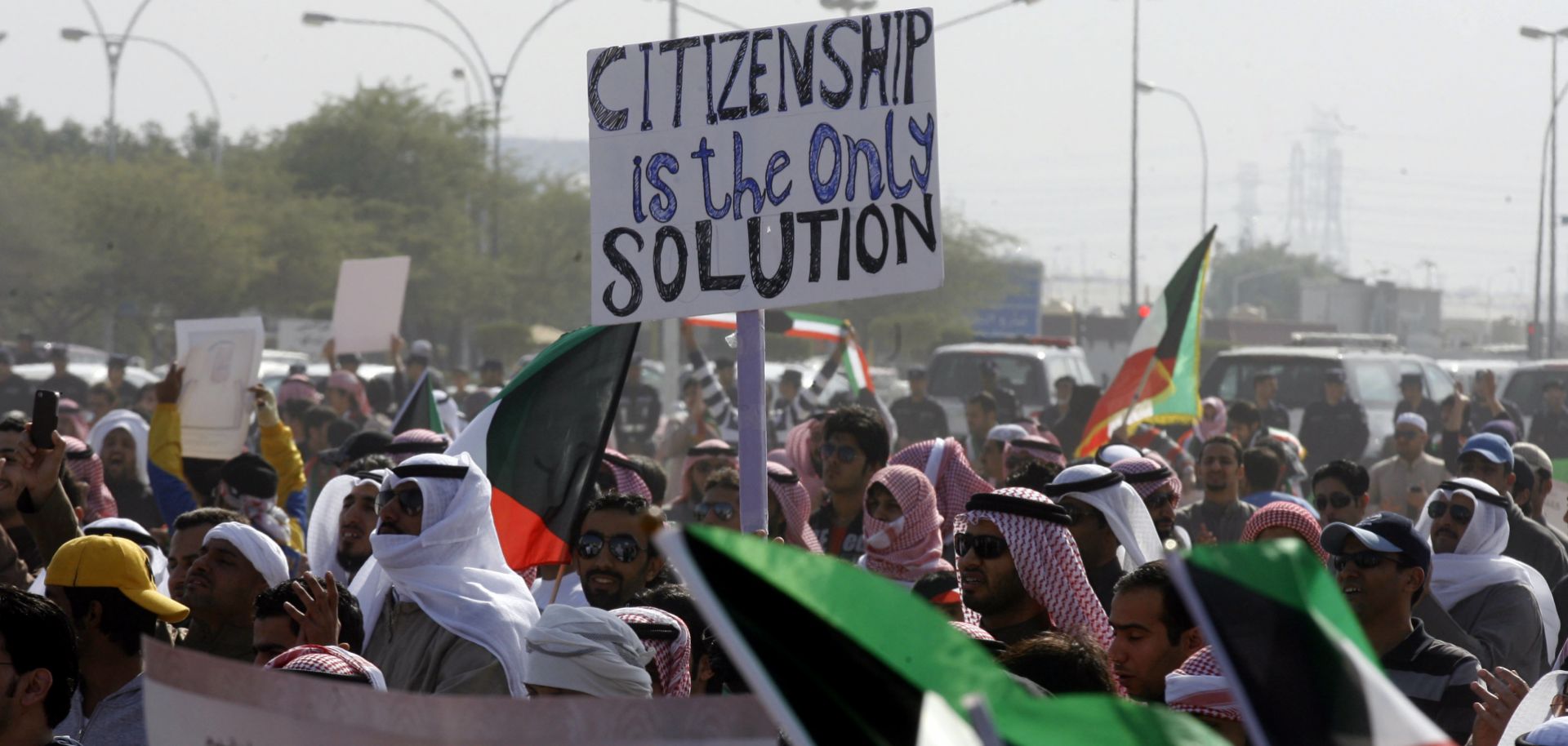
Members of Kuwait’s stateless Bidoon community protest to demand citizenship and other rights in Jahra, northwest of Kuwait City, in December 2011.
As part of their efforts to open up citizenship, Qatar and the United Arab Emirates will increasingly naturalize their stateless “Bidoon” residents — creating a region-wide precedent that will pose greater political and reputational risks for nearby Saudi Arabia and Kuwait, which will be slower to naturalize their much larger Bidoon populations. For generations, the countries of the Gulf Cooperation Council (GCC) have hosted large numbers of Bidoon (meaning “without” in Arabic) residents who failed to get citizenship as the region formed states in the 20th century. But now some countries are starting to rectify this situation. During an Oct. 26 speech, Qatar's Emir Sheikh Tamim bin Hamad Al Thani said that the country would soon amend its citizenship laws to include stateless residents like members of the Al Murrah tribe. Qatar’s government was responding to criticism, both at home and abroad, that it had excluded residents with legitimate claims to citizenship from voting in the country’s October legislative election. Doha’s treatment of its Bidoon community also gained international attention in the months ahead of the election, after Doha refused to provide members of the Al Murrah tribe with Qatari passports despite decades of residency and deep historical ties to the country.
- The Arab Gulf’s Bidoon population are mostly descendants of desert nomads who failed to register as citizens when countries began gaining independence — often because they were used to crossing the more informal borders that existed before the United Kingdom withdrew from the region in 1971.
- 170,000-350,000 Bidoons are estimated to be living across the Arab Gulf. Most are located in Kuwait and Saudi Arabia, though Bahrain, the United Arab Emirates and Qatar also have notable Bidoon populations. Exact numbers, however, are unknown since most Arab Gulf governments lump these stateless residents into their foreign-born population when conducting demographic surveys.
- Arab Gulf countries have refused to grant these populations citizenship over the decades in order to maintain tribal or sectarian balances within their borders. Host governments have also long questioned the national loyalties of the Bidoons living within their borders. During the Qatar blockade from 2017-21, for example, the Al Murrah tribe was seen as a potential avenue for Saudi influence in Qatar since the tribe had roots in both countries.
As part of their economic modernization strategies, Arab Gulf countries are loosening visa and citizenship requirements to attract talented and wealthy residents, which could make it easier for Bidoons to apply for citizenship. The United Arab Emirates, Qatar and Saudi Arabia are adjusting their visa and citizenship requirements to enable residents to stay longer, if not permanently. These changes are undermining the political precedence that previously denied Bidoon citizenship: whereas before citizenship and residency were carefully guarded, now they are becoming more accessible to even non-Muslim and non-Arabs. This political and social change could help enable stateless Bidoons to gain acceptance as GCC citizens, especially since they have similar cultural and religious roots as native citizens. Bidoons will also serve as an attractive demographic bulwark for Arab Gulf governments against an infusion of non-Muslim and non-Arab residents and citizens.
- The United Arab Emirates, Saudi Arabia and Qatar now offer permanent so-called “Golden Visas” to residents who demonstrate their economic value to the country, either through investments, property purchases or, in the case of Saudi Arabia, paying a large fee.
- In February 2021, the United Arab Emirates became the first Arab Gulf country to allow non-Arab and non-Muslims to earn citizenship through special talents or high investment. Bidoon residents in the region may also be able to apply for citizenship through this path, especially if they qualify through education or wealth.
- On Nov. 11, Saudi Arabia’s King Salman approved a decree opening citizenship to individuals with “exceptional” talents in religion, medicine, science, culture, sports and technology. The decree did not mention religious or language tests, suggesting that non-Muslims and non-Arabs with such talents may also now be eligible for Saudi citizenship.
But Kuwait and, to a lesser extent, Saudi Arabia are moving slower to liberalize their visas, making it less likely their substantial Bidoon populations will be able to gain citizenship as quickly as those in Qatar or the United Arab Emirates. Despite its Golden Visa program and new citizenship decree for people with “exceptional” talents, Saudi Arabia has an incentive to avoid naturalizing Bidoon quickly, as the kingdom is still gauging public support for its rapid social and cultural changes. Ordinary Saudi citizens, who are being eased off the cradle-to-grave welfare system, might also object to a fresh infusion of new citizens with whom they’d have to compete for jobs and state services. Kuwait, meanwhile, has been even slower to liberalize its visa and citizenship rules, as its population has long wanted to lower the number of foreigners living in the country. For Kuwait, naturalizing its large Bidoon population — most of whom are reportedly Shiite Muslims — would carry even greater political risks for the country’s Sunni monarchy. As citizens, Bidoons would be able to vote for seats in Kuwait’s democratically-elected parliament, which could thus change the current balance of power between established parties. Many Kuwaiti Sunnis are worried this would undermine the country’s sectarian balance and potentially create inroads for Shiite-majority Iran to gain influence in the country.
As Qatar and the United Arab Emirates normalize naturalization of their stateless populations, Saudi Arabia and Kuwait will face more pressure, both at home and abroad, to follow suit — potentially affecting their human rights reputations and, in Kuwait’s case, encouraging the already-restive Bidoon populations to carry out protests, strikes and riots. Bidoons living in Saudi Arabia, encouraged by what’s happening in nearby Qatar and the United Arab Emirates, might press for similar changes to their citizenry status. But they would likely face pushback and even a crackdown by the Saudi state. A crackdown would reinforce Saudi Arabia’s already poor international reputation on human rights, potentially affecting investor sentiment surrounding the kingdom and harming its relations with some of its Western allies, like the United States. Compared with Saudi Arabia, Kuwait is more tolerant of public dissent, though its Bidoon population is also more politically active. With regional precedence to point to for naturalization, Kuwaiti Bidoons may attempt to use public pressure to break the political barriers to citizenship. While the Kuwaiti government is less likely to respond with to a widespread crackdown, such unrest among its Biddoon community would nevertheless harm Kuwait’s reputation as a place to do business and make it appear unstable, undermining its attractiveness as an investment location.
