
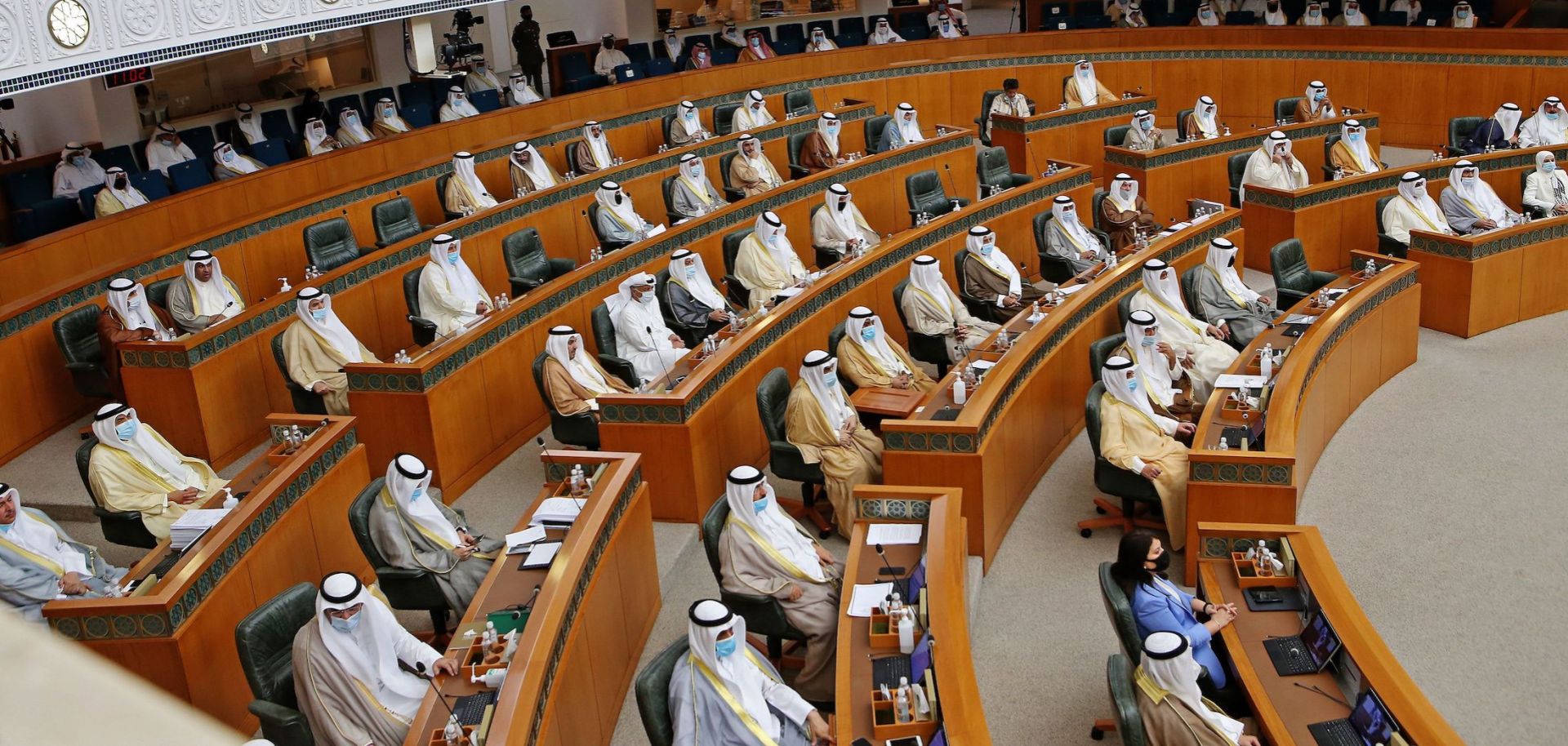
Kuwaiti legislators attend a parliamentary session at the National Assembly building in Kuwait City, Kuwait, on Oct. 20, 2020.
Upon taking office on Dec. 15, Kuwait’s new parliament will try to focus the government’s attention on politically sensitive anti-corruption efforts rather than the fiscal reforms its new emir wants to prioritize, setting the stage for near-term economic strain and long-term political inaction. Opposition members and independents gained control of nearly half of Kuwait’s National Assembly in Dec. 5 elections. In Kuwait’s political system, these lawmakers tend to support maintaining populist spending on benefits, subsidies and social program transfers. An opposition-leaning parliament with a fresh public mandate will thus be focused on maintaining that kind of spending, despite the desire of the emir, advisors and government ministers to implement some structural reforms that would improve Kuwait’s long-term financial security.
- Kuwait’s Dec. 5 parliamentary elections yielded a 60% turnover from the previous body and an increase by eight seats for opposition candidates. Given that the Kuwaiti National Assembly only has 50 total seats, the increase in opposition representation is substantial.
- Kuwait is among the wealthiest countries per capita in the world. But compared with other oil-rich states in the Arab Gulf, it also typically spends the most on subsidies, public salaries and related benefits.
Falling oil revenue has left the Kuwaiti government unable to pay salaries and other obligations without increasing revenue or taking out debt. Emir Sheikh Nawaf al-Ahmad al-Jaber al-Sabah, who took power in September following the death of his half-brother and longtime ruler Sheikh Sabah, is intent on solving this problem via a proposed law that would allow the government to take out more debt. But political infighting between current and incoming members of parliament, as well as between lawmakers, the emir and the rest of the Kuwaiti government, have delayed the passage of the long-awaited debt law in recent months. This reflects the unpopularity of the government increasing its foreign liabilities by taking out more debt, as well as concerns about transparency — a fight that will only continue under the new parliament.
- The first five months of the current fiscal year have seen a 55% decrease in government revenues, driven by low oil prices further exacerbated by COVID-19. This has forced the Kuwaiti government to consider taking out debt and slashing spending in order to balance its oil revenue-reliant budget.
- 70% of Kuwait’s budget is earmarked for allowances, subsidies, benefits and public sector salaries. Its growing budget deficit thus reflects the government’s potential inability to pay for these things without either an influx of revenue or debt to cover it.
- The proposed debt law would enable Kuwait to use foreign debt to patch up some of its anticipated budget deficit of $49 billion in 2020/2021.
- In the long term, the Kuwaiti government is also focused on the even trickier task of trimming expenses and implementing some structural reforms in order to prevent future financial crises.
A louder opposition voice at a time when the Kuwaiti government is trying to trim public spending and implement structural reforms also reflects both the public’s dissatisfaction with the country’s financial situation, as well as the existence of popular pushback against reform. Kuwait’s particularly vocal national assembly is a unique political body in the generally top-down and non-democratic power structures in the Arab Gulf that channels popular discussion on a wide range of issues, allowing for public pressure on economic and social issues to factor into government decision-making. Kuwaitis are experiencing a particular sense of uncertainty following the recent death of their country’s longtime emir, as they are unsure how his successor will change the extensive benefits system upon which they rely for economic and social stability.
Kuwait will struggle to enact timely fiscal reforms given the opposition’s laser-sharp focus on anti-corruption efforts that they deem necessary to resolve prior to taking on foreign debt or engaging in capital spending. More raucous debates, along with anti-corruption investigations and hearings demanded by government ministers, will further delay the passage of the debt law as well as other economic reforms. Given the importance of such legislation to the current government, there is a strong likelihood of parliament being dissolved again. This would lead to new elections, which could contribute to yet more delays on reforms if the emir doesn’t decide to push it through by decree immediately after dissolving parliament.
- The crown prince traditionally serves as a key mediator between the legislature and the rest of Kuwait’s government. How frequently Kuwait’s crown prince engages in parliamentary discussions will thus be important in gauging the status of intragovernmental relations.
- The new parliament will try to advance anti-corruption investigations and anti-graft measures to find ways to trim government excess rather than trim government spending that goes to Kuwaiti citizens, which will create political tensions and internal disputes that risk eroding some government legitimacy.
- If the Kuwaiti parliament continues to block the debt law, there could be delays in payments for salaries and subsidies, which could stoke unusual social unrest in Kuwait and in turn put pressure back on the parliament.
