
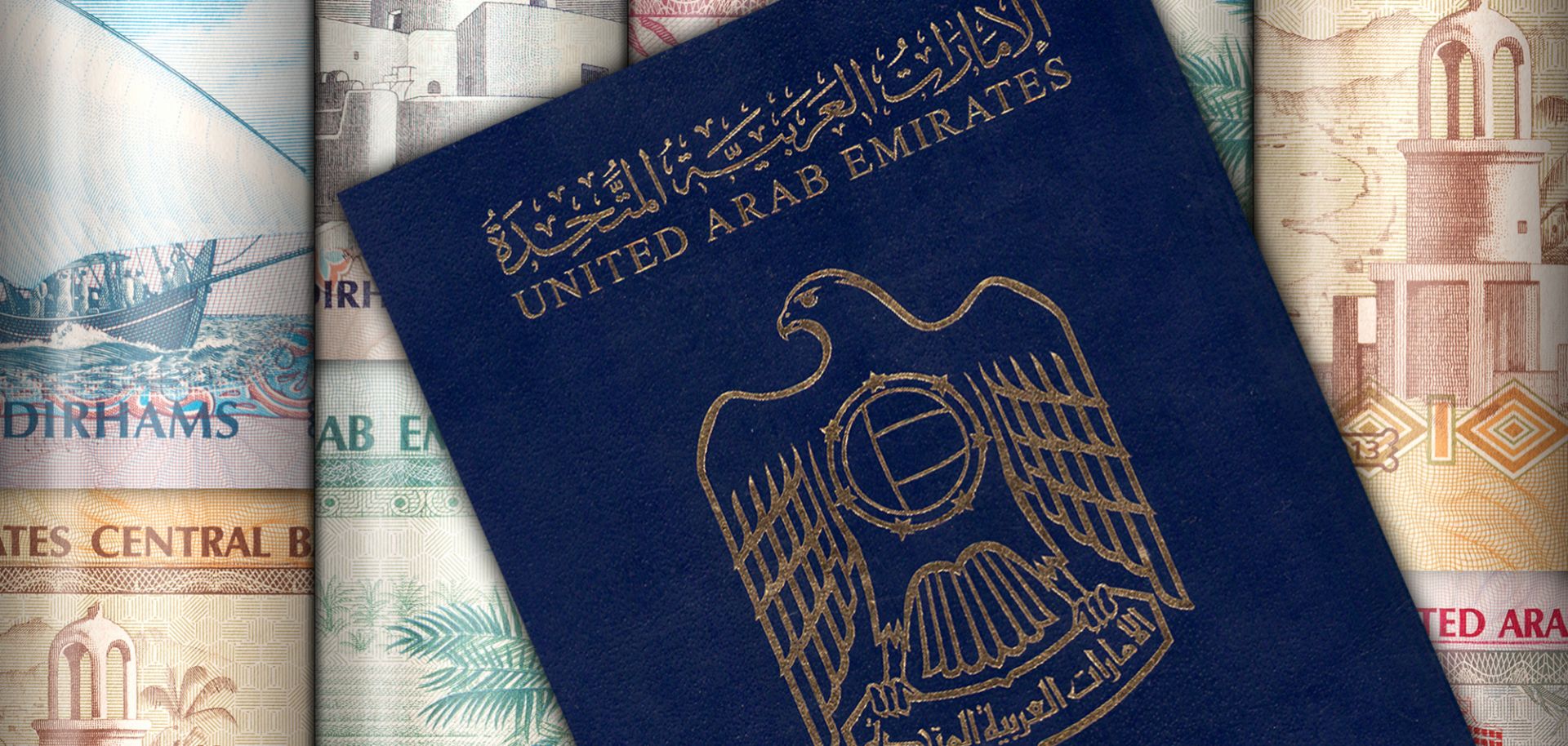
A display shows the UAE passport with the country's local currency in the background.
The United Arab Emirates’ new citizenship program for skilled foreign workers will likely further erode native tribes’ longstanding control over economic policy by bringing new players and power dynamics into the decision-making process. On Jan. 30, the United Arab Emirates announced that it had formally changed its citizenship laws to allow highly skilled foreigners to apply for Emirati passports. The new laws allow investors, doctors, scientists, intellectuals and other highly sought-after skilled foreigners to earn Emirati citizenship through nomination by either ruling families, courts or the Emirati cabinet. Exact procedures have not yet been announced, but the process appears to be controlled by high-level Emiratis. New UAE citizens will not have to give up the passports for their home countries.
With its economic future uncertain, the United Arab Emirates is accelerating its labor market reforms to include controversial citizenship for foreigners. The new laws add to previous labor market reforms designed to liberalize the country’s employment experience. Those reforms, however, have so far failed to attract the targeted volumes of talent and investment, particularly after expatriates fled the country during the lockdowns and layoffs caused by the COVID-19 pandemic in 2020. In addition to spurring an exodus of foreign labor, COVID-19 lockdowns throughout 2020 and 2021 have also decimated the United Arab Emirates’ tourism and construction industries, along with the country’s real estate markets.
- The United Arab Emirates’ growth model has been shifting away from relying on cheap, unskilled labor toward building a so-called “knowledge economy,” with highly skilled residents and citizens who would transform the United Arab Emirates into a post-oil economy focused on high-tech, manufacturing and skilled services (like financial technology).
- Starting in 2018, the United Arab Emirates began to introduce long-term residency permits for skilled labor in science and technology and investors to help increase the attractiveness of life in the United Arab Emirates, just as the cost of living and higher taxes began to undercut the country’s economic pull. The COVID-19 pandemic has since further undercut the country’s economic attractiveness, with thousands of foreigners leaving the country due to layoffs caused by lockdowns and global economic disruptions.
- In May 2018, the United Arab Emirates introduced a new 10-year-residency for highly skilled workers and investors whose investments added a substantial amount to the country’s economy. Investors were required to have around $2.7 million in various types of investments in the country. That same year, it also offered a five-year residency for investors with $1.3 million in property in the country, along with retirement visas for wealthy residents. Previously, most visas lasted only two years, and foreigners were not allowed to stay without an employer.
The United Arab Emirates’ ruling families will be able to use the new pool of citizens to accelerate the country’s economic transformation and undermine traditional tribal checks on their reform efforts. Many of the new skilled laborers will likely come from South Asia, Europe and other regions outside the Arab Gulf. This means that most will have no connection to the pre-existing social structures of the United Arab Emirates, thus undercutting the effectiveness of native Emirati tribes in pushing back against economic reforms. Emiratization quotas have historically limited how high foreign workers can climb in the country’s economy. But that will now change as well under the new laws, as foreign workers who earn citizenship will have the opportunity to take posts once reserved for tribally-connected Emiratis. New citizens, however, will still be reliant on the goodwill of Emirati leaders, who will still be able to strip them of their passports. Members of this new class of citizens are thus unlikely to oppose economic reforms.
- The United Arab Emirates’s political system relies on support and advisement from its tribes and non-royal established families to implement and craft some policies, in particular those relating to labor conditions and economic reforms that affect Emiratis. These traditional structures have at times served as a check on reformist impulses, notably by encouraging the Emirati government to maintain high spending on welfare programs even during economic downturns and making it difficult to restructure the welfare state to better encourage Emirati productivity and training for higher-quality jobs.
- Many of the United Arab Emirates’ most successful companies are staffed by foreign managers and executives, who with citizenship, will be free of current business regulations that often require jobs set aside for Emiratis as part of the country’s Emiratization programs. Emirates Airlines President Tim Clark, for example, is a British citizen, making it impossible for him to take over as chairman of the company. But with citizenship, Clark and those like him would be able to directly lead the high-profile companies they work for.
- Since the Arab Spring, there have been various reports of the UAE authorities stripping activists and Emirati dissidents of their citizenship over accusations of sedition. Some Emiratis have been forced to take Comoros passports in a scheme that sees the United Arab Emirates pay the island country for access to its citizenship rolls.
- Although an exact breakdown of skilled labor in the United Arab Emirates is unknown, the overall foreign resident population is dominated by South Asians, East Asians, Europeans and other non-Arabs. Skilled labor also tends to come from Europe, South Asia, East Asia and the Americas.
To offset native Emirati discontent at the dilution of their power, UAE rulers may be more willing to expand their political and social rights. To keep relations between the non-native citizens and traditional Emiratis from deteriorating, Abu Dhabi may offer traditional Emiratis new rights, like allowing them to hold multiple passports, expanding citizenship rights to native-born Arabs but who don’t have citizenship, increasing women’s’ rights to property and inheritances, and even loosening some restrictions on free speech to allow more public discussion on the role and future of non-Arab Gulf citizens in the United Arab Emirates.
