
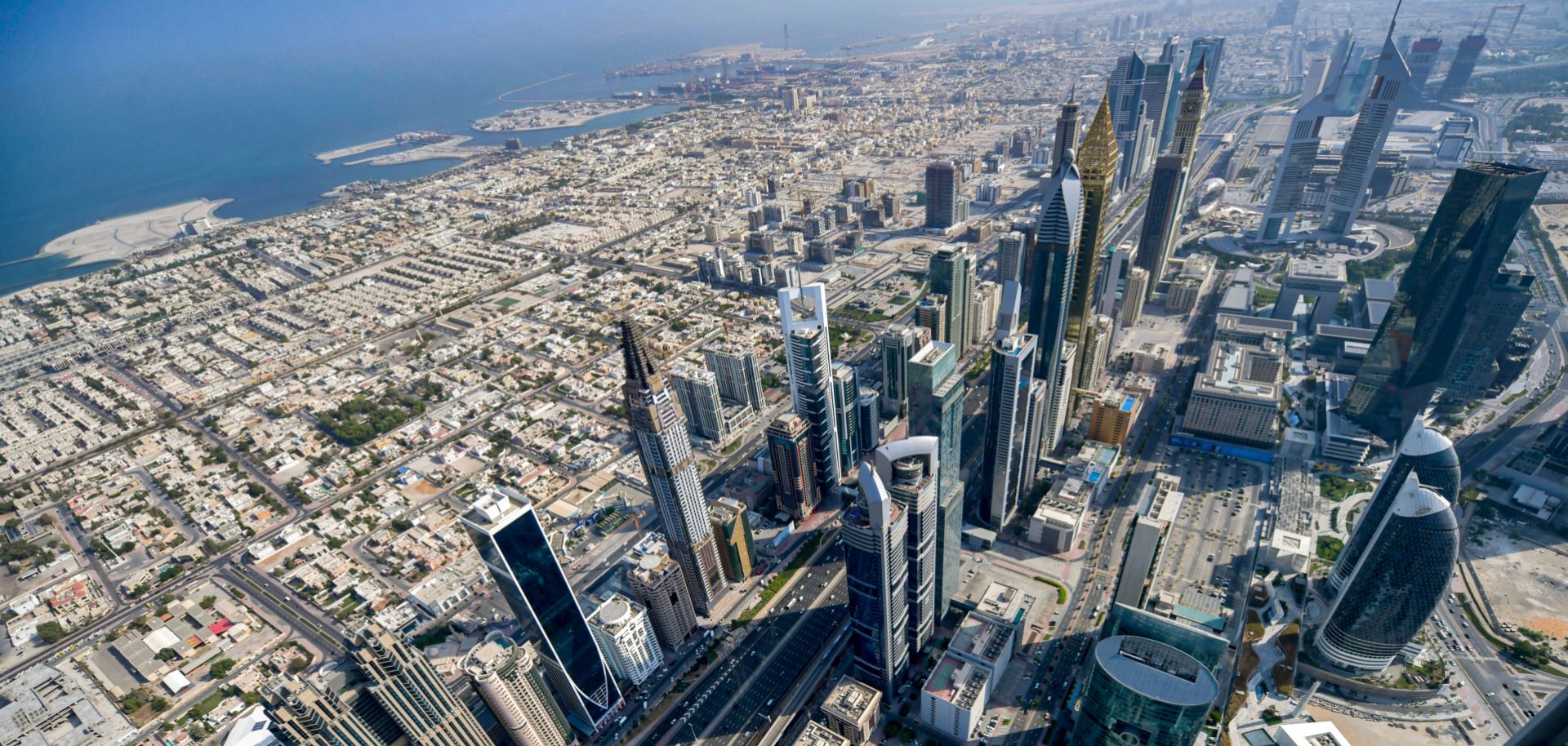
A picture taken during a helicopter tour organized by the government of the United Arab Emirates shows an aerial view of Dubai on July 8, 2020.
The United Arab Emirates is considering offering citizenship to its large expatriate population, which would significantly alter the country’s political economy, as well as its regional relationships, by assimilating non-Arab Gulf residents into its middle- and upper-classes. Over time, this new group of foreign-born Emirati citizens would likely erode the tribal and ethnic dynamics that have long shaped the governance of Abu Dhabi and Dubai, along with the cultural foundations driving many aspects of cooperation in the Arab Gulf. On Sept. 30, the Emirati government unveiled proposed changes to the country’s citizenship law that would ease the way for investors, long-term residents and wealthy foreigners to earn a permanent place in the country. With foreigners far outnumbering its local population, the United Arab Emirates’ current citizenship laws have offset the country’s long-standing demographic imbalances by ensuring the influence and prominence of its minority Emiratis via special legal and political protections. Changing those laws would thus open the door for the emergence of a non-Emirati elite who could challenge the country’s powerful Bedouin and merchant classes.
- In 2018, native Emiratis only make up around 11 percent of the United Arab Emirates’ population, with even stronger imbalances in favor of foreigners in the economic powerhouses of Abu Dhabi and Dubai. The U.S. Central Intelligence Agency (CIA) estimates that the vast majority of the country’s expatriate population (59.4 percent) are from India, Pakistan and Bangladesh, with Egyptians (10.2%) and Filipinos (6.1%) making up a notable portion as well.
- Currently, the United Arab Emirates only allows automatic birthright citizenship to those born to at least one Emirati parent, with some special exemptions allowed for long-term Arab residents and rare presidential decrees.
The changes to citizenship would likely later the cultural make-up of the economic upper-classes of the United Arab Emirates, reducing the dominance exercised by citizens with tribal Yemeni, Bedouin and Iranian roots. Powerful families, tribes and elite groups have long dominated Emirati domestic and foreign policy, either as royals or as key supporters of the royal families. In 1971, these groups were given Emirati citizenship, with arrivals coming after being kept as impermanent residents. Only citizens are currently able to access the country’s generous welfare system and best government positions. And until only recently, Emirati citizens were also the only ones allowed to independently run businesses outside of the country’s handful of free trade zones.
- A growing and stable population of middle- and upper-class workers from the Arab world, whose home countries are often corrupt and unstable, has established deep roots in the country. These Arab groups would welcome citizenship opportunities, as would long-term Emirati residents from India, Pakistan and Bangladesh.
- The drive to create a modern nation-state prompted Abu Dhabi and Dubai to recruit an expatriate professional class to populate the economy’s white-collar worker force. These residents gain wealth through impermanent residency, but the United Arab Emirates’ limited provisions for retirement and investor-class residency usually force them to eventually leave. On Oct. 3, the government of Dubai announced the launch of a program that eases restrictions on long-term retirement for expatriate professionals and wealthy investors aged 55 and above, though it does not alter their citizenship status.
Granting expatriates access to the political status once reserved for native Emiratis would diminish the influence of tribal and Iranian communities over government policy, especially in Abu Dhabi and Dubai. The United Arab Emirates’ political economy is currently underpinned by wealthy Bedouin and merchant tribal leaders whose power is transferred through lineage. The leaders of these communities have long had the freedom to push back and criticize government policies enacted by the country’s seven royal families, so long as it happened under the guise of tribal traditions and stayed out of public media. The addition of new citizens outside this tribal system, however, would enable the country’s royal families — particularly the Al Nayhans of Abu Dhabi and Al Maktoum of Dubai — to pursue policies with less domestic pushback by providing them with new bases of support to counter these tribal and Iranian influences.
- In Dubai, the settlement of Iranians in the 20th century has historically helped maintain UAE-Iran economic and social ties, despite the United Arab Emirates’ overall strategic relationship with Tehran often being adversarial. Abu Dhabi, however, did not have the same Iranian settlement pattern, helping shape the city’s more hawkish stance toward Tehran. The new citizenship changes would thus grant Abu Dhabi’s Al Nayhan family even greater room to enact more nationalist and anti-Iran foreign policies.
Non-Arab Gulf citizens would be more likely to support royal policies designed to reduce the budgetary burden of the welfare state, as well as more nationalist foreign policies. Pushback among welfare-dependent Emirati tribes and families have served as checks on economic reforms that would restructure the United Arab Emirates’ current rentier state. The addition of non-native citizens, however, would help counter this check by reducing their control over political positions and key sectors of the country’s state-reliant economy. These new citizens do not share native Emiratis’ history with the country’s welfare state, making them less dependent on it and more likely to support government efforts to change, including the reforms currently underway designed to secure the United Arab Emirates’ post-peak oil demand future.
- The United Arab Emirates’ generous safety net has long provided native Emiratis benefits regardless of skillset or employment status, which has reduced their incentive to gain the labor skills needed to enter the private sector. Resident workers who might become citizens, on the other hand, are hired and recruited purely for their workplace skills, and rarely can access welfare benefits.
Given their status as first-generation Emiratis, expatriate citizens would likely be particularly loyal to an emerging new brand of confrontational nationalism, further undercutting the United Arab Emirates’ social and cultural relationships with its key allies in the Arab Gulf. The United Arab Emirates’ new nationalist push is centered on creating a single Emirati identity that subsumes tribal lines. Many of those tribal lines, however, extend across the larger Arab Gulf.
- Several major tribes in the United Arab Emirates also have branches in other countries such as Qatar, Bahrain, Kuwait, Saudi Arabia and Oman. These centuries-old trade, marriage and political ties helped to cement the common regional identity that fomented the Gulf Cooperation Council (GCC) and, in times of crisis, has seen the Arab Gulf countries team up against external aggressors.
- The emergence of a more hardline nationalism among Emirati leaders in recent years, however, has weakened the United Arab Emirates’ relations with neighboring countries whose foreign policies do not align with its regional strategic goals in places such as Iran, Libya, and Yemen. This has, in turn, helped propel conflicts between Abu Dhabi and its fellow GCC members, including the ongoing blockade with Qatar and pressure campaigns against Oman.
