
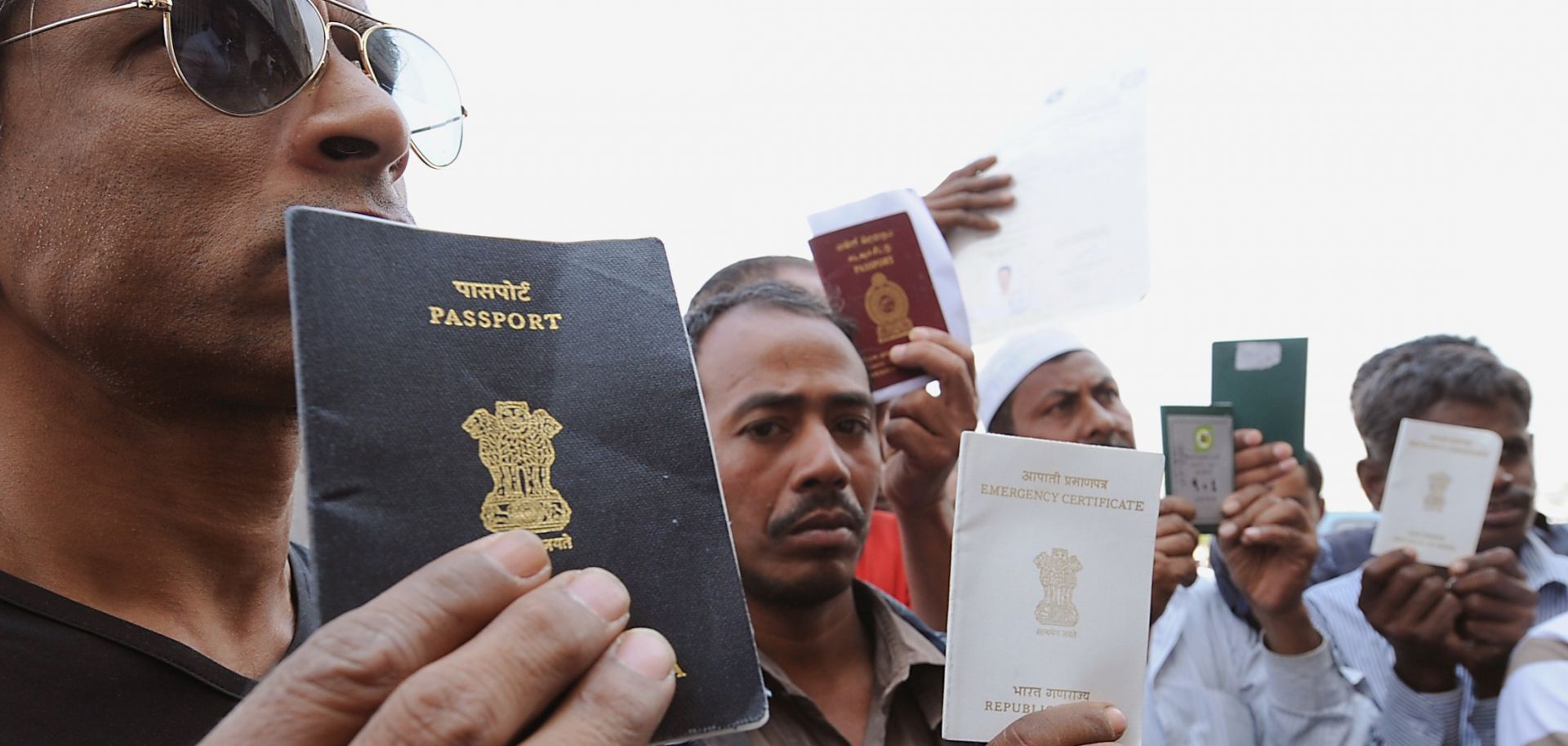
Foreign workers show their passports as they gather outside an immigration office in Riyadh, Saudi Arabia, on Nov. 4, 2013.
Saudi Arabia’s kafala reforms will increase flexibility in the kingdom’s foreign labor market, but achieving Riyadh’s 2030 Vision plans for a post-oil economy will require improving efficiencies within the Saudi workforce via broader reforms and skills development programs. On Nov. 4, Saudi Arabia’s deputy minister for human resources said the country would begin altering its kafala labor system in March 2021 by loosening restrictions that tie foreign workers to specific employers and contracts.
- The changes will enable foreign employees to switch jobs and contracts without having to leave the country and renewing their visas.
- Beginning in March, foreign workers will also be able to leave the country without obtaining an exit visa from their employer.
By eliminating current policies that often force such workers to exit the country before they can be rehired, Saudi officials are seeking to support local companies trying to leverage the pool of foreign workers in the kingdom who are being laid off due to the fallout from the COVID-19 pandemic. Previous restrictions on foreign labor gave Saudi employers social and legal leverage over foreign workers by denying them residency while undercutting worker rights with little protection against adverse work conditions. But these restrictions have also undercut Saudi Arabia’s attractiveness to foreign workers, particularly when set against the more liberal labor markets of nearby Qatar and the United Arab Emirates.
- Since the onset of the kingdom’s COVID-19 crisis earlier this year, the unemployment rate among Saudi citizens has reached a 20-year high at 15.4 percent.
- Saudi Arabia’s non-oil private sector contracted by 10 percent in the second quarter of 2020. The kingdom’s oil sector also shrank by 5.2 percent during the same period due to lower demand from the pandemic, as well as a Russo-Saudi price war in the spring that drove down oil prices.
- While these economic downturns have hit many key industries, including tourism and construction, some areas of development continue to advance, often backed by state spending or stimulus. This has left some companies in a position to maintain hiring or take advantage of talent whose positions elsewhere have disappeared.
Saudi citizens will maintain social and political advantages despite these reforms, preserving their purview over key positions in the kingdom’s economy, which is likely to undercut elements of broader labor reform needed to improve Saudi Arabia’s overall economic performance. Saudization remains a national priority and has gained greater urgency with the economic downturn’s increase in Saudi unemployment. The kingdom’s labor department, however, is mostly run by Saudi citizens, making it susceptible to informal tribal, family and cultural influences that could affect how strictly the new labor reforms are enforced and implemented.
- The unemployment rate among female Saudi citizens rose from 3.2 percent in the first quarter of 2020 to 31.4 percent in the second quarter, according to Saudi statistics. This marks a notable setback for the kingdom’s Saudization policies designed to bring more women into the workforce. Many Saudi women work in services that at times compete with cheaper foreign labor, and these sectors have been affected by the drop in consumption caused by the pandemic and the subsequent lockdowns.
- Other Arab Gulf states have reformed or abolished kafala, including Qatar and the United Arab Emirates. But enforcement concerns have often left some foreign workers in these countries exposed to employers’ abuse, as native citizens use their influence with the state to ward off inspections or enforcement of existing statutes.
Meeting Riyadh’s Vision 2030 goals for economic productivity will require deeper training, educational and structural reforms to the kingdom’s labor market. But the policy evolution and political will needed to enact those reforms will threaten entrenched Saudi interests. Saudi Arabia’s educational system is just beginning to implement deeper skills-based training, a process that will take many years before students emerge into the economy prepared for the non-oil sector. Other necessary structural reforms — including limiting the availability of cheap foreign labor, as well as increasing the incentives for the private sector to hire Saudi citizens while concurrently eliminating the number of public sector jobs — will take time and require the cultivation of deeper political support among the kingdom’s elites.
- Saudi Arabia’s education system is undergoing reforms, but it will take years to see the results of those changes. The United Arab Emirates, for example, began an education reform project in 2009 in Abu Dhabi. But the Emirati citizens who have been fully brought up in that updated education system still have yet to enter the workforce.
- Compared with the United Arab Emirates, Saudi Arabia’s education reforms will also have to encompass a much larger population of students, with over 40 percent of the Saudi population under 24 years old.
- Private sector companies often prefer cheaper, sometimes better-skilled foreign labor, while Saudis citizens have resisted entry into the private sector and preferred waiting for reliable, secure government jobs with generous pensions and benefits. Previous attempts to wean Saudis off government payrolls have been met with resistance, and Riyadh will remain wary of removing too many Saudi workers from the public sector at such an uncertain time for fear of social and political backlash.
