
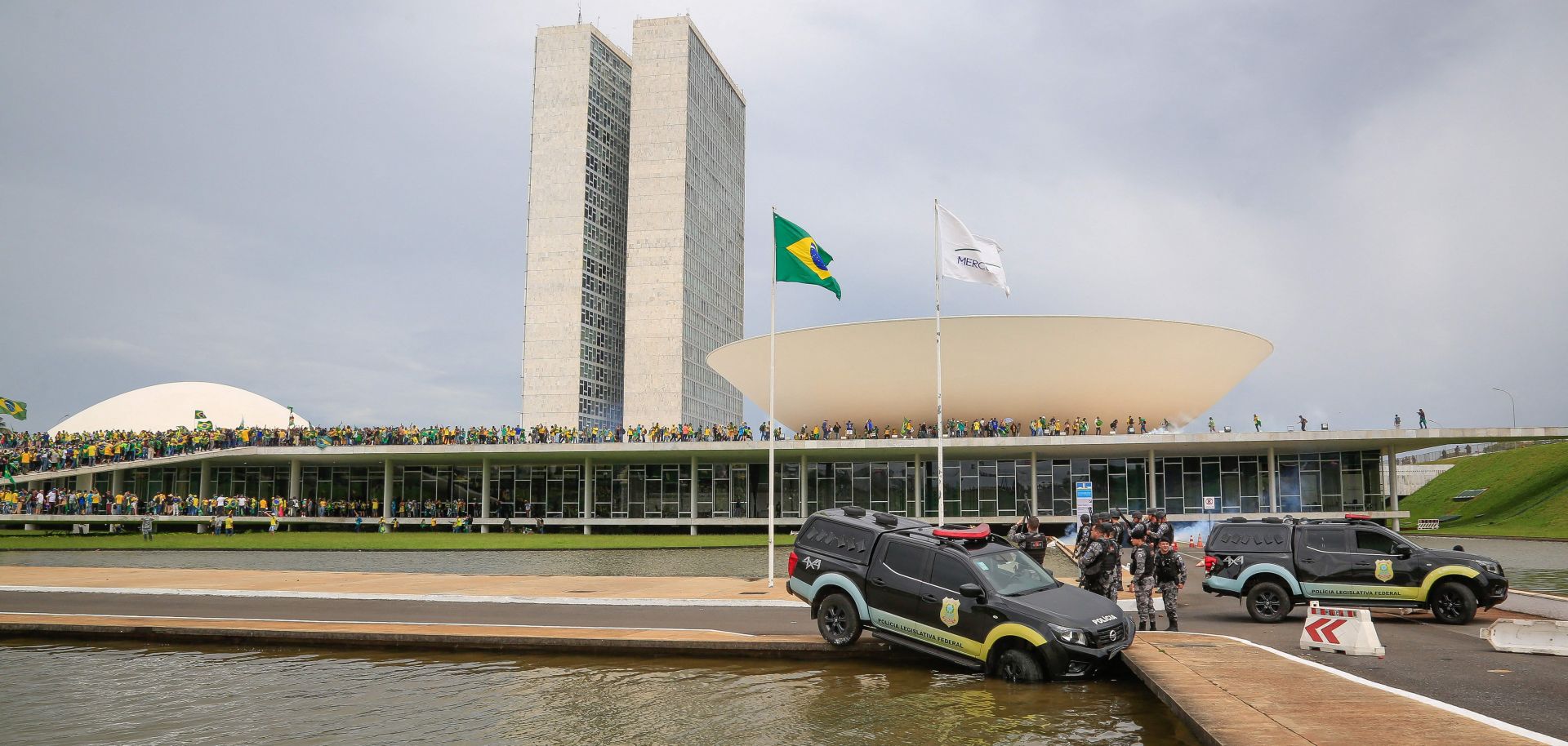
Members of Brazil’s Federal Legislative Police stand next to a vehicle that crashed into a fountain as supporters of former President Jair Bolsonaro invade the National Congress in Brasilia on Jan. 8, 2023.
In the wake of the capital insurrection, Brazil's government will likely increase efforts to monitor inflammatory rhetoric online and the spread of misinformation, but the ensuing investigations and arrests of public officials involved in the riots could still trigger more disruptive far-right protests. On Jan. 8, supporters of Brazil's former right-wing president Jair Bolsonaro broke into and vandalized the headquarters of the country's three branches of government — including the presidential palace, the Congress building and the Supreme Court — after overwhelming security forces in the capital of Brasilia. Once inside the buildings, the rioters smashed windows, broke furniture and destroyed artwork in protest of President Luiz Inacio Lula da Silva's electoral victory in October 2022, which many Bolsonaro supporters (and the ex-president himself) believe was fraudulent despite several international audits saying otherwise. Organizers and attendees of the demonstrations likely hoped the tumult would force the military to intervene and reinstall Bolsonaro as president. But security forces eventually entered all three buildings and escorted the protesters out, restoring peace after two chaotic hours.
- At the time of the riots, da Silva was in another state of Sao Paulo and both the Supreme Court and Congress were in recess, meaning that the government buildings were mostly vacant of officials.
- Bolsonaro issued a statement on Twitter indicating that he did not support the events on Jan. 8 and equated them to the violent leftist protests that erupted in Brazil in 2013 and 2017. While Bolsonaro has formally contested the results of the 2022 presidential election, his efforts have taken the form of petitions and not active calls for protesters to stage an uprising (though he has implicitly condoned some of their prior actions).
- Demonstrators covertly organized the Jan. 8 riots on social media sites like WhatsApp and Telegram by using codewords — particularly ''Selma's party'' (which is a play on a military term for ''war cry'').
- Da Silva was sworn in on Jan. 1 after narrowly defeating Bolsonaro in the Oct. 30 presidential runoff race. In the months leading up to the election, Bolsonaro had repeatedly aired unfounded suspicions of voter fraud.
- The riots affirmed that Brazil's military apparatus remains unlikely to assist insurrectionists and that Brazil will not see its government overturned in the near future — reassuring markets and investors, as indicated by the slight rise in Brazil's overall IBOVESPA index on Jan. 9.
The Supreme Court's efforts to arrest high-level security officials and politicians in connection to the Jan. 8 events will likely spark demonstrations in the coming years. 1,200 people have already been arrested in connection with yesterday's riots. In the medium term, Brazil's Supreme Court will likely also pursue investigations and arrests of any officials who could have aided the rioters, with da Silva saying that ''whoever did this [would] be found and punished'' in a Jan. 8 tweet. Indeed, the court has already suspended several top officials who may have contributed to the two-hour delay between protesters breaching government buildings and security officials restoring peace — including the governor of Brasilia, Ibaneis Rocha. As more formal investigations are launched and arrests are made, Brazil's far-right apparatus will likely view the legal crackdown as unfair, as many of the officials and politicians targeted will likely have right-wing allegiances. Far-right leaders will probably use the investigations to renew demonstrations in major cities across the country. The risk of large, disruptive and potentially violent protests will be particularly acute if members of Bolsonaro's family are investigated or prosecuted in connection with the Jan. 8 events. Given the slow-moving nature of judicial investigations in Brazil, this dynamic could also play out for years — with allegations and detainments occurring periodically, followed by surges of protest activity.
- Brasilia Security Secretary Anderson Torres, who served as a former justice minister under Bolsonaro, was fired on Jan. 8 and has an arrest order out against him. But the ability to carry out the arrest order will be complicated because Torres is currently in the U.S. state of Florida.
- It will also be difficult for the judiciary to connect Bolsonaro, or his family, to the events of Jan. 8 as they did not publicly support the riots. Any attempts to arrest Bolsonaro would be complicated by the fact that he is currently residing in Florida; it is unclear if he is with Torres, but it is likely.
The riots will likely spur increased legislative support for the da Silva administration on measures to reduce the spread of violent online rhetoric and misinformation in the country. Following the capital insurrection, the centrist and right-leaning parties that comprise Brazil's ''Centrao'' coalition in Congress will seek to distance themselves from Bolsonaro and the coming wave of investigations. This will see more lawmakers temporarily rally around da Silva's new left-wing administration on issues directly related to the riot, including measures to curb the ability to coordinate violent activity online. However, such increased support from the centrist bloc is unlikely to extend to broader efforts to halt the spread of contentiously defined ''fake news'' — and is even less likely to extend to the highly polarizing items on da Silva's main policy agenda, which includes reducing Amazon rainforest deforestation and increasing social welfare spending). Brazil's Supreme Court, for its part, will likely also capitalize on public support for non-violence by renewing efforts to curb the greater spread of misinformation in the country, including through increased monitoring of far-right activity on social media and other online platforms. Depending on what such monitoring uncovers, the court could mandate that social media platforms increase the enforcement of the misinformation guidelines they already have in place or adhere to new, more expansive guidelines adopted by the government — either of which would risk inciting more right-wing demonstrations.
- A proposed bill informally known as the ''Fake News Law'' has been stalled in Brazil's Congress since April 2022, after the centrist coalition refused to support an initiative to fast-track the legislation (which was also widely criticized by tech companies). While da Silva has previously supported this law, he may also seek to propose a new one of his own in the wake of the Jan. 8 events.
