
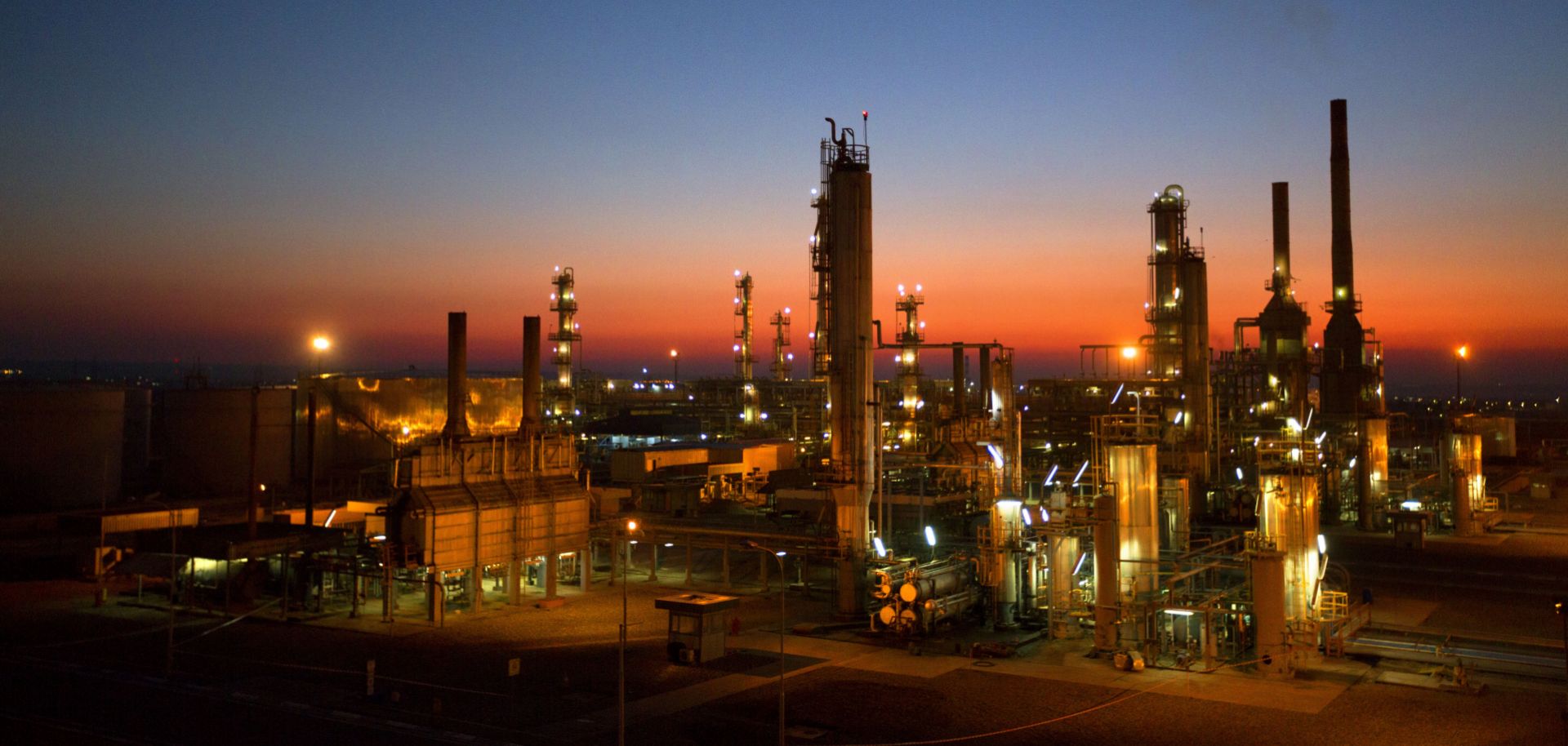
The Kawergosk oil refinery in Iraqi Kurdistan is seen at sunset.
Recent cooperation between Iraq's federal government in Baghdad and the government in Iraq's semi-autonomous Kurdish region suggests that a pragmatic solution to many of their disagreements is possible, but oil exports will remain a major sticking point in the near term. A long-delayed government formation process in Iraq has progressed in recent weeks thanks to cooperation between the country's feuding groups, including the Kurds. On Oct. 13, the two largest and most powerful political parties in Iraqi Kurdistan agreed on a presidential candidate and voted in the federal Iraqi parliament alongside other parties — bringing Iraq the closest it's been to forming a government in a year. Kurdish leaders' involvement in the government formation process proves that they can still work productively with their federal counterparts in Baghdad when Iraq's stability is at stake. This bodes well for continued political and security cooperation between the Kurdistan Regional Government (KRG) — which sits in Erbil and controls domestic affairs in the Kurdistan Region of Iraq (KRI) — and Iraq's central government in Baghdad. But in the near term, the KRG will likely keep drawing a hard line on oil exports and sharing revenue on those exports, despite facing mounting legal pressure from Baghdad.
- On Oct. 13, Iraq's new President Abdul Latif Rasheed named Mohammed Shia Al Sudani as the country's prime minister-designate and asked him to form the next government. Al Sudani has 30 days to submit his Cabinet lineup to the National Assembly for approval.
- Since Iraq's 2021 parliamentary elections, numerous efforts at government formation have failed due to rivalries between the major Shiite parties, particularly the Shiite Coordination Framework and the Sadrists.
- The government formation process is being led by a new bloc called the State Administration Coalition, which brings together the pro-Iran Shiite Coordination Framework, the Sunni-majority Taqaddum party and the Kurdistan Democratic Party (KDP). The coalition says it is focused on drafting an oil and gas law that will be agreed to by both the federal and Kurdish-Iraqi governments.
The KRG and the Iraqi federal government have sparred over various issues — including budget revenue allocation, security cooperation and territorial demarcation — since Iraqi Kurdistan was established as a semi-autonomous region in 2005. The 2005 Iraqi constitution, drafted in the formative years following the 2003 ouster of Saddam Hussein and his authoritarian government, sought to settle the demands of Iraq's ethnic Kurdish minority for a self-ruled territory by officially granting them control over the northern region of the country, which is where most Iraqi Kurds live. By nature of being the umbrella government over the KRG, Iraq's federal government is still, in theory, in charge of securing the borders in Iraqi Kurdistan. Iraq's Federal Supreme Court also technically has jurisdiction in the semi-autonomous region. But Kurds' overwhelming desire for sovereignty, combined with ongoing territorial disputes, has long complicated Baghdad's ability to assert power over the KRI.
- Over 90% of voters in Iraqi Kurdistan supported a non-binding independence referendum held in the region in 2017. In a show of force following the referendum's results, Iraqi federal forces closed the region's borders and recaptured large swathes of territory disputed by both governments — including the oil-rich Kirkuk fields.
But the issue of oil exports (and, in particular, how to divvy up the revenue generated by those exports) remains by far the largest and most intractable point of contention between Baghdad and Erbil. Both the Iraqi federal government and the KRG control the development of some of the world's largest and most lucrative oil and gas reserves. According to the U.S. government's Energy Information Agency, the KRG-controlled areas hold roughly 3.7 billion barrels of oil resources. The KRG itself more generously estimates they control 45 billion barrels of oil, which includes unproven reserve estimates as well as the reserves in Kirkuk. Baghdad also controls the allocation of Iraqi budget funds to the KRG, which comprise an important part of the KRG's own budget and is supposed to be proportional to the amount of Iraq's population that lives in the KRI. After the backlash from Baghdad over the 2017 referendum, the KRG agreed to hand over oil exports to Baghdad in exchange for 17% of the federal Iraqi budget, but the agreement has not been implemented. Only a small amount of money has been transferred to Erbil and no oil export control has been transferred to Baghdad.
If the new coalition succeeds in forming a government, it could improve relations between Erbil and Baghdad, in part because it includes Iraq's most powerful Kurdish party (the Kurdistan Democratic Party). This could help yield compromise on complicated files like security cooperation, potentially improving Iraqi stability. The KRG has militia forces, or peshmerga, that protect it, and which have worked closely with federal Iraqi forces in counterterrorism and security operations in the past. But disputes endure over the payment of peshmerga salaries, as well as over territory demarcation. Historically, uniting over security issues has led to compromises on economic- and oil-related issues. The 2014 oil revenue sharing agreement (which established a framework for revenue sharing between the two governments for the first time, even if it hasn't been implemented) was paved thanks to a strong impetus on both governments to cooperate closely on security cooperation to defeat the Islamic State terrorist group, which at the time was terrorizing northern and central Iraq. Any future major security threat will likely see Peshmerga and federal security forces work together pragmatically, helping ease Iraq's often-worrisome security picture.
However, disagreements between Erbil and Baghdad over oil exports and revenue will likely still worsen in the near future as Baghdad deploys its stronger leverage to try and exert greater control over Kurdish oil. In February, Iraq's Federal Supreme Court ruled that Kurdish oil and gas products that aren't exported in coordination with Baghdad are illegal, citing that only the federal government has legal control over what can be exported out of Iraqi territory per the country's 2005 constitution. Previously, Baghdad had little choice but to try to ''force'' control over Kurdistan's energy production, some of which is located in disputed regions. But the Supreme Court ruling has since enabled Iraq's federal government to use more legal mechanisms to try to freeze future Kurdish oil sales or development — namely, by trying to force international companies to cut ties with the KRG until it cooperates with Baghdad's wishes of granting the federal government oversight over all of Iraqi Kurdistan's energy sector. This has angered Kurdish officials in Erbil, who have continued to export oil via Turkey without the explicit consent of Iraq's oil ministry, saying the court decision was politically motivated and that Kurdistan's right to export and produce oil is enshrined in Iraq's constitution. Within this context, oil-related tensions between Erbil and Baghdad have only intensified over the past year. And they are unlikely to quickly ease, even if a new federal government opens the door for increased cooperation elsewhere — especially as high global prices further motivate both sides to retain control over lucrative oil shipments.
- On Feb. 15, Iraq's Federal Supreme Court ruled that Kurdistan's 2007 oil and gas law, which regulates the Kurdish oil sector and is the basis for foreign companies' investment in the region, was unconstitutional. At the heart of the dispute is the interpretation of Article 112 of the Iraqi constitution, which says the ''federal government, with the producing governorates and regional governments, shall undertake the management of oil and gas extracted from present fields.'' The Iraqi government and Federal Supreme Court interpreted this to say that only the federal government can regulate oil and gas production, while the Kurdish government has said the article only applies to ''present fields'' that were in production before the constitution passed in 2005.
If Baghdad's legal pressure successfully deters all international companies from doing business with the KRG, the financial blow will likely eventually force Kurdish regional leaders to abide by the Supreme Court ruling. Several major international oilfield service companies have heeded warnings from federal Iraqi institutions against brokering new contracts or investments in the KRI for fear of being banned from doing business in the country. This loss of business risks serving a devastating blow to Iraqi Kurdistan's economy, given that oil exports fund 85% of the KRG's budget and that the regional government is already holding $38 billion in debt. For Erbil, generating more revenue in the future depends on more development and investment from foreign firms with special expertise. If foreign firms continue to bow to Baghdad's pressure campaign by cutting ties with Kurdish oil, the regional government will thus likely have little choice but to bow to the federal government's demands that it hand over control of Kurdistan's oil production.
- According to a letter seen by Reuters on Aug. 23, Iraq's State Organization for Marketing of Oil (SOMO) threatened buyers of crude oil from Iraqi Kurdistan with legal action. SOMO on Sept. 19 said it had informed international companies not to purchase crude oil from Kurdistan, following the Federal Supreme Court's guidelines.
- Iraq's oil ministry has removed several companies from its blacklist, including the U.S.-based Weatherford, after the firms pledged not to seek new contracts in the KRG. France's TotalEnergies also recently sold its 18% stake in the Sarsang oil field in Kurdistan for $155 million amid pressure from Iraq's Federal Supreme Court.
- According to an Aug. 30 Reuters report, the KRG has calculated that oil production in Iraqi Kurdistan could be cut in half by 2027 without new exploration or major investments. If Iraqi Kurdistan can accrue optimal levels of investment, the regional government foresees the region's oil output rising in five years from current levels of 434,000 barrels per day (bpd) to 580,000 bpd, with 530,000 of those barrels being exported. But without those investments, the government foresees the region only being able to export 240,000 bpd of oil due to expected depletion at aging wells.
But in the near term, Iraqi Kurdistan's continued oil exports to Turkey and domestic refining capabilities will enable Erbil to maintain control of the region's energy production, despite mounting pressure from Baghdad. Erbil exports through Turkey's Ceyhan Oil Terminal without the explicit consent of Iraq's state-owned SOMO oil company. Turkey is thus a lifeline for Erbil, and Ankara shows no signs of wanting cooperation with the KRG to slow. For Erbil, pursuing its own exports as long as it possibly can will ensure that the KRG doesn't lose control over the one thing that generates revenue and enables Iraqi Kurdistan to not be entirely dependent on Baghdad.
- Non-Western companies are not leaving Iraqi Kurdistan as Western firms have been since the February Supreme Court ruling. UAE-based Dana Gas and Russian gas giant Gazprom, for example, remain heavily active in the semi-autonomous region, despite both companies being summoned by a Baghdad court to appear as defendants in cases filed by the oil ministry.
- Most downstream activity in Iraq's Kurdistan region is conducted by local firms.
