
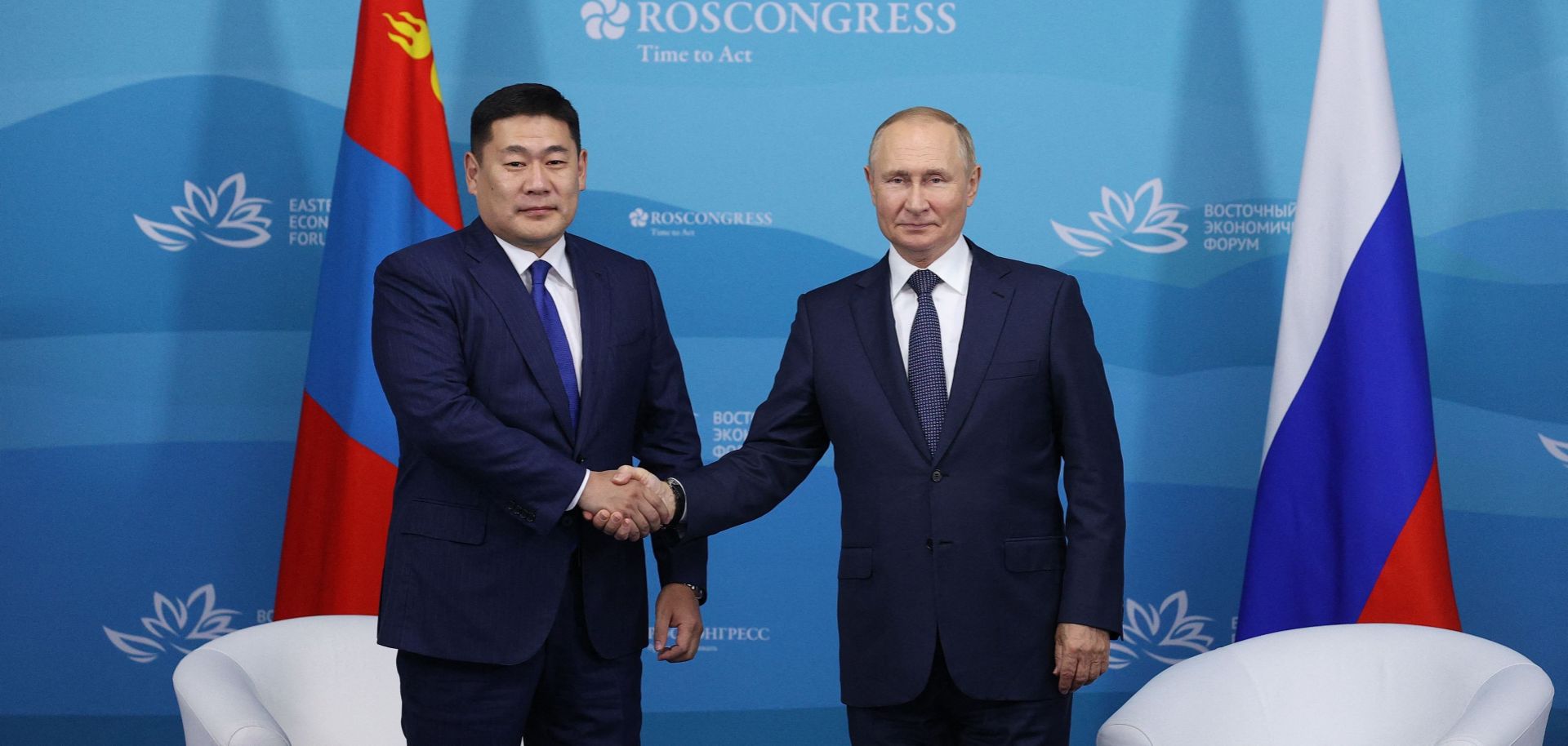
An upcoming trilateral summit between Mongolia and its two powerful neighbors, Russia and China, will showcase Ulaanbaatar's efforts to balance its reliance on Moscow and Beijing with its drive for greater economic and political independence. Mongolian President Khurelsukh Ukhnaa will meet Russian President Vladimir Putin and Chinese President Xi Jinping on the sidelines of the Shanghai Cooperation Organization (SCO) summit in Samarkand, Uzbekistan, on Sept. 15-16. The meeting follows a surge in Mongolian diplomatic and economic outreach centered on attracting new investment, expanding cross-border transportation corridors, promoting economic diversification, and buffering Mongolia from its heavy economic reliance on China.
- In August, UAE Minister of Economy Abdullah bin Touq Al Marri hosted the Mongolian ambassador to discuss expanded economic cooperation, as well as interest in the Mongolian food and agriculture sector. A team from Malaysia's Halal Development Corporation also recently visited Mongolia to assess integrating Mongolia into Halal meat supply chains.
- U.S. Assistant Secretary of State for East Asian and Pacific Affairs Daniel Kritenbrink visited Mongolia in August to highlight the strategic partnership between the two countries and attend the groundbreaking of a Millennium Challenge Corporation (MCC) water recycling facility project. In early September, a bipartisan U.S. Congressional delegation comprising members of the House Armed Services Committee, House Foreign Affairs Committee, and House Homeland Security Committee visited Mongolia.
- In August, Ulaanbaatar and Seoul announced agreements to expand cooperation in rare earth element supply chains and climate change mitigation.
- Earlier in September, Mongolia and Thailand held their first Joint Trade Committee meeting as part of efforts to increase bilateral trade between the two countries.
- In early September, Iranian Deputy Minister of Industry, Mine and Trade Mohammad Mehdi Baradaran visited Mongolia to discuss economic cooperation and private sector investment; Baradaran was the highest-level Iranian official to visit Mongolia in decades.
- Indian Defense Minister Rajnath Singh visited Mongolia in early September to enhance the two country's strategic partnership.
The engagement is part of Mongolian Prime Minister Oyun-Erdene Luvsannamsrai's New Revival Policy to diversify economic and trade relations, attract investment into new areas of the economy and chip away at over-dependence on the mining and mineral sector. A recent change to Mongolia's constitution has allowed an expansion of the cabinet, bringing in several parliamentarians and potentially increasing the chance for some of the prime minister's economic reforms to pass through parliament.
- In December 2021, the Mongolian government launched its New Revival Policy, which seeks to counteract the economic damage caused by the COVID-19 crisis by attracting more investment, increasing infrastructure connectivity, cracking down on corruption and easing business regulations.
- On Aug. 30, Mongolia's parliament approved a list of new cabinet ministers, expanding the number of cabinet positions to 21 following new changes to the country's constitution. Several members of the new cabinet are considered ''pro-business.''
- The Mongolian People's Party (MPP) currently holds the majority in the parliament, as well as the presidency, making it easier to pass government initiatives.
Despite these efforts, Mongolia is finding it difficult to attract alternative investments or break out of its geographic and economic constraints. Landlocked and squeezed between China and Russia, Mongolia has long sought to find international partners that can soften the country's natural exposure to Russian and Chinese influence under its so-called ''third neighbor'' policy. However, Mongolia's geography has limited the efficacy of this policy, as all of the country's trade must still go through either China or Russia. Mongolia's extreme dependency on mining — which accounts for more than 70% of the country's exports — also leaves its economy vulnerable to external downturns which impact demand. Strict constraints on land ownership, widespread corruption and weak physical infrastructure, as well as a relatively small population, constrain foreign investment in Mongolia outside of resource extraction as well.
- Several new rail lines are opening between Mongolia and China, including at least one wide-gauge line that avoids delays at the border. Coal exports have been limited by slow rail connections and the frequent use of trucks as the primary transport method, something COVID-19 has significantly curtailed. The Mongolian government is hoping the new rail lines will enable faster and more profitable exports to not only China, but also through China to other countries.
- Russia has committed to begin construction in 2024 on the Power of Siberia 2 pipeline that would link its Arctic natural gas production sites to China via a pipeline that traverses Mongolia. Ulaanbaatar would receive transit fees and access to Russian gas, potentially reducing its own dependence on coal as a primary power generation fuel.
- Russia and Mongolia have agreed to a lower-price long-term contract for Russian fuel oil deliveries, softening Ulaanbaatar's vulnerability to price spikes.
- China and Russia are stepping up infrastructure investment in Mongolia, but this is primarily focused on accessing Mongolia's natural resources.
Mongolia will continue to try and balance its international relations to strengthen its own economy and political options, but the emerging geopolitical environment will further complicate its historic inability to break out of China and Russia's orbit. Mongolia's vast mineral resources, along with its location between China and Russia, provide it with some leverage to shape relations with its neighbors and beyond. Moreover, underlying distrust between Russia and China offers Mongolia some room to exploit. But Russia's ongoing war in Ukraine has also highlighted Mongolia's vulnerability and the inherent challenges in finding any ''third neighbor'' partner willing to come to its defense. And Ulaanbaatar wants to avoid being forced into joining any sort of bloc with China and Russia that pits it against the West. Mongolia has a long and bitter history with both of its neighbors, and will continue to pursue any initiative that preserves its independence of action. But the more U.S.-China competition or Russian isolation increases, the harder Ulaanbaatar may find it to access its ''third neighbors.''
- Mongolia's economy faced significant pressure over the past two years as COVID-19 undermined the country's tourism industry and reduced commodity exports, primarily due to China's strict ''zero-COVID'' policies. This reiterated Ulaanbaatar's vulnerability to external factors beyond its control or influence.
- Continued Western sanctions on Russia are already delaying further development of its Arctic natural gas fields, raising questions about the viability of the Power of Siberia 2 pipeline. China's willingness (or capacity) to handle a significant increase in Russian natural gas also remains unclear.
- Mongolia continues to participate in both U.S.- and Russian-led military exercises, but rising tensions between Washington and Moscow may eventually make it harder to hold drills with both countries.
