
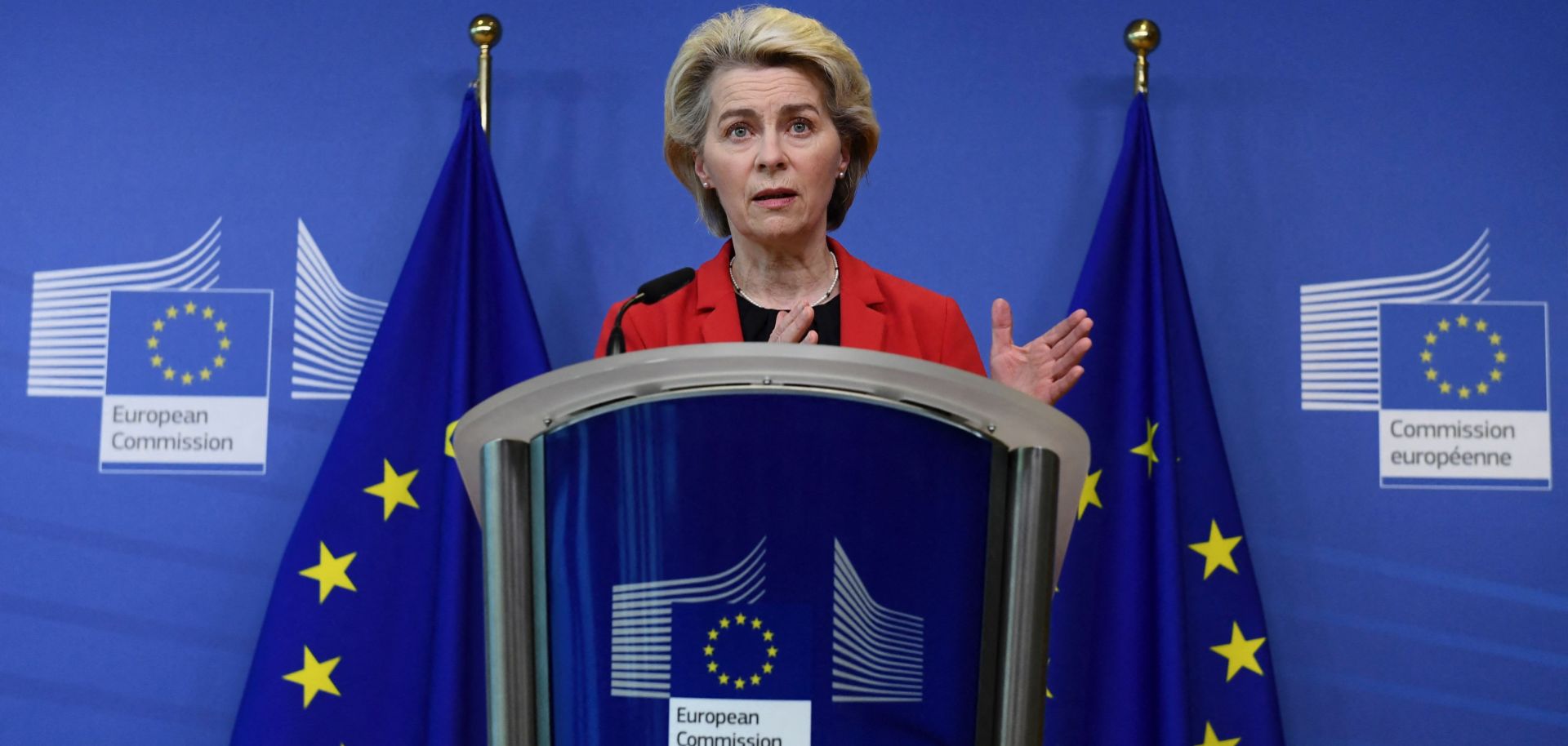
European Commission President Ursula von der Leyen gives a statement on Ukraine at the EU headquarters in Brussels, Belgium, on Jan. 24, 2022.
The European Union will likely impose robust economic sanctions if Russia invades Ukraine, but the bloc will struggle to come up with high-impact punitive measures in response to other, more likely acts of Russian aggression. In recent days, EU governments have intensified their debate over how to deal with a potential escalation of the conflict between Russia and Ukraine. While member states agree that a formal Russian invasion would trigger economic and political sanctions against Moscow, the bloc is internally divided over how to react to disinformation campaigns, cyberattacks, attempts to destabilize the Ukrainian government or interruptions in natural gas supplies to Ukraine, which are some of Russia’s many options. Eastern European and Baltic governments believe that a cyberattack or a disinformation campaign should be enough to trigger sanctions against Russia, but some Western European governments have defended a more cautious approach, arguing it would be hard to identify the perpetrators behind such actions.
Considering Russia’s multiple options to attack Ukraine, the European Union is likely to consider several alternatives and make a decision only after Moscow makes a move. According to media reports, the European Commission is currently working on a list of potential sanctions, but will not reveal it unless Russia displays direct aggression against Ukraine. The European Union’s options include imposing export controls on Russian goods, targeting Moscow’s ability to convert foreign currency, implementing tighter sanctions on Russia’s oil and gas industry (likely focused initially on technology transfers), imposing restrictions on Russia’s access to Western semiconductor technology, banning Western funds from buying Russian sovereign debt, and adding more individuals close to Russian President Vladimir Putin to the bloc’s list of travel bans and asset freezes. However, more drastic actions — such as cutting off Russia’s access to the SWIFT global financial messaging network, or imposing broad Iran-style sanctions on Russia’s oil and gas sector — are unlikely without an actual invasion due to the economic blowback such actions would have on the bloc. The European Union’s close trade and investment ties with Russia also explain why the bloc will be more reluctant than the United States (which has comparatively weaker economic ties with Russia) to impose painful sanctions. But the probability of stronger EU sanctions will increase significantly if Russia launches a full-blown military invasion in Ukraine.
- Russia is a large supplier of products including fertilizers, aluminum, steel and nickel to Europe, which means that strict export controls would also disrupt European supply chains. Large European companies in sectors from banking to automobiles are active in Russia and would be negatively affected by financial and export bans.
- Russia is the European Union’s main supplier of natural gas, which gives Moscow some leverage in its dealings with Brussels. Russia’s natural gas exports to Europe have been at reduced levels for several months, which has contributed to rising energy prices across the Continent at a time when inventories are at unusually low levels.
- The German government remains internally divided over whether to block the Russia-backed Nord Stream 2 pipeline from becoming operational. In late 2021, the government put the decision in the hands of Germany’s energy regulator, which is currently assessing whether the pipeline complies with EU rules. A formal military invasion of Ukraine would severely increase the probability of the German government blocking the pipeline, but other less aggressive Russian actions could enable Berlin to preserve its current ambiguous position on the issue.
The European Union’s internal divisions could convince Russia that any aggressions against Ukraine that fall short of a military invasion will have tolerable economic consequences. Brussels is likely to adopt a progressive approach to sanctions, adapting them to the severity of Moscow’s actions and making them subject to modifications. According to media reports, some EU governments are already asking to exempt certain companies or existing contracts (such as on energy supplies) from potential sanctions. In addition, EU-wide sanctions require unanimous support from the 27 members of the bloc, which could result in watered-down measures to appease some member states. Against this backdrop, Russia is more likely to increase support for separatists in eastern Ukraine, launch cyberattacks against the Ukrainian government and/or conduct destabilization campaigns targeting Kyiv — all actions that would likely trigger a milder reaction from the European Union compared with a full-blown invasion. Moscow will likely also keep natural gas exports to Europe relatively low and refuse to lower prices for prospective buyers in order to keep its leverage in negotiations with the European Union and discourage Brussels from imposing economically painful sanctions.
- The European Union is also internally divided on the issue of arms exports to Ukraine, a decision that member states will continue to make at an individual level. Granting additional financial assistance to Kyiv is less controversial, and the bloc is likely to increase grants and loans for the Ukrainian government in the coming weeks.
