
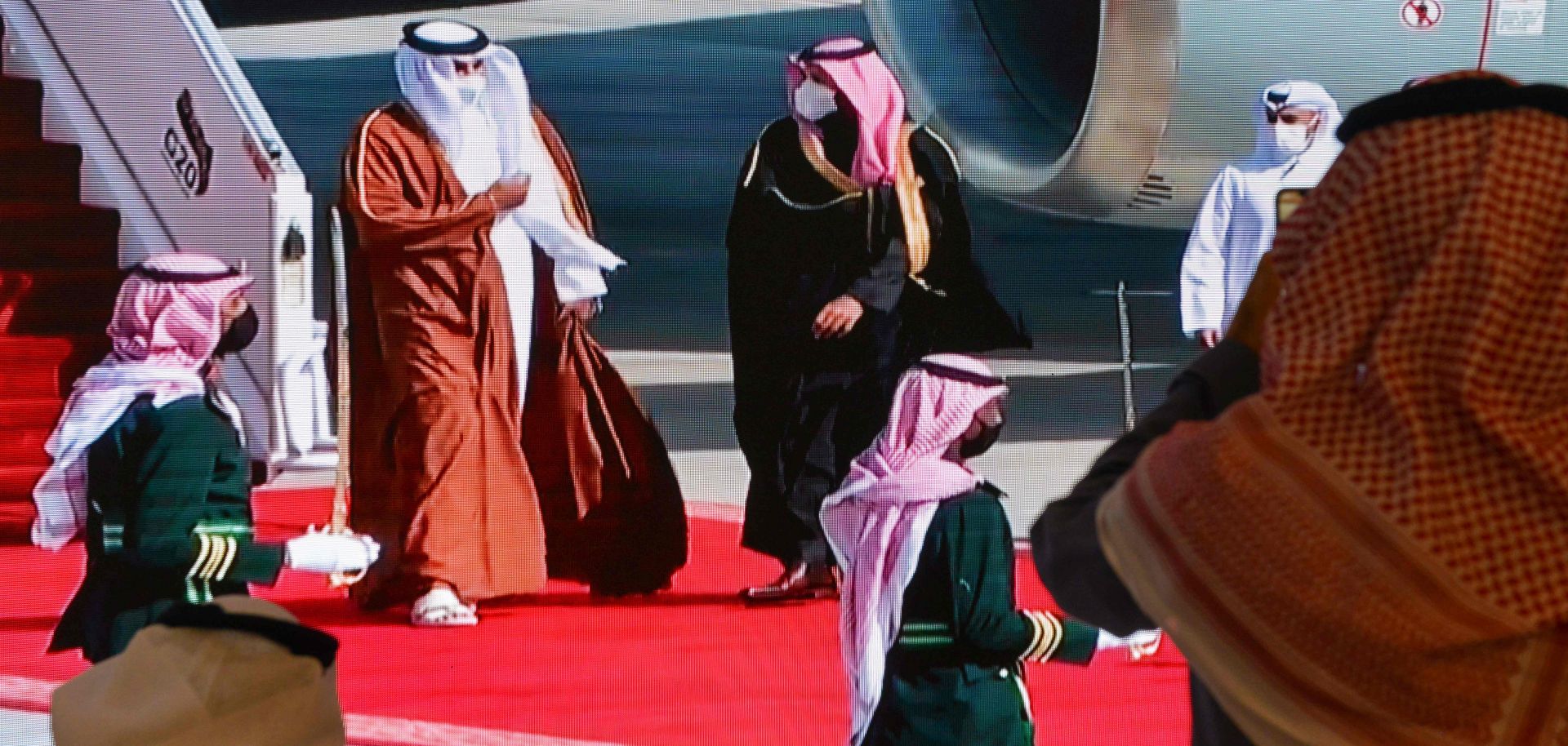
Journalists watch Saudi Crown Prince Mohammed bin Salman (center right) welcome Qatar’s Sheikh Tamim bin Hamad Al Thani (center left) on a screen ahead of the Gulf Cooperation Council (GCC) summit in the Saudi city of al-Ula on Jan. 5, 2021.
The post-blockade detente between Saudi Arabia and Qatar will remain fragile as numerous underlying factors could give way to a resumption of tensions. On Dec. 9, Saudi Crown Prince Mohammed bin Salman visited Qatar for the first time since Riyadh ended its yearslong blockade of Doha in January. Upon arriving in the Qatari capital, the prince received a warm welcome from Qatar’s ruling Emir Sheikh Tamim bin Hamad Al Thani, who embraced the Saudi ruler on the tarmac. The trip marks a notable step in the reconciliation of Saudi-Qatari relations, which had soured in recent years amid Prince Mohammed’s rise to power and the Saudi-led GCC embargo of Qatar.
- Shortly after Prince Salman took power in 2016, Saudi Arabia began closely aligning with the United Arab Emirates, which shared its concerns about Qatar’s comparatively warm ties to Iran and support for the Muslim Brotherhood, as well as Doha’s use of its media empire (led by Al Jazeera) in stoking dissent and reporting on Saudi and Emirati internal political situations.
- In an attempt to force Doha to reverse or abandon these policies, Saudi Arabia and the United Arab Emirates rallied Egypt and Bahrain to cut their diplomatic ties, travel and commercial links with Qatar in 2017, issuing Doha 13 demands to change its behavior. In June 2017, they even briefly considered military intervention in Qatar before the United States stepped in.
- Over the next four years, the blockade stagnated and the Qatari economy actually grew as Doha shifted its trade and business ties. The United States remained firmly allied to Qatar throughout the blockade, which U.S. leaders criticized as undermining GCC solidarity and, in turn, overall regional stability. Turkish troops set up a base in Qatar as well. Doha, meanwhile, made no progress on any of the demands issued by blockading states.
- In early January, Saudi Arabia decided to abandon the largely unsuccessful blockade and began restoring ties with Qatar to ensure its good standing with the new more Saudi-skeptic administration of U.S. President Joe Biden. The United Arab Emirates, Bahrain and Egypt have since also reconciled their relations with Doha, with little mention of the blockade’s demands.
Saudi-Qatari diplomatic and business ties will warm in the near term. But with none of the issues that led to the blockade resolved, various developments that could still renew tensions between Riyadh and Doha and potentially result in another full severing of ties. Such developments include:
- A more aggressive Iran. If Saudi-Iranian rapprochement efforts fail, Riyadh will pressure its neighbors, including Qatar, to back it in resuming a hawkish approach designed to isolate Tehran. Additionally, if U.S.-Iranian nuclear talks fail and Iran becomes more aggressive regionally (especially in places where Saudi Arabia has vital interests, like Yemen, Bahrain and Iraq), Riyadh will react by hardening its own position on Iran and expect its neighbors to do the same. In either circumstance, Riyadh is likely to try to pressure Doha economically and diplomatically to toe the regional line. But given Qatar’s long-standing commitment to neutrality in Iran-GCC tensions, Qatar will probably resist these efforts, leading to an impasse and potential Saudi escalation that could include interrupted economic ties, diplomatic isolation, a return to a full blockade, or even covert or military intervention.
- A sudden resurgence of Islamism, especially in the Arab Gulf states. Political Islam, and especially the Muslim Brotherhood, has suffered notable setbacks since 2012-13. But the movement could still return if there is a future economic regional crisis. The Muslim Brotherhood could also attract more support if there is a power vacancy in an authoritarian state like Jordan or Egypt (such as the death of a king or president), or if social reforms in countries like Saudi Arabia spark a conservative backlash. If Riyadh believes its legitimacy (or that of one of its allies like Jordan) is threatened by this resurgence, it is likely to pressure Qatar again to cut ties with the Muslim Brotherhood — potentially up to the point of disrupting bilateral economic ties and, if Islamism appears strong enough, another full severing of those ties.
- Embarrassing or unfavorable coverage of Saudi Arabia in Qatari media. Saudi Arabia’s human rights record, Prince Mohammed’s governing record and the kingdom’s endemic corruption are all potential fodder for Al Jazeera and other Qatari media outlets. Coverage of such topics could spur Riyadh to return to a hard-line stance against Qatar if a particular story is seen as crossing Saudi red lines by, for example, directly criticizing members of the Saudi monarchy (especially the prince or the king), encouraging boycotts of Saudi events over the kingdom’s human rights record, or reporting on how Saudi Arabia suppresses dissent. Riyadh would likely retaliate against such unfavorable coverage, either by having its own media publish critical coverage of Doha or by restricting economic ties to punish businesses in Qatar.
- A new U.S. president. U.S.-Saudi relations have stayed relatively the same since President Joe Biden took office in January. Biden has, however, signaled he would monitor Riyadh’s regional behavior much more than his predecessor, which factored into the kingdom’s decision to abandon the Qatar blockade shortly before Biden was inaugurated. But if the Biden administration is succeeded by one less focused on Saudi behavior and human rights (whether that be in 2024 or 2028), it could encourage Riyadh to return to its more aggressive approach to Qatar – especially if Prince Mohammed is king by then, as he’d have no formal checks on his power.
