
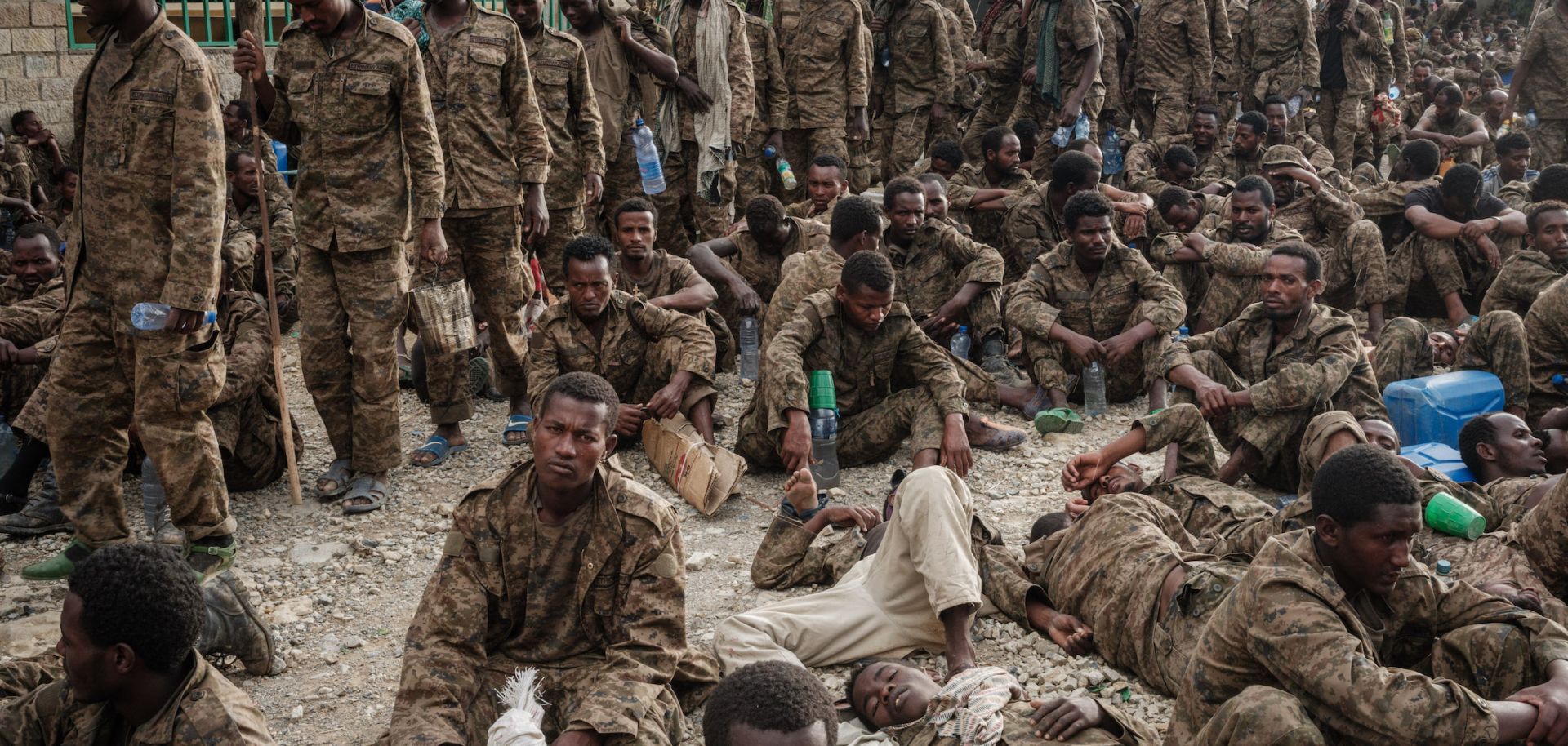
Captive Ethiopian soldiers on July 2, 2021, in Mekele, the capital of Ethiopia's Tigray region.
U.S. pressure to force Ethiopian parties to the negotiating table and agree to a cease-fire will have a hard time ending the conflict in Ethiopia and improving the worsening humanitarian crisis there. U.S. President Joe Biden signed an executive order, announced publicly by the White House on Sept. 17, creating a new sanctions regime to be used against anyone involved in the Tigray conflict and blocking progress toward a cease-fire and possible negotiations. Thus far, no one has been sanctioned by the Treasury Department, but Biden threatened to use them against all sides of the conflict if a cease-fire does not emerge. In a Sept. 16 conference call with the press, a senior U.S. administration official said that "the administration will take aggressive action, under this executive order, to impose sanctions against a broad range of individuals or entities," if steps were not taken to resolve the conflict.
- The United States previously cut aid for Ethiopia, banned some Ethiopians from traveling to the United States and sanctioned the head of the Eritrean army's chief of staff under the Magnitsky Act over the Tigray conflict, but the new sanctions regime dramatically broadens the legal basis for more sanctions.
- The executive order authorizes the Treasury Department to place wide-ranging financial sanctions on any individual or entity obstructing a cease-fire or peace process, disrupting the delivery of aid, involved in attacks in northern Ethiopia, taking steps to undermine democracy in Ethiopia, or taking steps to undermine Ethiopia's territorial integrity.
- Sanctions may also be placed on any security force that has operated in northern Ethiopia since November 2020 and any entity within the governments of Ethiopia or Eritrea, the Tigray People's Liberation Front (TPLF), the Amhara regional government, or Amhara regional or irregular forces.
The United States will need to aggressively wield its new sanctions regime to achieve even a temporary cease-fire or half-hearted negotiations designed to appease Washington rather than resolve the conflict, and neither is likely to happen quickly. After the executive order was published, Ethiopian Prime Minister Abiy Ahmed wrote an open letter to Biden criticizing U.S. policy and the TPLF, reiterating that his government considers the TPLF a terrorist organization and comparing the conflict to the U.S. "War on Terror." Thus far, TPLF officials have not publicly responded to the new call by the United States, but given Abiy's rejection, they will likely maintain their aggressive military posture. Inaction will likely lead to the United States putting a number of sanctions in place over the next two months. The U.S. sanctions regime potentially has teeth, as anyone listed would essentially be blacklisted from the global financial system. Less clear is whether Washington will accept the political costs of expansively sanctions against a broad swath of those involved in the conflict, such as the entire Ethiopian or TPLF militaries or ministries, or if it will limit itself to specific commanders and political figures. In previous conflict theaters where the United States has not backed one side over another (such as Libya), the United States historically has taken the narrower approach.
- On Oct. 4, Abiy is expected to name a new Ethiopian government as a parliamentary session begins following this summer's elections. Abiy will likely lay out an aggressive strategy against the TPLF at that time, but U.S. officials have said they will be watching for a change in strategy.
With the Tigray conflict worsening — and spreading beyond the Tigray region — the economic and humanitarian toll is likely to continue to deteriorate over the next few months. New U.S. sanctions will complicate efforts by nongovernmental organizations to work with sanctioned entities, even if there are significant humanitarian carve-outs from sanctions designed to protect the delivery of humanitarian supplies and aid. If key officials or military units are sanctioned, their resolve to continue fighting may increase in response. For foreign companies, compliance risks working with the Ethiopian government, Amhara regional government and other Ethiopian entities will increase as the United States widens its sanctions net in order to force the parties to the negotiating table.
- In its Sept. 16 update, the U.N. Office for the Coordination of Humanitarian Affairs said that the last humanitarian cargo to enter Tigray did so on Sept. 7.
