
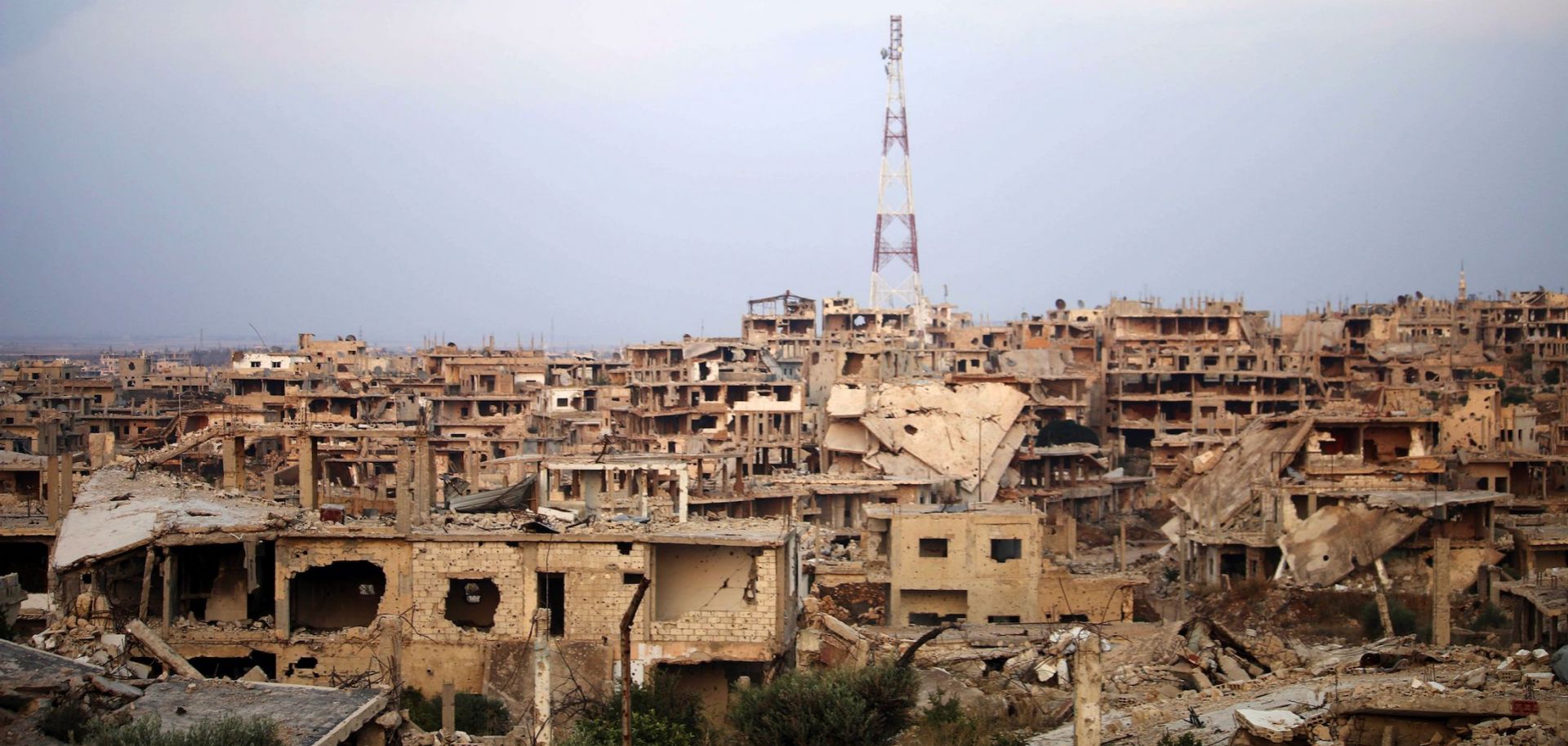
A picture taken on Aug. 2, 2018, shows destroyed buildings in the southern Syrian city of Daraa.
If government and rebel forces in Syria fail to ink a new cease-fire agreement, an escalation of fighting in the south could inspire unrest in other regime territories and send a new flood of refugees into Jordan. Tensions erupted between regime and rebel forces in the southern border city of Daraa on July 29, marking what the Syrian Observatory for Human Rights called the “most violent and broadest clashes in Daraa since it came under regime control.” The Syrian Al-Watan newspaper claimed a military operation had begun against rebel forces, while activists and opposition sources said that rebels had taken military checkpoints and repelled government attacks. Daraa has been in crisis since June 25, when Syrian forces demanded former rebels turn over light weapons under a cease-fire deal signed in 2018. But rebels balked at the prospect, with Syrian forces surrounding the city in an attempt to pressure rebels into conceding their weapons.
- Daraa lies on a vital Jordan-Syrian border crossing, a major source of pre-war trade that the two countries were in the process of restoring following pandemic-related closures. The Syrian government’s access to the crossing and Jordanian trade has been made all the more crucial by the war-torn country’s growing economic troubles, which is inspiring protests in even loyalist territories.
- Daraa is also the site of one of the few regime-rebel reconciliation deals that did not result in an evacuation of rebels to Idlib province, leaving many rebels in place and armed as part of the cease-fire. But the area has been plagued by instability since 2018, with Iranian and Syrian forces clashing with rebels in one-off shootings and bombings.
In the near term, rebels and Damascus will carry out talks for a new cease-fire designed to strengthen their respective positions against each other. Both sides will likely continue to use military force to jostle for advantage in another cease-fire, with Syria seeking Russian and Iranian backing to conduct a more thorough military campaign in Daraa. Rebels, meanwhile, will aim to utilize enough military pressure to earn concessions from Damascus in another set of negotiations. Russia has been hesitant to conduct widespread military operations in southern Syria in part because of concern about creating a new flood of refugees that might provoke international outrage. Moscow also fears such operations could heighten Israeli and U.S. interest in on-the-ground combat to protect nearby Golan Heights from Iranian-backed forces.
- During the 2018 offensive that saw Daraa recaptured by Syrian forces, Russia had to assure Israel that Iranian-aligned forces would not entrench themselves in the aftermath of the operations and that Israel’s border at the Golan Heights would remain secure.
If cease-fire talks fail and rebels are able to hold off Syrian forces in Daraa amid the continued fighting, unrest will risk spreading throughout the rest of Syria, with militants likely launching attacks from Idlib province. Caused by ten years of civil war, the COVID-19 crisis and crushing U.S. sanctions, Syria’s deepening economic crisis is fueling protests and unprecedented levels of dissent across the country, including in territories loyal to the government. A rebel victory at this late stage in the conflict could embolden dissidents to challenge government control and demand economic or even political concessions. It would also signal to militants in Idlib that Russian and Iranian backing might be weakening or can be rolled back, emboldening them to harass Syrian forces along the cease-fire line in the province.
But if Damascus gets enough Iranian and Russian support to carry out an expansive military operation in the border city, the subsequent escalation of violence will risk sending a new wave of refugees into overburdened Jordan. Should the rebels continue to make headway in Daraa, Russia and Iran may give the Syrian government fuller backing for a major military operation, including air support. Such an operation, however, would cause widespread civilian casualties and send a new flood of Syrians into Jordan. This would, in turn, force other countries to step up aid to Syria’s southern neighbor, which already hosts 655,000 Syrian refugees.
