
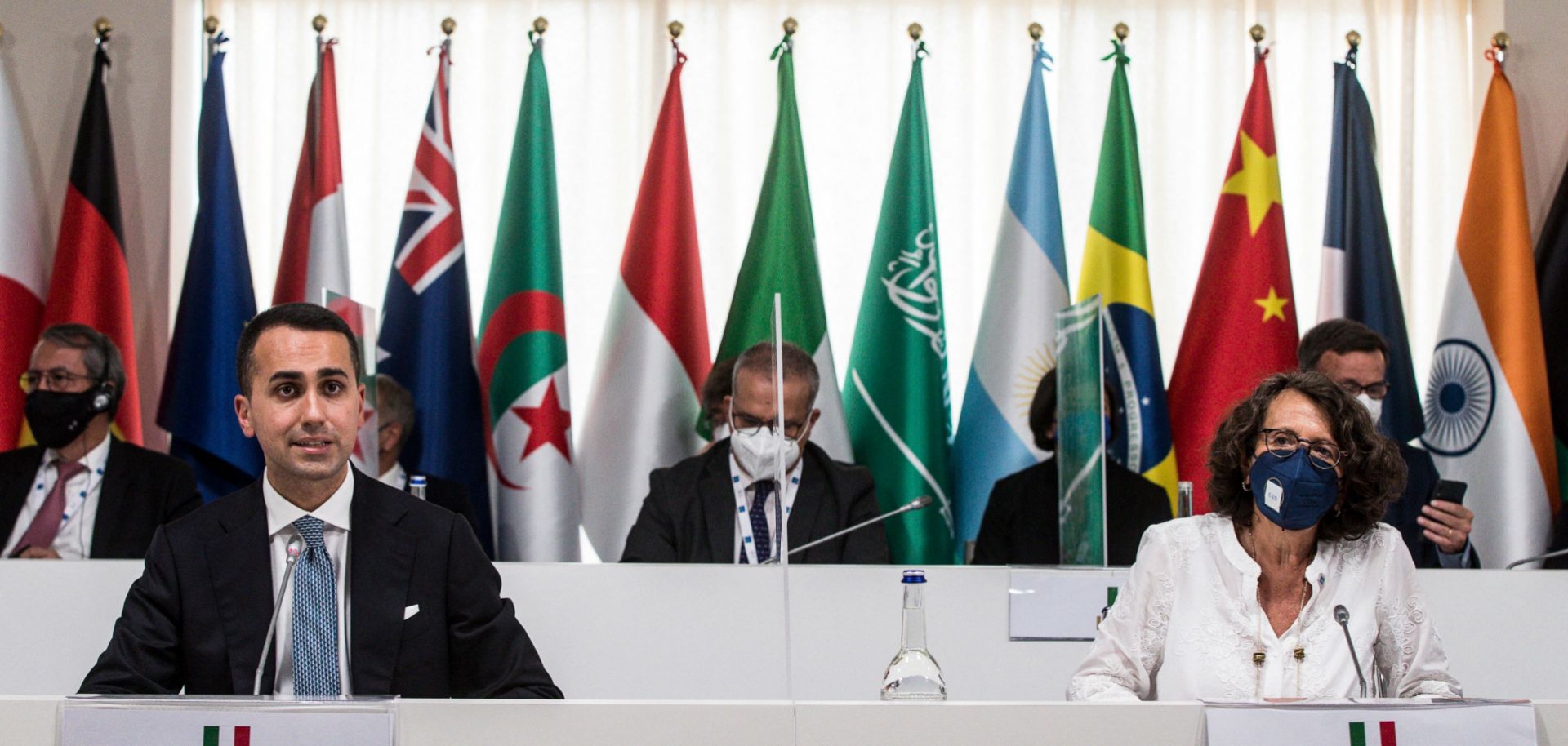
Italy’s top foreign policy officials attend a G-20 joint session on June 29, 2021.
Competing interests between the European Union, the United States and emerging economies could prevent Group of 20 (G-20) countries from reaching a deal on a global tax overhaul. This would deprive governments of much-needed resources to cope with the aftershocks of the COVID-19 pandemic by discouraging corporate tax shifting. G-20 finance ministers will meet in Venice on July 9-10 to discuss a draft global tax deal agreed to in principle by 130 countries on July 1, with the aim of completing it by the G-20 summit in October. At stake is up to about $200 billion a year in potential lost tax revenues from not passing the deal at a time when governments worldwide are facing large post-pandemic budget deficits and rising public debt, as well as renewed tensions caused by mainly U.S.-based multinational tech companies not paying taxes on digital services sold abroad.
The possible need for a 67-vote supermajority in the U.S. Senate on the so-called “Pillar 1” part of the deal — which seeks to tax multinationals in the territories where they earn their revenue and not only where they are based — could complicate its ratification. Taxing large companies on the basis of where revenues are earned (and not where they’re headquartered or “book” profits) could require altering existing tax treaties or creating new ones. A legal argument that U.S. legislation overrides international treaties could feasibly be made — but in the face of possible solid Republican opposition, and at the risk of alienating Democratic lawmakers who have proven reluctant to challenge or change long-standing Senate procedures.
- The U.S. Senate is split 50-50 between Democrats and Republicans. This means all Democrats would need to vote together if no Republicans join them in order for Democratic Vice President Kamala Harris to break a tie.
- Senate Republicans have been scathing in their criticism of the pending draft agreement. Key House Republicans have also been overwhelmingly negative, although Democrats have a slight majority and could afford defections.
Another obstacle to the deal is the European Union’s proposed digital tax, which is the result of Brussels’ need for new revenues to finance its pandemic recovery plans. The European Commission is planning to introduce an EU-level tax on gross revenue from digital services, or a digital services tax (DST). Individual member countries are also planning to increase taxation for cross-border sales and services in their jurisdictions made by tech giants that are mostly based in the United States (like Google, Amazon, Apple and Facebook).
- The European Commission and several European governments have announced or implemented their own plans to tax multinationals in the digital sector. The Organization for Economic Cooperation and Development (OECD) and G-20’s could obviate the need for national taxation by including provisions accomplishing the same ends. Nonetheless, 13 EU countries and the United Kingdom are at various stages of implementing national taxes and there is no guarantee those will be repealed, even if some have put those taxes on hold to wait for developments in negotiations with the United States. France, for example, has said an international agreement would replace national action.
- While the administration of U.S. President Joe Biden has been overall less confrontational on the issue of digital taxes compared with its predecessor, U.S. Trade Respresentivie Katerhine Tai warned on June 2 that Washington was holding in abeyance Section 301 retaliatory tariffs for the DSTs imposed by Austria, India, Italy, Spain, Turkey and the United Kingdom. U.S. Treasury Secretary Janet Yellen has also voiced concerns that the European tax plans target American businesses. Yellen is discussing the issue with her EU counterparts ahead of the G-20 ministerial meeting and will meet with Eurogroup finance ministers afterward.
The European Union also lacks unanimity on “Pillar 2” of the deal, which introduces a global 15% minimum corporate tax. Ireland, Estonia and Hungary have all voiced opposition, arguing that a global corporate tax would harm economic growth and investment. Poland and the Czech Republic are skeptical of the idea as well. EU ratification would also require the support of Cyprus, which is a member of the bloc but has not been involved in the global tax talks sponsored by the G-20-OECD.
In addition to gaining support from more hesitant G-20 countries, a final deal would need to maintain OECD-proposed provisions as well, opening the door for additional complications that could endanger the entire multilateral joint effort. G-20 members China, Argentina, Saudi Arabia, Russia and Turkey are reluctant about the global tax deal. The OECD has also proposed exemptions and other carve-outs for specific industries and special economic zones exempting corporate investments in physical assets, such as plants and equipment. Within the broader group in the OECD-sponsored talks, Barbados, Kenya, Nigeria, Sri Lank, St. Vincent and the Grenadines are also opposed, while Peru abstained from the recent agreement.
But even if all the political obstacles within the G-20 are overcome, there is no guarantee that international tax havens will cooperate and cease competition over taxes that have driven down aggregate global government revenues and increased government debt loads. Credible academic studies indicate that as much as 40% of global foreign direct investment is made solely to shift profits and royalties on patents to low-tax countries. That’s reduced global average tax rates from 40% in 1980 to only 24% in 2020, as tax haven countries compete in cutting tax rates to attract revenues. Corporate efforts to shift profits cause economic costs and inefficiencies that are unproductive.
