
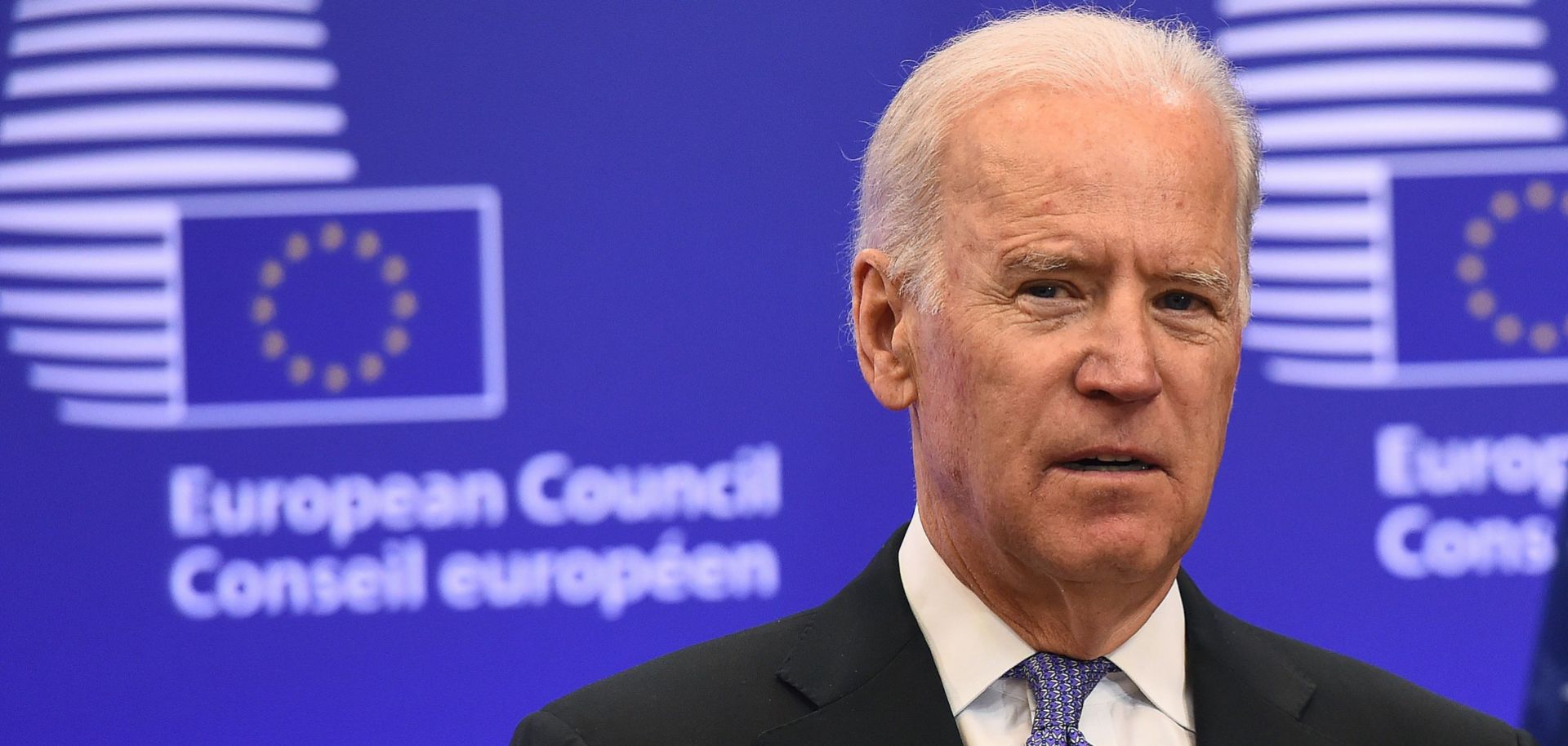
Then-U.S. Vice President Joe Biden speaks during a 2015 meeting with EU leaders in Brussels, Belgium.
The United States and the European Union are trying to present a united front against both China and Big Tech, but key differences on issues like data privacy will complicate efforts to find a unified position on technology-related issues. The European Union and the United States announced the establishment of the U.S.-EU Trade and Technology Council (TTC) on June 15 to coordinate their efforts during U.S. President Joe Biden’s visit to Brussels. Both sides also agreed to establish the U.S.-EU Joint Technology Competition Policy Dialogue, which aims to coordinate issues relating to antitrust and competition policy.
- Neither the TTC and nor the competition dialogue mentions China directly but the establishments dovetail the recent NATO and G-7 summits where the United States and other North American countries agreed to take a stronger stance toward China, with NATO calling China a “systemic challenge.”
- The TTC will establish working groups on securing supply chains and coordinating proposals for technology standards, along with groups focused on climate and green tech, as well as data governance and export controls.
- Although the joint U.S.-EU statement did not announce any specifics. But prior to the summit, Politico reported that reaching a new agreement on cross-border data transfer rules with the European Union was one of the Biden administration’s priorities.
The flurry of announcements comes as Biden is rehabilitating Washington’s relationship with its allies and partners in part to anchor a global push against China. In his first five months in office, Biden has clearly prioritized reducing tensions with U.S. allies over various issues, including tariffs imposed by his predecessor. Biden has also sought to internationalize the campaign against China and is framing China’s rise as a fundamental threat to Western democratic and free-market ideals. Europe, meanwhile, is also increasingly taking more aggressive action against China.
- Ahead of the group’s June 11-13 summit, the G-7 announced that it had reached an agreement on international tax reforms. This then prompted the United States to propose imposing tariffs on some European countries in retaliation for their adoption of digital services taxes. Italy, the only G-7 member that has signed a memorandum of understanding with China on its Belt and Road Initiative, also announced that it was reviewing the agreement at the summit.
- At the June 14 NATO summit, the Biden administration did not prominently demand European members to increase defense spending as the Trump administration did in previous NATO summits.
- On June 15, the United States and European Union also reached an agreement on tariff disputes involving Airbus and Boeing subsidies.
- The European Union increased its regulatory oversight to review Chinese investment in recent years and in May proposed new rules that would allow the European Commission to block acquisitions by companies that receive subsidies from a foreign government.
The high-level political agreements regarding China only mask what are likely to be difficult negotiations between the United States and the European Union over technology issues — particularly when it comes to implementation of any agreements on antitrust and privacy, which would require domestic legislation in both jurisdictions. The global dominance of U.S. multinational tech companies, which even China cannot compete easily with, sits at the heart of many of the tech-related disputes between Brussels and Washington.
- Competition and Antitrust: The European Union will take a more expansive view than the United States on curbing practices by tech companies that it deems anti-competitive, in part due to the fact that it's often European competitors who see their market opportunities diminished. The European Union’s proposed Digital Markets Act is already raising flags in Washington. The act aims to regulate platform companies with a large user base, but a leading European lawmaker involved in the drafting process said that it should only target the five largest platform companies, which are all American. The lawmaker’s comments prompted the U.S. National Security Council to send a letter in June to European officials warning that the act should not unfairly target U.S. companies. The United States has also proposed a raft of different antitrust measures and reforms against the tech industry. But in order to more closely align the U.S. antitrust position with Europe’s, the push will need bipartisan support in Congress, which will prove difficult given that even Democrats are divided on how aggressive to pursue antitrust reform.
- Data Transfers: The European Union will likely continue to have stricter rules on privacy and limitations on government access to personal data. This could make any new data transfer agreement subject to another strike down by European courts. The last two EU-U.S. agreements have been struck down over concerns about the U.S. intelligence community's access to personal data and weaker rules restricting government access. The European Union is hesitant to enter another data transfer agreement, given its concerns. Any such deal would likely also require changes to U.S. surveillance and national security laws, which could be problematic domestically in the United States.
- Artificial Intelligence: The European Union proposed wide-ranging rules on artificial intelligence (AI) in April and differing opinions on the bloc’s new rules are likely to quickly emerge on the TTC. The EU rules would prohibit the use of AI algorithms in ways that would infringe upon the EU Charter of Fundamental Rights and create transparency requirements in sensitive areas, including requiring notifications when using chatbots and deep fakes. The strict rules go against the United States’ historic light-touch approach to the emerging tech sector. The chairman of the U.S. National Security Commission on Artificial Intelligence, Eric Schmidt, has already criticized the rules in May, calling them a “very big setback for Europe” with respect to advancing and improving the technology if fully adopted.
- Taxation: The G-7 agreement on international tax reform is a positive announcement toward such reform under the G-20 and Organization for Economic Co-operation and Development (OECD)’s Inclusive Framework, which involves more than 130 countries. But sticky issues remain. The G-7 negotiations focused heavily on reaching a consensus for backing a 15% minimum corporate income tax, as well as divvying up taxing authority on large multinational technology companies on the basis of profits and revenue in various countries as opposed to their headquarters. But the final details on the precise tax base and how to address the U.S. retail giant Amazon, which often has low profit margins, has not been reached. Countries that have historically relied heavily on offering special economic zones with no corporate taxes to gain investment are expected to demand carve-outs, which could lead to European tax havens like Ireland demanding the same. Although no longer a member of the European Union, the United Kingdom is also pushing for a carve-out for financial sectors.
