
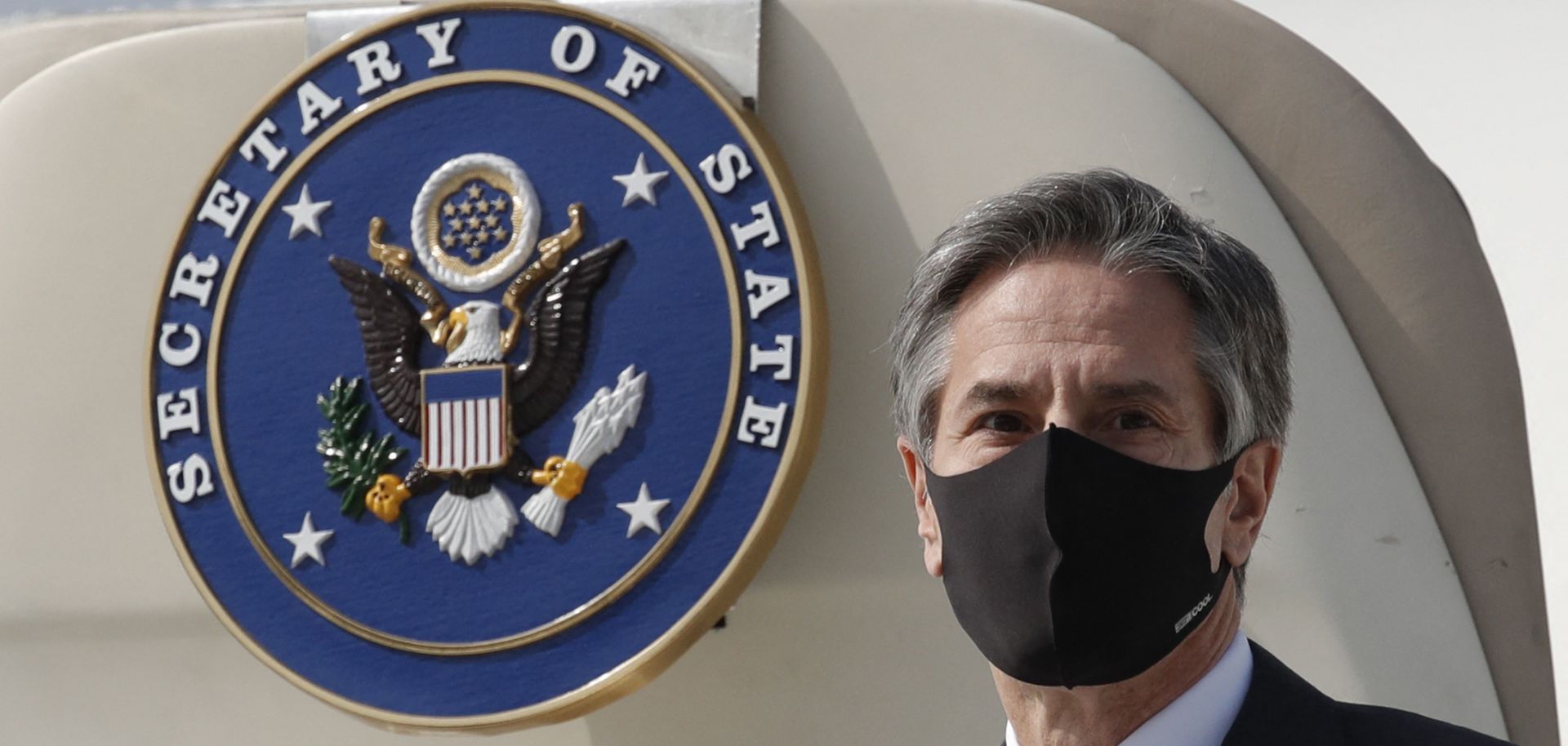
U.S. Secretary of State Antony Blinken arrives in South Korea on March 17, 2021.
The first face-to-face meeting between officials from the new U.S. administration and China is unlikely to lead to any breakthroughs; rather it is intended to set the strategic tenor of relations from the U.S. side. U.S. Secretary of State Antony Blinken and National Security Advisor Jake Sullivan will host Chinese Foreign Minister Wang Yi and director of the Office of the Foreign Affairs Commission of the Central Committee of the Communist Party of China Yang Jiechi in Alaska March 18-19 for the first face-to-face talks between the administrations of Joe Biden and Xi Jinping. Expectations are low, at least in regards to any early easing of trade or security frictions. The White House will instead use the meeting to reset Beijing’s expectations while laying out the contours of its evolving policy toward China, which so far appears to be a fairly hard-line stance.
Ahead of the meeting, U.S. officials engaged in a rapid series of diplomatic and military dialogues with partners and allies, highlighting local concerns and priorities to reinforce a common front. The United States has emphasized multilateralism and a focus on strategic competition with China ahead of the meeting. Just a few of the actions from the past week include:
- Biden joined a virtual summit of the leaders of the Quad countries (the United States, India, Australia and Japan), agreeing on collaboration in countering COVID-19 and reinvigorating a grouping seen as the core of a counterbalance to China in the Indo-Pacific region.
- Blinken and U.S. Defense Secretary Lloyd Austin visited Japan and South Korea for strategic talks, and Austin will continue on to India while Blinken heads to Alaska. The meetings in Japan and Korea followed the conclusion of negotiations over delayed defense cost-sharing agreements.
- In both Japan and South Korea, the visiting U.S. officials addressed particular local concerns, including the Chinese maritime activity in the disputed Senkaku/Diaoyu Islands and South Korea’s cautious balance of engagement and deterrence with North Korea. This was meant to reinforce the sense of cooperation.
- Kurt Campbell, the administration’s Indo-Pacific coordinator, said Washington would not improve relations with China until Beijing ceased its “economic coercion” of Australia, noting similar Chinese behavior toward several other U.S. allies and partners. The message was not merely to Beijing — it was also intended to rebuild trust by allies that the United States would defend them or help offset costs of their actions against China.
- Washington approved the sale of key military technologies to Taiwan to assist with domestic submarine development, suggesting a continuation of expanding sales and a willingness to help bolster Taiwan’s defense capabilities.
Biden’s focus on a multilateral approach, which was signaled well before the November election, is a key component of his administration’s foreign policy. Rebuilding trust will take time. Perceptions of U.S. unreliability led to significant changes in Philippine relations with the United States and China, have strained ties with South Korea, and remain a sticking point in U.S. attempts to bring partners in alignment with U.S. priorities. But the initial efforts by the administration show at least a recognition of this challenge, and highlight the importance Washington pays to removing a key tool from China’s diplomatic arsenal — that is, the ability to exploit significant differences among countries within the U.S. alliance and partner structure.
The Biden administration is approaching the meeting by highlighting its renewed multilateral approach, but also showing continuity with its predecessor’s hard-line perceptions of China. Beijing initially saw the meeting as an opportunity to “reset” relations, to find areas of collaboration and to ease tensions between the two powers. But as the meeting draws closer, the Chinese have shifted their own expectations, and are cautiously downplaying the importance of the meeting. Nonetheless, they have signaled that they will call for the removal of U.S. sanctions and a significant shift in relations, likely as a way to highlight their “willingness” and U.S. “intransigence.” The United States has promised to address hot-button issues, including Hong Kong, Xinjiang and Taiwan, and the Chinese no longer expect any swift talk of easing trade tensions. China’s strategic interests remain unchanged, and Beijing is unlikely to back down on any of its internal issues (or Taiwan), suggesting this first meeting will be rather contentious.
Coming out of the meeting, we will be watching for any signs of tactical cooperation, areas of further escalation, and signals for future discussions on economic and trade issues. While there are few expectations for a major adjustment to bilateral relations in Alaska, we can monitor for more subtle tactical adjustments.
- There may be announcements of future bilateral or multilateral working groups that could provide space for focused dialogue and cooperation, even as strategic relations remain strained. Both Washington and Beijing at times have hinted at potential collaboration on issues of multilateral interest — from managing the COVID-19 pandemic to alternative energy and climate change mitigation. There is also room for further defense talks on setting protocols for military encounters at sea or in the air, for search and rescue coordination, and for countering piracy and illegal fishing.
- Further escalation of tensions between the two could be signaled by demands for significant changes in behavior. If Washington sets specific expectations and deadlines on China for political actions in Hong Kong or human rights activities in Xinjiang, for example, we could see a further degradation of space for cooperation. China could also make clear threats regarding what it considers its territorial waters, building off of the recent change in laws regulating its Coast Guard use of force.
- While Washington is trying to unify its partners and allies, China may shift its focus to keep the gaps open. China may step up its Code of Conduct negotiations with the Association of Southeast Asian Nations (ASEAN), for example, to dissuade Southeast Asian nations from signing on to any broader U.S. initiatives, and shift its active maritime pressures from the South China Sea to the East China Sea. The Chinese may also step up diplomacy with South Korea, which remains concerned that the Biden administration may abandon anything that happened in North Korea relations during the Trump administration.
- While not a significant part of the Alaska meeting, the next phase of the U.S.-China dialogue is likely to focus on economics and trade. The Alaska talks will give some sense as to how tightly the United States will tie economic, strategic and human rights issues, or whether it will continue the general pattern of the past administration, keeping the three tracks somewhat separate. The former would make any quick progress complicated, but may also drive more strategic dialogue between China and the United States.
