
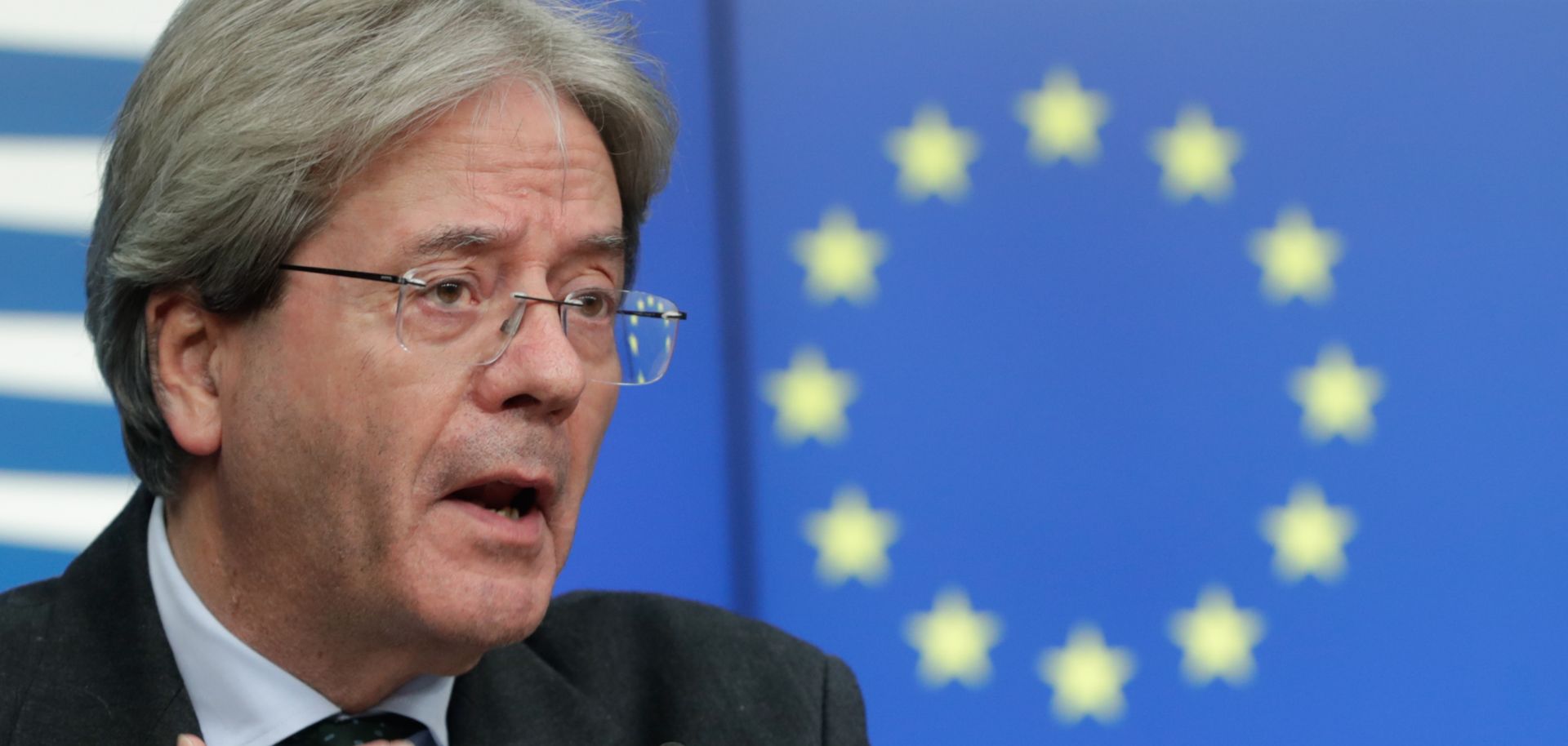
EU Economy Commissioner Paolo Gentiloni speaks during a press conference after a virtual meeting at the European Council in Brussels, Belgium, on Feb. 15, 2021.
The European Union will move forward with a plan to force large multinational companies to be more transparent about the taxes that they pay in every member state. This measure will likely expose the special (and unpopular) deals that small countries often offer to corporations and, indirectly, increase EU pressure for higher taxation of digital companies. The Portuguese government, which holds the rotating presidency of the European Union, announced on Feb. 25 that it has secured enough support from member states to move forward with a plan to force multinationals with revenue of more than 750 million euros that operate in the bloc to reveal their tax payments and activities for each member state. The proposal will now move to the European Council and the European Parliament, which means that it could be months before it is enforced. Opponents to the plan, which include Luxembourg and Ireland, could challenge its legality and take it to the European Court of Justice.
- The country-by-country reporting plan for multinationals was first discussed in 2016 in the wake of a scandal that revealed the so-called “sweetheart tax deals” that Luxembourg offered to multinational corporations. But the plan made little progress because of opposition from countries including Luxembourg, Ireland and Sweden. Any tax reforms in the European Union must be approved unanimously by member states, which gave these countries veto power.
- Portugal was able to end the stalemate because it proposed the plan as a competition issue instead of a taxation issue, arguing that it does not represent a change in the way that taxes are levied in the European Union but only a change in the way they are reported. Competition issues are decided using qualified majority, which deprived the opponents of the plan to levy their veto power.
- Ireland’s Minister of State for company regulation Robert Troy warned that the measure must be “consistent” with “international cooperation and exchange-of-information arrangements, which are based on confidentiality.” He also said that “it is essential that the proposed directive is developed with the appropriate legal basis to ensure it is legally robust.”
The proposal will likely prompt additional scrutiny of special tax deals that multinationals receive across the Continent. While these agreements are not necessarily illegal, the breaks may precipitate reputational damage for the companies and governments involved, as the deals tend to be unpopular among voters and consumers. The ongoing pandemic-induced recessions in Europe are likely to make people across the Continent even more critical of the tax benefits that governments grant to large corporations. A more homogeneous tax reporting in the European Union would also add transparency and greater harmonization of practices across member states, which is likely to improve the business climate in the bloc. The Portuguese proposal could also reignite the debate over the harmonization of corporate tax rules in the European Union, though this is improbable in the short-to-medium term because of resistance from some member states.
- In September 2020, EU Economy Commissioner Paolo Gentiloni said that the European Commission was looking for ways to eliminate the “aggressive tax planning” structures that distort the European Union’s single market in order to secure “a level playing field” among member states.
- In a May 2020 report, the European Commission urged Cyprus, Hungary, Ireland, Luxembourg, Malta and the Netherlands to take action against “aggressive tax planning.”
- In March 2019, the European Parliament warned that Luxembourg, Malta, Ireland, the Netherlands and Cyprus displayed “traits of a tax haven and facilitate aggressive tax planning."
- The European Commission has repeatedly expressed interest in the creation of an EU-wide Common Consolidated Corporate Tax Base (CCCTB) system, a common set of rules for determining the tax base of companies that operate in the bloc. But such a decision would require unanimous approval, which severely reduces the chances of its approval.
This plan is also indirectly connected to an EU proposal to force large digital companies to pay taxes not only in the countries where they are legally based, but also in the territories where they sell their products. Greater scrutiny of tax practices in every EU member state is likely to make this issue more visible. For years, Brussels has been pushing for large digital companies to pay more taxes in the countries where they are active, and not only in the territories where they have their legal seats. This has resulted in disputes with the United States because most of the companies that would be targeted by such a policy are American. The European Commission has said that its preferred option is a global deal within the framework of the Organisation for Economic Co-operation and Development (OECD), but Brussels has said it is willing to act unilaterally if no global agreement is found. Some individual EU member states such as France, Italy and Spain have announced their own taxes.
- In 2019, France introduced a 3% digital service tax (DST) for companies that annually generate at least 25 million euros in French sales and 750 million euros in global revenue. But Paris suspended the collection of the tax shortly thereafter to allow for discussions at the OECD on the issue. In November 2020, France announced its intention to resume the collection of the tax.
- The United States announced tariff hikes against French products in 2020 to retaliate against France’s digital tax. The Office of the U.S. Trade Representative announced in January that the measure had been suspended indefinitely.
- In January 2021, the Italian revenue agency released its guidance on a national DST. Rome’s plan is to start collecting the tax in March.
- The Spanish parliament approved a 3% DST in November 2020. The tax entered into force in January.
- The European Commission has also said it will present a proposal for an EU-wide DST in mid-2021.
- On Feb. 26, the U.S. government said it would work with its OECD partners to address “the tax challenges of digitization.”
