
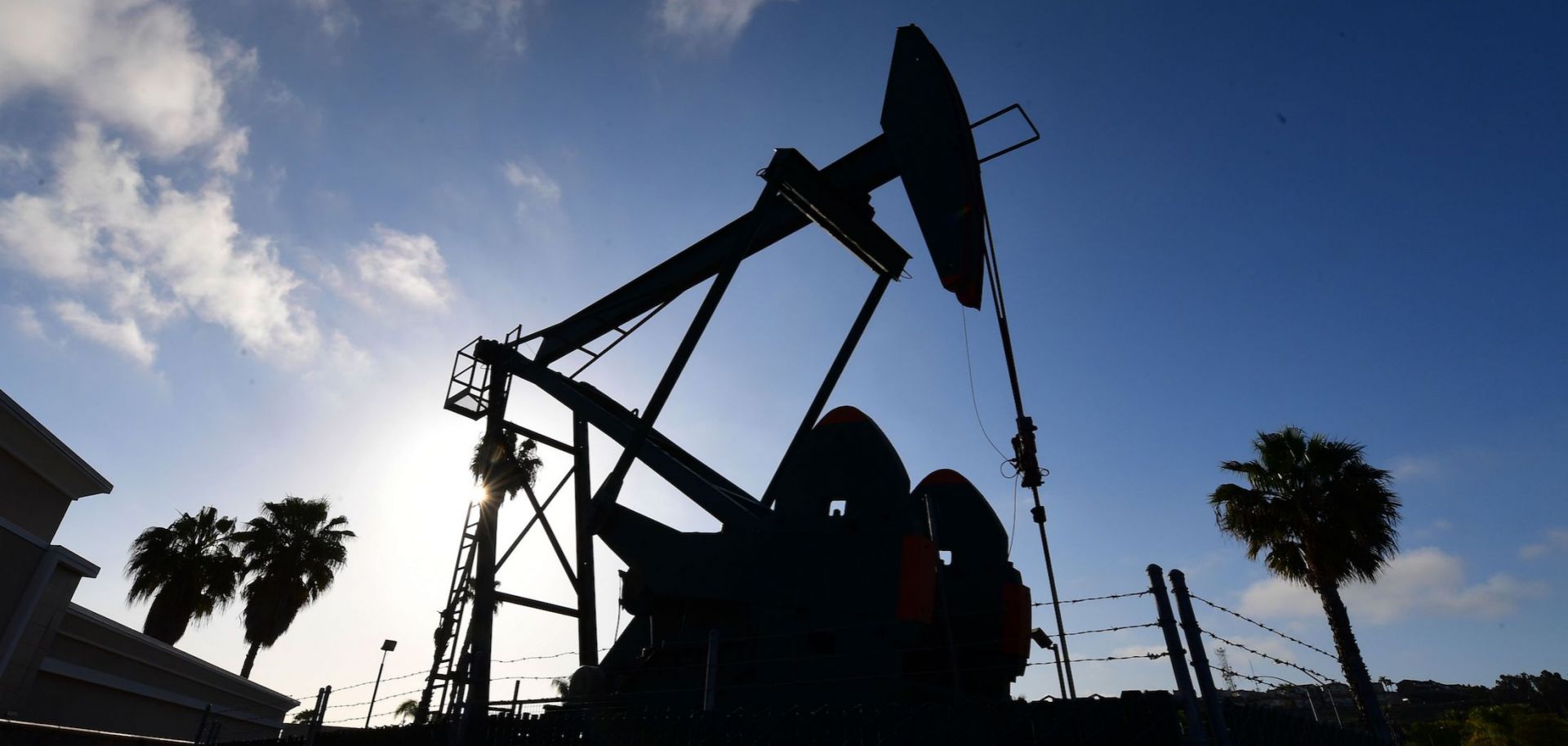
An oil pumpjack operates in Signal Hill, California, on April 21, 2020, a day after oil prices dropped to below zero amid the ongoing COVID-19 pandemic.
Crude oil prices are likely to stall heading into the fourth quarter of 2020 as global demand remains sluggish, while modest rises in OPEC+ supply undermine efforts to rapidly balance the market and drain excess inventories. This means the fiscal position of countries highly dependent on oil export revenues will likely continue to be strained, and that any recovery in drilling activity and the oilfield services sector will be slow.
The Prospect of a Prolonged Pandemic
The resurgence of COVID-19 infections in many countries around the world has undermined the oil market's notion that the recovery in petroleum product demand will continue upward in the absence of a vaccine. Expectations of a swift demand recovery in recent weeks have also been hampered by concerns about new mandatory lockdowns in places where economic activity had resumed, as well as slower economic recoveries elsewhere.
The most recent International Energy Agency (IEA) forecast released on July 10 had indicated that, based on revised and more accurate data, the worst of the global demand destruction at the peak of initial COVID-19 lockdowns in April was only 16.4 million barrels per day (bpd), compared with the up to 30 million bpd loss other forecasts were estimating at the time. The IEA also estimated that demand would average 94.3 million bpd in the third quarter of 2020, down only 6.5 million bpd from the 100.2 million bpd during the same period in 2019. Assuming perfect OPEC+ compliance with output quotas from the June 2020 meeting (which is unlikely), this would leave the global inventory overhang draining at a rate of over 4 million bpd in the third quarter of 2020. However, this rate of inventory decline looks increasingly unlikely to materialize:
- In India, the aggregate number of COVID-19 cases has risen by about 20 percent in the last week alone, and states and cities across the country are now starting to reimpose varying degrees of lockdowns. At 3.7 million bpd, India's crude oil imports for July were still down sharply from the record 4.7 million bpd India hit last fall. Renewed lockdowns could drive this further down.
- In the United States, gasoline demand in early July was still 9 percent below the same period in 2019, and the upward trend in the weekly "product supplied" data from the U.S. Energy Information Administration (EIA) has stalled. Meanwhile, some large states like California and Texas have reimposed closures on certain types of businesses, such as bars and dine-in restaurants. U.S. unemployment claims have also ticked back up, reversing the trend toward economic recovery.
- The global picture is worrisome as well, making the market less confident that expectations of further demand recovery will materialize in the near-term. Aggregate new daily infections are now running at over 200,000, with countries including Spain, China and Vietnam announcing localized lockdown measures to contain new outbreaks.
The Production Problem
On the supply side, while compliance remains good overall by historical standards, OPEC+ is continuing to move forward with tapering production cuts. Several countries — namely, Iraq, Nigeria, Angola and Kazakhstan — were not fully compliant with output cuts in the second quarter of 2020. Prior to the July 15 OPEC+ monitoring committee meeting, these countries pledged to compensate for their previous overproduction in response to pressure from Saudi Arabia and Russia by keeping volumes below their quotas in August and September. OPEC+ had clearly signaled on July 15 that it would stick with its June 6 decision to taper production cuts from 9.7 million bpd to 7.7 million bpd. But these pledges by previous "cheaters" allowed Saudi Energy Minister Prince Abdulaziz bin Salman to claim that the "real" cut in August and September would be around 8.3 million bpd, based on perfect compliance and counting those extra "make up" volumes. However, there remains little evidence that these four countries will actually increase their compliance.
- On July 23, the International Oil Daily reported that Iraqi tanker export loadings had risen by an average of about 300,000 bpd during the first three weeks of July compared with June levels. That rolls back what had been a compliance level of 91 percent in June — atypically high for Iraq. Baghdad has also allowed Japan's Japex to restart production at the Gharraf field, which produces heavy crude. Iraq's production cuts have concentrated on the heaviest crudes, which usually sell for a lower per-barrel price. Bringing these volumes back thus implies a move away from compliance.
- There also is evidence that Angola is probably raising production, despite its pledge to make up for past noncompliance. Angola's tanker loading schedule for September includes 42 cargoes, well above the 38 cargoes on its August schedule.
With the rest of the OPEC+ countries beginning to gradually raise production in August, the only real way to force these members to adhere to deeper production cuts would be threatening to drive prices down by raising global output further. Saudi Arabia did this unilaterally after the OPEC+ meeting in March failed to reach an agreement. But given the sustained draw on Riyadh's fiscal reserves amid the ongoing COVID-19 crisis, the kingdom is unlikely to do so again.
- Compliance has historically proven to be better at the beginning of a cut, with cheating gradually increasing as prices begin to recover.
- U.S. production is already beginning to move modestly higher as companies reopen wells that were shut-in when prices dropped below their current operating costs. This will prove only a temporary reversal if crude stalls as expected, as prices will be insufficient to restore most new drilling activity. But it will contribute to an uptick in global production at least through Q3 2020.
A Stalled Price Recovery
While it's still likely that the massive inventory overhang will start declining in the third quarter of 2020, rising supply and a stalled demand recovery mean that the pace of inventory normalization will likely fall far short of the over 4 million bpd the IEA forecasted less than a month ago. Unless these factors reverse, crude oil prices will likely remain below the level needed to stimulate an uptick in short-cycle drilling activity.
- There is risk to the downside if COVID-19 lockdowns are reinstituted more widely in the United States, China, India or other major oil-consuming countries in Europe. This will, in turn, maintain pressure producers' finances, with prices falling to recover to budget breakevens for most OPEC member countries. This will even include countries such as Kuwait and Iraq, which have both kept their budgetary oil-breakevens prices in the $50-$60 per barrel range.
- Conversely, the weakening recovery should help to maintain cooperation between Saudi Arabia and Russia ahead of the next OPEC+ meeting in December, despite Russia's less-aggressive overall price objectives.
- This also will lengthen the recovery timeframe for the oilfield services sector, as prices remain below the roughly $50 threshold that would see a modest recovery in upstream development activity.
