
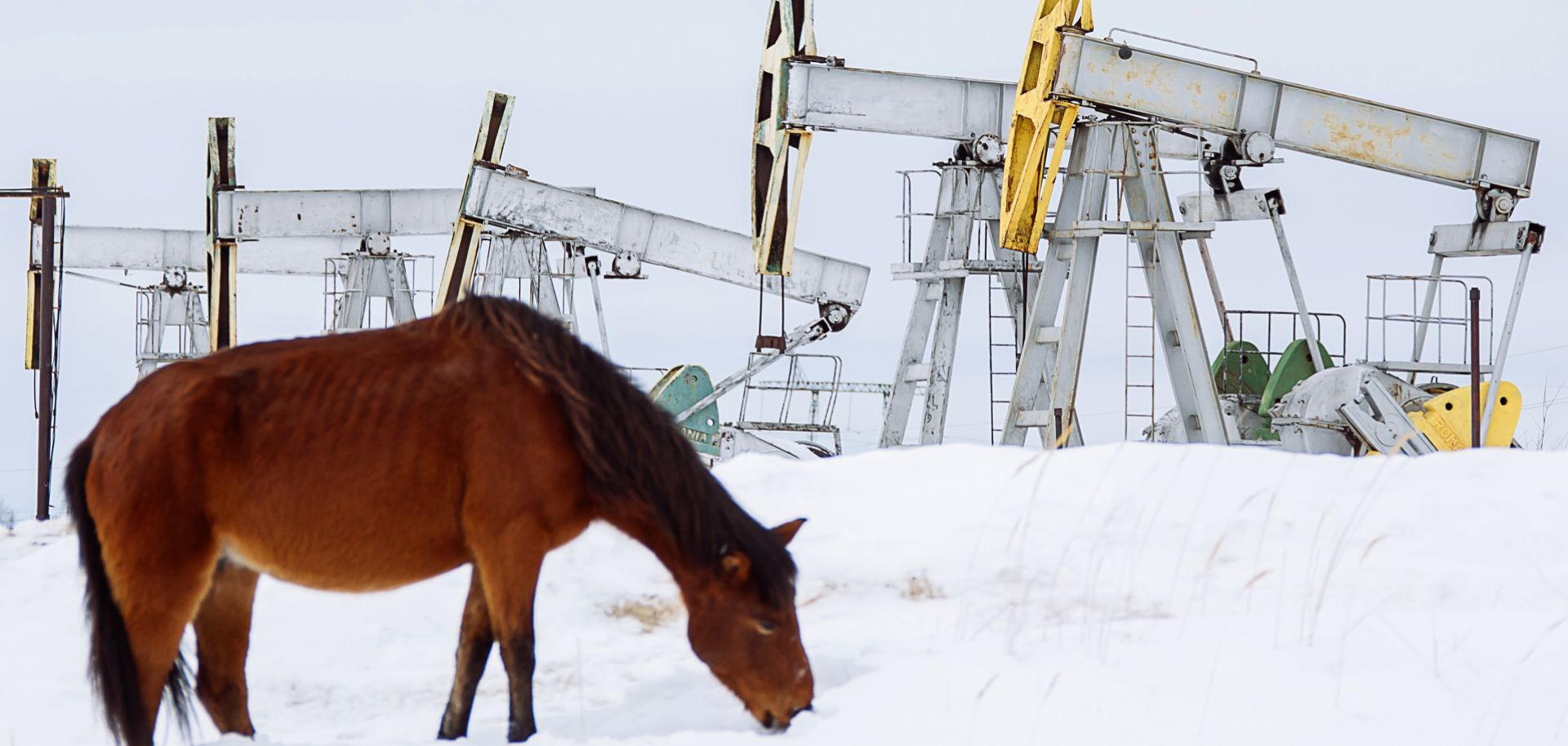
A horse grazes near oil pumpjacks outside the Russian city of Surgut on March 10, 2020.
What Happened
On April 12, OPEC and non-OPEC allies (also known as OPEC+) agreed to an unprecedented headline production cut of 9.7 million barrels per day (bpd) to support global oil prices, which have plummeted due to coronavirus-related demand shocks. This represents more than double the 4.2 million bpd volume targeted by OPEC (without non-OPEC participation) in the midst of the 2008 financial crisis, highlighting the severity of the current crisis.
The historic agreement resulted from a confluence of interests between the world’s top three producers (including the United States, Russia and Saudi Arabia), driven by the physical constraints of the crude oil market:
- With the current decline in demand estimated by as much as 30 million bpd or more due to the COVID-19 pandemic, available storage capacity is filling at a rate that would’ve been exhausted by the end of May. Global production thus had to decline, whether or not there was any sort of agreement on restraint.
- A large percentage of Russia’s oil exports are hard-wired via pipelines into Europe. This weakened Moscow’s negotiating position, necessitating the near-term agreement to a coordinated cut.
- Concerned about employment losses in the U.S. oil industry, U.S. President Donald Trump and U.S. senators from oil states had significantly ramped up pressure on Saudi Arabia to reverse its recent production increase.
What It Means
The new production cut deal, however, is probably going to prove insufficient to stem further downward price pressure in the second quarter of 2020, as the production declines will take longer to materialize and be less than what’s outlined in the new agreement.
- The actual amount of the OPEC+ coordinated cut will be less than 9.7 million bpd in the second quarter of 2020. In a separate compromise, Saudi Arabia and Russia agreed to set their baseline production levels at 11.3 million bpd, which is above Saudi Arabia’s baseline during the first quarter of 2020. This also reflects the likelihood that several other important producers such as Iraq, Kazakhstan and Nigeria will likely fail to comply fully with their share of the cuts. As a result, the “real” coordinated cut is more likely to be closer to 6-7 million bpd.
- Mexico was able to commit to a smaller cut, proportionally, of only 100,000 bpd. That fits with President Antonio Manuel Lopez Obrador’s promises to his political base to restore the country’s production after sharp declines in recent years, and to revitalize the state-owned energy firm Petroleos Mexicanos (PEMEX). Saudi Arabia had initially opposed the smaller Mexican cut, but U.S. pressure eventually forced Riyadh to concede.
- The communique from the Group of 20 (G-20) meeting on April 10 vaguely referenced global cooperation on mitigating oil oversupply, but contained no hard numbers or even model-based projections. The OPEC+ communique put the volume expected from G-20 (but not OPEC+) producers (the United States, Canada and Brazil) at 3.7 million bpd, but without a specific timeframe. Norway also has not as yet put forward any sort of target.
- U.S. production declines, in particular, will take time to materialize. The U.S. Energy Information Administration’s latest short-term energy outlook showed a peak-to-trough decline from roughly 13 million to 11 million bpd, though that drop takes through the end of September to fully materialize.
The actual amount of the OPEC+ coordinated cut will thus likely be closer to 6-7 million bpd in the second quarter of 2020 as opposed to the 9.7 million set forth in the new agreement. This will leave the market at high risk of further price declines until it is clear that global storage capacity will not be exhausted. U.S. West Texas Intermediate (WTI) crude prices will need to stay below $30 per barrel to continue shut-ins based on prices below current operating costs for shale, as well as marginal wells in the United States.
What’s Next
Looking forward, the OPEC+ agreement will probably remain in place through 2020. But as inventories decline and Brent crude prices begin to recover above $40 per barrel, the confluence of interests between Russia, Saudi Arabia and the United States that made the current agreement possible is likely to ebb and pose challenges to its sustainability through the beginning of 2022.
- Saudi Arabia will continue to want to keep the agreement in place through the first quarter of 2022 to promote a recovery to a level that makes their budget deficit more manageable, drawing down the overhang in inventories.
- The United States also will want to see the agreement kept in place, having made no commitment to restrain output after it becomes economic. This would likely still be the case if Trump were to be replaced in the November presidential election.
- Russia, however, will not be eager to draw inventories down at a rapid pace, after seeing how the original OPEC+ deal stimulated growth in competing supply in the United States and elsewhere in 2017-2018. A WTI price level below roughly $50-$55 per barrel is required for U.S. shale to return to growth for an extended period. But this range could be acceptable for Moscow to avoid loss of market share, given that Russia’s budget balances oil prices in the mid-$40s range. Russia also fully accepts that Brent prices above $65 per barrel would spur a surge in investment.
