
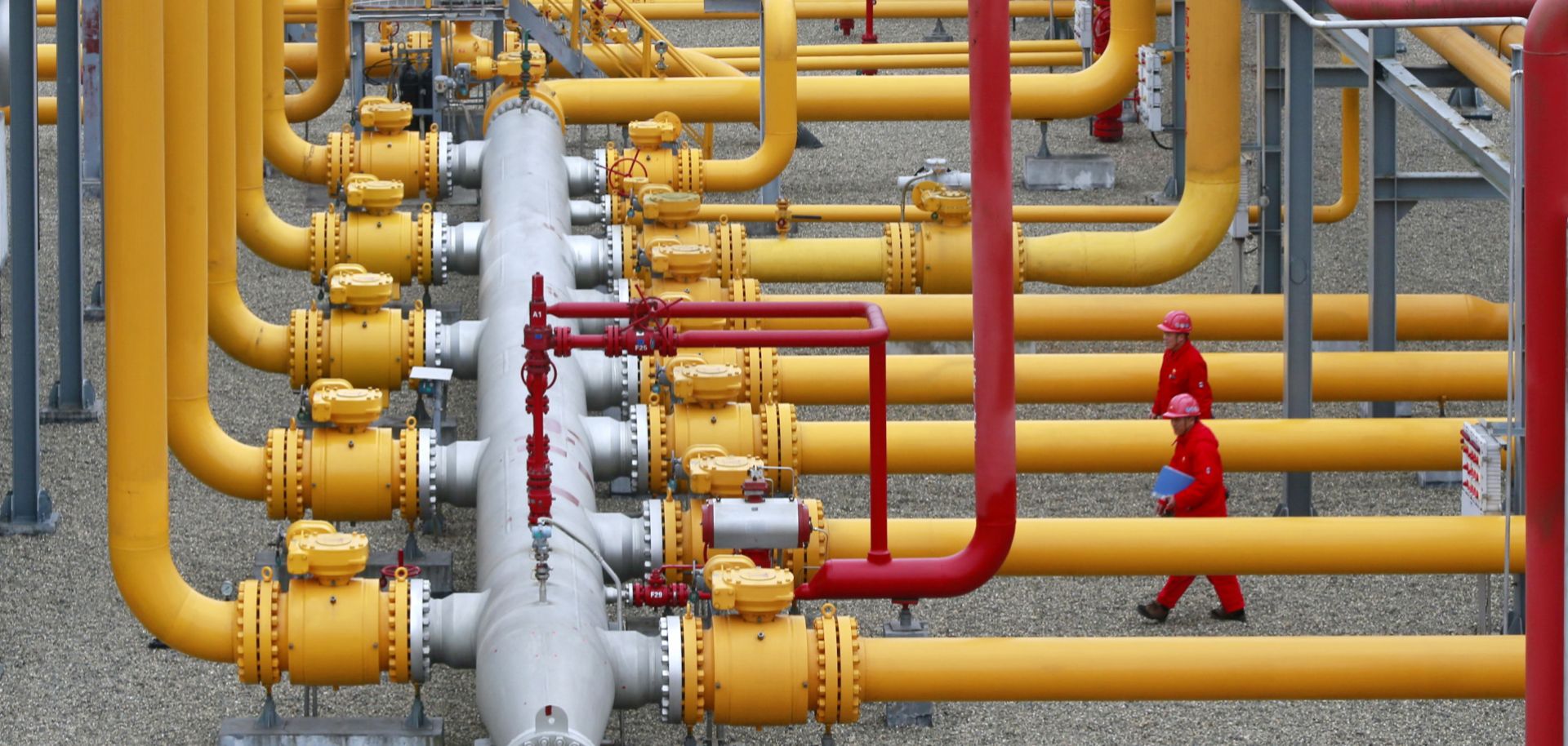
Employees of PetroChina Southwest Oil & Gasfield Co., a CNPC subsidiary, work at a natural gas purification plant in Suining in southwest China's Sichuan province on Jan. 15. The impact of the new coronavirus outbreak on the oil market is unavoidable.
For the oil market, the new coronavirus has come at an inopportune time. The market began the year with hopes that a U.S.-China trade truce would lead to more robust global demand growth, as speculative funds surged into the market in anticipation of a deal — resuming even after a brief rise and fall following the United States’ assassination of senior Iranian military leader Qassem Soleimani. But even before it became clear that the coronavirus would have a major impact on demand, market sentiment regarding demand growth was weakening based on other data, as the large “net long” positioning left the market poised for a rapid drop as hedge funds and other asset managers sold off their positions. The International Energy Agency (IEA) had predicted a supply surplus of about 1 million barrels per day (bpd) for the first half of 2020, while recent U.S. production has grown and inventories have risen even as OPEC+, the informal grouping that brings together OPEC and other oil producers, announced new production cuts in December.
And now, amid the coronavirus outbreak, uncertainty is also pervading the market as the virus could impact oil demand in any number of plausible ways. Even if China largely confines the epidemic to its borders, for instance, there will still be a significant impact on demand over the course of the year. And needless to say, the market impact would be much more profound if the virus becomes a global pandemic.
In the end, OPEC+ is likely to take partially successful action to mitigate the impact on prices. Nevertheless, any action will likely be modest and limited in duration due to Moscow's reluctance to overreact, lest the alliance propel a price surge to coincide with a rapid end to the epidemic and the associated curbs on economic activity.
A Lack of Data
Anecdotal evidence suggests that the virus' impact on oil demand is large. Chinese refiners, for instance, are reportedly exercising the downward variance rights in their term contracts with Middle Eastern exporters to reduce crude oil imports. The lack of data, however, makes it impossible to make an accurate estimate. For one, China does not publish data on end-user demand, so observers must impute that data from information regarding production, trade flows, refinery utilization and inventories. Credible sources with good quantitative analytical resources have published some ballpark estimates, with S&P Global Platts estimating that demand loss could reach as high as 2.6 million bpd in February and Bloomberg publishing an even rounder number of 3 million bpd. Anything published at this point, though, is highly speculative.
The estimates draw on plenty of anecdotal evidence that the new coronavirus has heavily impacted both travel and industrial activities in China, which has imposed stringent restrictions on movement amid business shutdowns that have spread well beyond Hubei province. They also draw on the available data points, including anonymously sourced press reports from reputable news outlets, which cannot give a complete picture but nonetheless support the view of a significant reduction in oil demand. One Chinese oil industry source cited by Reuters on Feb. 5 said aviation fuel sales plunged by 25 percent during the last week of January due to the curtailment of travel. The source also suggested that February would be much worse and that China's demand for jet fuel in the first quarter could fall by half. A Wall Street Journal report on Feb. 3 said Sinopec had cut its refinery runs by 13 percent to 15 percent across the board. And two days later, Reuters reported that a China National Offshore Oil Corp. (CNOOC) refinery in Huizhou in Guangdong province — well outside the quarantine area — had cut its runs by 8 percent. Furthermore, those run cuts may not even capture the entire volume of demand loss, meaning traders will be watching Chinese petroleum product exports closely to see if they provide evidence that domestic refiners are seeking to unload more excess product supply than usual into foreign markets. The sharp hit to immediate demand has caused the forward curve on crude oil futures to flatten out from backwardation, in which near-dated future contracts are more expensive, to contango, where long-dated future contracts cost more. The bend of the curve encourages refiners and storage facilities to accumulate inventories but hits exporters which are selling at set differentials on near-dated benchmarks like Brent.
China consumed an average of 14.5 million bpd of petroleum products in 2019, according to data from the U.S. Energy Information Administration (EIA); given that, even a 15 percent hit to demand would represent a fall of more than 2 million bpd. Nonetheless, if the coronavirus outbreak remains largely confined to China and ebbs sharply before the end of the first quarter, the impact on full-year demand could be much more modest. BP, for example, has forecast a range of 300,000 to 500,000 bpd as a full-year average. The OPEC Secretariat, meanwhile, circulated an internal estimate to officials on Feb. 4 that forecast a baseline drop of 200,000 bpd and a worst-case fall of 400,000 bpd for the entire year. To many analysts, however, the estimate is low and may not necessarily reflect the views of Riyadh, Moscow and other leading actors in OPEC+.
As for natural gas, even less hard data is available, although an impact is inevitable. China imports relatively high-priced liquified natural gas (LNG), largely for industrial and petrochemical use instead of for generating electricity or for residential and commercial purposes. Accordingly, it is safe to assume that the shutdown of industrial plants will have a large impact, but there are fewer data points to help make inferences than with oil. CNOOC, in fact, has declared force majeure on imports and is refusing to accept new cargoes for now, compelling exporters to dump volumes into the spot market, driving down prices to all-time lows of below $3 per million British thermal units. Some majors, including Shell and Total, have rejected the legal basis for CNOOC's force majeure claim and intend to pursue compensation through arbitration if necessary. Spot LNG, meanwhile, can be extremely volatile, as most LNG is still sold under term contracts with set pricing formulas.
OPEC+ Considers a Modest Approach
Even if China largely contains the coronavirus outbreak to its soil and ends it within a few months, the current loss in demand would compound the accumulation of large crude oil inventories (this despite the loss of over 1 million bpd in production in Libya) in the first quarter of 2020. Russia is likely to agree to Saudi Arabia's request that it endorse an additional production cut, but differences in views between Moscow and Riyadh will limit the magnitude and duration. Russia, ultimately, is much better placed to absorb a decline in prices in terms of its budgetary requirements; President Vladimir Putin, for example, stated last June that he differed with Riyadh on price preferences and noted that a price of $60-$65 per barrel for Brent was optimal for Russian interests as Moscow does not want to subsidize competing production growth and lose more market share.
However, dealing a short but sharp hit to demand is a much more rational use of cartel action, even given Putin's concerns, as it would aim to limit a further drop in crude oil prices rather than push them back up to levels that would remove the pressure from competing supply growth, particularly U.S. shale. In this, however, the challenge for producers would be to correctly gauge the total size of the demand loss, given the wide range of uncertainty around such figures. For this decision, the two countries that matter are Saudi Arabia and Russia. The kingdom would like to "go big" with a headline cut of 1 million bpd or more — and probably for an extended period — while Russia would prefer to mount a more limited response, perhaps 500,000 bpd, and for a limited duration to avoid a commitment that could overheat the market if the virus' impact is not as great as originally feared.
Last week, OPEC+'s technical committee recommended that existing cuts continue until the end of the year and that the group reduce production by an additional 600,000 bpd through the end of June. On Feb. 7, Russian Foreign Minister Sergei Lavrov indicated that Russia would continue to cooperate with OPEC+ to address the crisis, although he pointedly refrained from endorsing the OPEC+ committee recommendation. In the end, Moscow will probably get its way on the matter, just as it did at the December OPEC+ meeting in which attendees agreed to modify the definition of Russian crude oil to exclude condensates, negating any real requirement for the country's producers to reduce production under the incremental 500,000 bpd headline production cut. Accordingly, OPEC+ could agree to a modest additional cut, which would expire no later than the end of the second quarter, at any time or, as is more likely, at a ministerial meeting in Vienna this week or next.
The spread of the new coronavirus beyond China to global pandemic proportions would naturally have far more serious consequences for the market, but there is nothing in the spread of the illness so far to suggest that the globe is about to witness such a doomsday scenario. But even if the virus' impact on the market is far less drastic, there appears little chance of a bullish year for crude oil, in which demand growth outstrips supply, due in some measure to Russia's desire not to lose market share. For that reason, a case in which inventories increase only moderately and Brent rises back into the $60s range over the summer is the best — plausible — scenario.
