
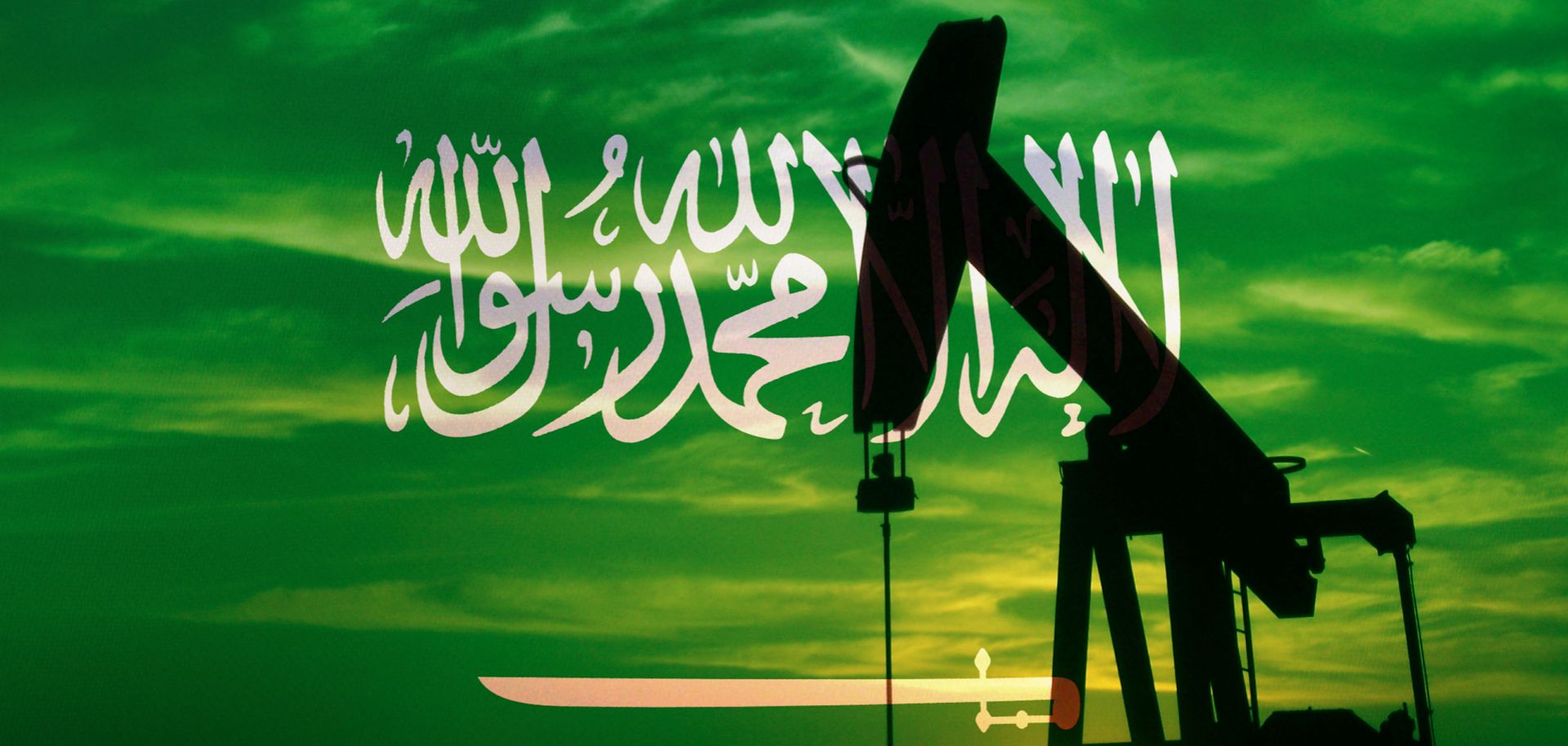
An image of a Saudi flag overlaying an oil pumpjack.
As COVID-19 saps oil demand, the economic fallout will likely leave Saudi Arabia back in the role of "price taker," as the kingdom's new austerity measures strongly imply Riyadh recognizes it will eventually need to adjust its spending habits to the global oil market instead of the other way around. With no immediate recovery in sight, Saudi Arabia will likely find itself drawn toward modestly raising oil production in tandem with Russia in order to gradually regain and then expand its market share, rather than relying on its tried-and-true method of cutting output to force higher prices. This, however, will require coordinating the gradual unwinding of current OPEC+ production cuts.
The depth of the austerity measures Saudi Arabia announced on May 10 indicates it lacks confidence that OPEC+ can eventually support prices at a more comfortable level once the market rebalances.
- Saudi Minister of Finance Mohammed al-Jadaan did not hint that any of the austerity measures will be rolled back once the current COVID-19 crisis passes. His message has been one of shared sacrifice on an ongoing basis, indicating that Riyadh believes the global oil market's recovery to previous price levels on a sustainable basis is not assured.
- This is a big shift from Saudi Arabia's confident tone in public messaging that prevailed up until mid-2019, when it became clear that competing non-OPEC production could make it impossible to defend a Brent price floor at even $60 per barrel.
- Saudi officials voiced confidence for much of 2018 that $70 per barrel Brent price, or greater, was sustainable. But instead, the kingdom ended up driving a boom-and-bust cycle that had already corrected downward to around $50 per barrel prior to the impact of the COVID-19 pandemic.
Saudi Arabia will eventually be forced to decide between increasing oil production or trying to force prices higher. The decision point is unlikely to arrive in 2020, but could arrive in 2021 depending largely on how rapidly demand recovers.
- OPEC+ production cuts and a faster-than-expected initial 1.5 million barrels per day (bpd) drop in U.S. oil output has instilled a brief sense of relief in the market. But a decision point looms as crude oil prices recover toward the level where drilling activity in the United States, as well as investment decisions on deepwater offshore projects, could again begin to pick up, possibly next year.
- Saudi Arabia has learned that aggressively pushing for higher prices in order to trigger a boom-and-bust cycle for competing non-OPEC production is counterproductive and not limited to shale. Large offshore projects coming online in Norway, Guyana and Brazil — which were approved in early 2017 as part of the initial OPEC+ deal — are compounding the current glut. Norway's production is still up roughly 10 percent from a year ago based on its Johan Sverdrup field, even after it decided to cut production by 200,000 bpd for a limited time.
- Keeping prices below the mid-$50s through 2021 would have the added benefit of continuing the decline in U.S. output, which has largely been driven by oil well shutdowns. But even as some of those wells are reactivated, the lack of new drilling and decline rates could cause the peak-to-trough decline in U.S. production to hit roughly 4 million bpd by the end of 2021.
Russia's desire to eventually to regain its market share will further dissuade Saudi Arabia from trying to force global prices higher by taking more of its own output offline.
- Since the May 6 OPEC+ meeting, Russia has made it clear it's committed to the current cuts, though Russian Energy Minister Alexander Novak has on several occasions stated that the timeline for phasing down the cuts may be flexible.
- Russia and other OPEC+ members had been expected to reduce the current production cut from 9.7 million bpd to 8 million bpd during the group's next meeting on June 9. But concerns about a reversal of the reopening of economies due to a potential second wave of COVID-19 infections, particularly in the United States and China, could prompt members to delay such a move.
- In the long term, however, Russia will eventually want to take back its market share in the price range slightly above its budget-balancing price in the mid-$40s, but below the mid-$50s level.
- Moscow will not want to exert a strong pull on inventories to rapidly return to a "normal" level, having seen the result of that in the 2017-2019 boom-and-bust cycle. This preference will inevitably lower the incentive for Saudi Arabia to keep OPEC+ together and maintain the same production cut.
Market share is the one and only silver lining for Saudi Arabia, since larger volumes will increase revenues, though not to the levels they enjoyed in 2017-2019.
- With the voluntary additional cut to 7.5 million bpd they announced in early May, and their recent production volumes of 12 million bpd, Riyadh currently has 4.5 million bpd of spare capacity — and will have more once the jointly-run oilfields in Saudi Arabia and Kuwait's so-called "Neutral Zone" is fully returned to operation.
- Saudi production had remained under 9 million bpd during most of the 2017-2019 period. But with U.S. production now having taken a major hit, and a long price-driven gap in the project development pipeline for deepwater likely to start in 2023, there will be an opportunity for Riyadh to expand its oil output well beyond that.
This is not a "price war" scenario, but rather analogous to what took place in the late 1980s and early 1990s after Saudi Arabia abandoned its swing producer role and accepted that there was a strong price equilibrium in the high teens-low $20s per barrel.
- During this time, Riyadh gradually reactivated capacity, signaling strongly to the market that they would not allow prices to reach a level that enabled windfalls elsewhere. But the kingdom still ended up with debt levels that would have been problematic had prices not risen sharply in the 2000s.
- This time around, a Saudi market share strategy will delay competing supply growth, but there remains no demand surge on the horizon that would improve the situation.
For Saudi Arabia, the challenge will be unwinding the OPEC+ cuts in a coordinated way that prevents a stampede to produce more oil among other countries with substantial spare capacity, including Russia and Iraq.
- Russia also will want to keep Saudi production from racing ahead, which would strengthen Riyadh's leverage given its much higher spare capacity.
- Likewise, Iraq will have an incentive to manage the reversal of its production cuts, as Saudi Arabia would be back in more of a position to "punish" cheaters.
