
(KIM HONG JI/Getty Images)
The Liberal Democratic Party, now led by Shinzo Abe, has ruled Japan for six decades, only briefing slipping from power during 1993-96 (in the wake of the real estate collapse) and during 2009-12 (under the Democratic Party).
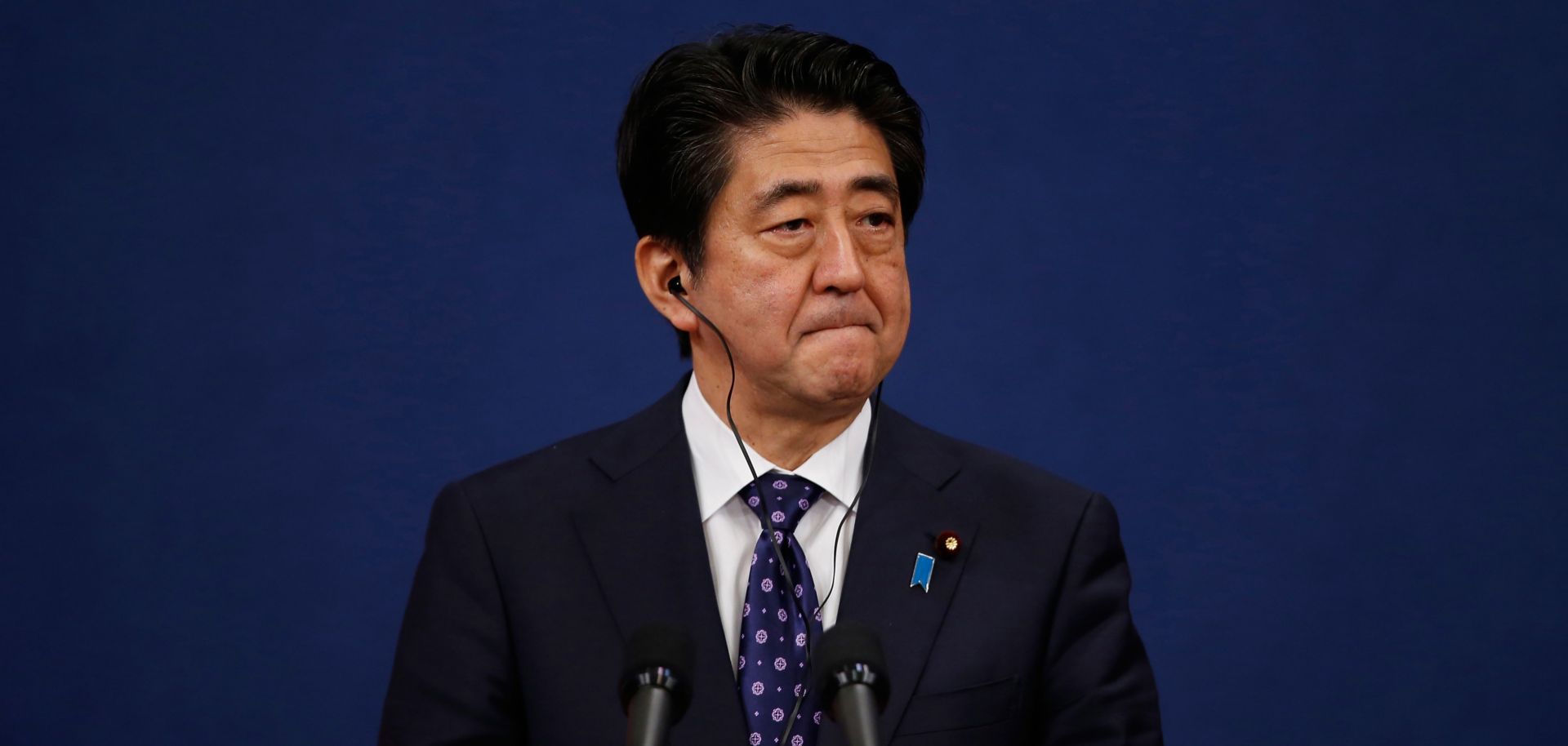
Japan's prime minister is playing his political cards carefully as he gambles that his party can hold on to power. Shinzo Abe's ruling Liberal Democratic Party (LDP) will soon face a contest at the polls that could challenge his grip on the government and affect the party's ability to ram through its legislative agenda. The Oct. 22 general elections will pit LDP lawmakers against the conservative upstart Hope Party, led by Tokyo Gov. Yuriko Koike. And with an LDP leadership contest looming in late 2018, these elections could determine whether Abe can secure his tenure through 2020.
At stake is Abe's ambitious reform agenda, which aims to tackle Japan's economic stagnation and looming demographic crunch and to shepherd the country's slow transition back to a more active role in the Pacific order. Besides the domestic concerns, the intensifying crisis in North Korea and Abe's plans to overhaul the Japanese Constitution are high on the voters' list of considerations. Regardless of whether the snap elections erode the foundations of his power, Japan will continue to reassert itself as a military power — and, in fact, this trend could accelerate given the Hope Party's hard-line nationalist position.
A Snap Decision
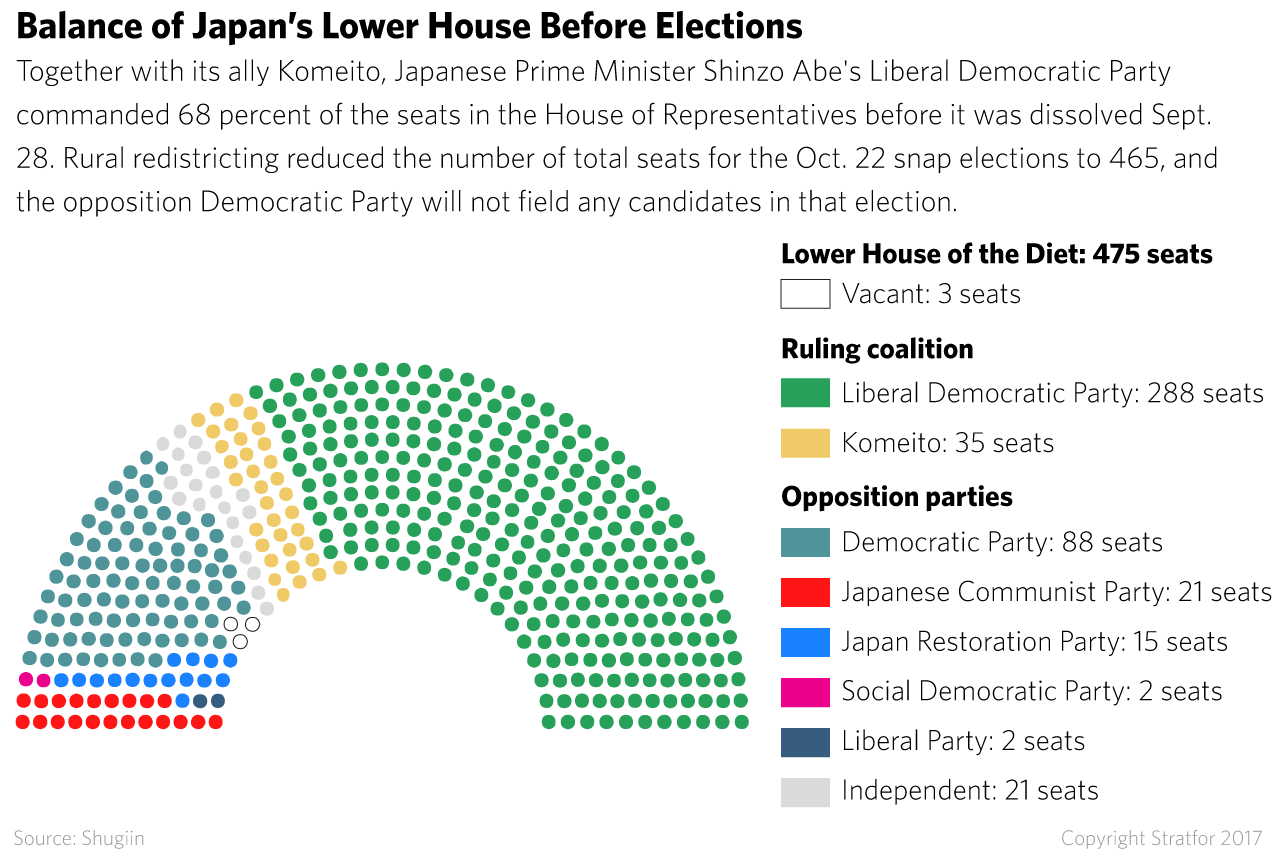
Abe's decision to call an election rests on a number of political considerations. Terms in the lower house, where Abe counted on a strong coalition majority, expire in December 2018, and snap elections usually occur sometime during the second half of these terms. The past year had not been a felicitous time for elections for the LDP. Abe's approval ratings hit a record low over the summer after successive scandals and aggressive legislative moves proved unpopular with the public. But his popularity rebounded in September on the back of a Cabinet reshuffle in August and his handling of North Korea. This bounce presented a strong opportunity for Abe — one he probably calculated had a short shelf life.
With the LDP leadership contest moving closer, Abe appears to be hoping that snap elections now will give him time to score legislative victories and consolidate his position. With the approval of the national budget occupying the first months of 2018, now is the best time to do so. Additionally, he has set a personal deadline of 2020 to reform the constitution — meaning that he will probably need to aim for a nationwide referendum on the matter in late 2018 to allow time for the changes to be implemented. Most of all, in calling elections now he appears to have counted on a fractured and unpopular opposition, given that the main opposition Democratic Party has been dogged by abysmal ratings and internal battles. Abe's decision to call snap elections is tied to his reform agenda, and a strong showing would secure the LDP's lower house position through 2022, giving him room to manage the 2018 party leadership contest and upper house elections in 2019.
Japan's Changing Role
These elections — and the question of Abe's continued rule — come at a critical historical moment for Japan. Over a quarter century after the end of the Cold War, the country has yet to adjust its regional role to the new balance in the Pacific. Two decades of near-zero economic growth and a defense-oriented military have left Japan unable to counter a rising and increasingly assertive China. Coupled with the U.S. trend toward delegating more responsibility to its regional allies and Japan's graying population, this new order presents a major risk to Japan's security.
With his economic policies, dubbed Abenomics, the prime minister has implemented structural reform, monetary easing and fiscal stimulus with varying degrees of success. But adjusting to the new order in the Pacific means, among other things, that Japan's military must become a tool of foreign policy. In recent years, piecemeal policy changes have broadened the mission of the Japan Self-Defense Forces. And the landmark 2015 security legislation passed under Abe has been key. These laws allow Japan to assist with international peacekeeping, to provide support to foreign militaries and to use force to protect countries under attack when that attack also threatens Japan's security. (The last of these could cover shooting down a North Korean missile bound for U.S. territory.) But Japan's 1946 constitution still contains a key provision, Article 9, that renounces the use of war as a tool of foreign policy and bans an offensive military.
Abe's Dreams
Abe has long harbored a strong personal ambition to lead constitutional reform in Japan. And the 2017 crisis in North Korea has intensified the push toward his 2020 deadline. But the prospect of constitutional change has sharply divided the public. The reforms would require approval of a two-thirds majority of both the upper and lower houses as well as majority approval in a nationwide referendum. Abe has been dragged down before by constitutional reform: His 2006-07 tenure as prime minister ended when he stepped down amid abysmal approval ratings, partly because he pushed through military reforms and supported a referendum on constitutional change. He did not return to the office until 2012.
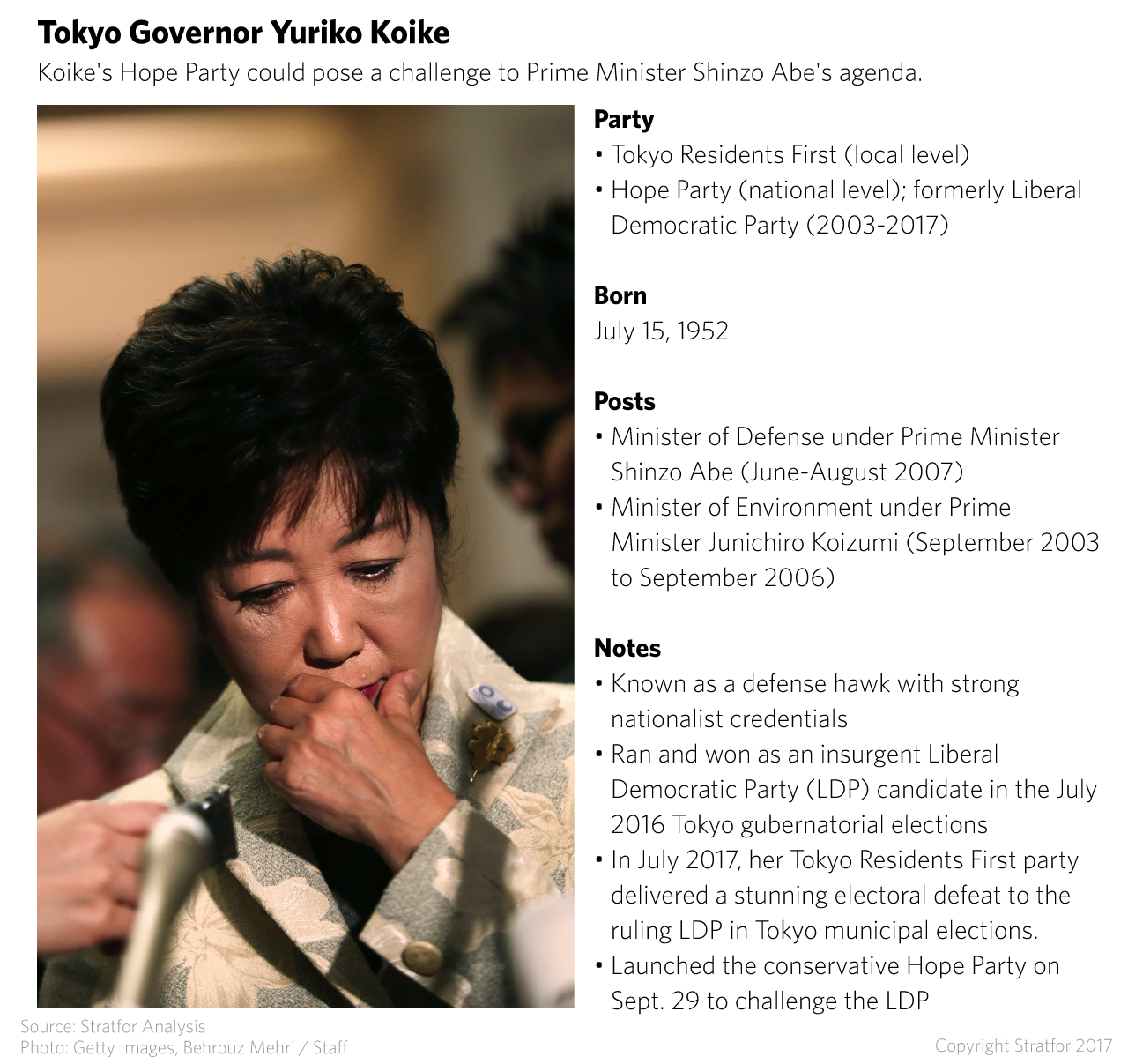
Advancing his ambitious agenda will require a strong hold on power and room for political maneuvering — both of which Abe hopes to secure in the Oct. 22 vote. But the LDP will be facing a stiffer challenge in the snap elections than it initially anticipated. As a member of the LDP, Koike defied the party to run for Tokyo governor in 2016 and won. And in July 2017, she resigned from the LDP and founded the Tokyo Residents First Party, which won a substantial victory in Tokyo municipal elections. She has long held ambitions for national power, and Abe's call for snap elections was meant partly to catch her before she could gather steam.
A New Hope
Koike's recently launched Hope Party has consolidated a relatively strong position, however, though recent polls show it has lost some momentum. The party hopes to field candidates for about half of the lower house seats and has sought to coordinate with other non-LDP parties. And the main opposition Democratic Party made a surprise announcement Sept. 28 that it would not compete, urging its candidates to join the Hope Party or to run as independents. Many have already done so. The Hope Party has proposed popular stances opposed to nuclear power and against Abe's plan for a consumption tax hike. The prime minister now finds himself facing a coherent conservative challenger with strong support from a major metropolitan center instead of a fragmented liberal opposition.
The LDP has ruled Japan for six decades, only briefing slipping from power during 1993-96 (in the wake of the real estate collapse) and during 2009-12 (under the Democratic Party). It is unlikely that this will change — although it's not out of the realm of possibility. Even if the Hope Party does not win a majority, a strong electoral performance could deal as devastating a blow to the LDP at the national level as it did in the Tokyo municipal elections. That could cause challengers within the LDP to turn on Abe. Koike appears to have this in mind and has pulled Hope Party candidates from races involving key rivals of Abe's LDP.
Regardless of the precise outcome, there is little doubt that the new government that emerges from October polls will be quite different from the one going in. New political considerations and new alliances to navigate could trouble Abe's rule, particularly if the Hope Party successfully reaches out to LDP coalition ally Komeito. And Koike has also said she won't rule out a coalition partnership with the LDP, but one condition for working together might be Abe's exit.
But, unlike past opposition parties, Koike's Hope Party is not a force bent entirely on derailing Abe's agenda. In fact, Koike is a defense hawk with strong nationalist credentials, and her proposals are more of a small government, conservative counterpoint to Abe. She has also explicitly vetted her candidates for their pro-constitutional reform stances. Therefore, while a poor LDP showing might shake Abe's political standing, it could result in a lower house more favorable to an increasingly aggressive regional posture for Japan. The challenge for Abe may be that the Hope Party could seek to steer constitutional change in a more hard-line direction.
That said, there is no guarantee that the Hope Party will field a potent opposition in the lower house, which is shrinking from 475 to 465 members. The party recently absorbed a number of former Democratic Party candidates, and these lawmakers might again choose to break ranks once in place. And with Koike balancing her duties as Tokyo governor and manager of lawmakers at the municipal level, directing a still-forming national party will be challenging. In fact, two lawmakers in the Tokyo assembly who rejected her bid for national power citing neglect of her responsibilities to Tokyo have defected from her regional party.
Japan's upcoming snap elections will be a bellwether of Abe's standing in Japan and, in many ways, of the direction of the country's reforms. But regardless of how constitutional change shapes up, Japan's regional posture is already changing. The question is whether Abe himself will be along for the ride. The wisdom of calling snap elections is unclear — but Abe is gambling with his political future.
