
On the surface, the factions of the ruling party controlled by Venezuelan President Nicolas Maduro and National Assembly Speaker Diosdado Cabello appear to make most of the important political decisions in the government. However, the PSUV has been steadily deteriorating for several years. The death of former President Hugo Chavez in 2013 left the party without a charismatic, popular leader at its helm, and Venezuela's worsening economic crisis has significantly reduced its support among voters. As a result, power in Venezuela has been divided among several strong factions that periodically compete with one another for influence. Though Maduro and his circle currently have clout within Venezuela's executive, legislative and judicial branches, the elections could change all that.
Both Maduro and Cabello seem to be addressing the threat to their power by attempting to retain control of the government's various institutions while avoiding making long-delayed but much-needed economic reforms. At some point, the government will have to take steps to reduce its spending, stem inflation, counter currency distortions and cut the losses incurred by massive subsidies. But pursuing these measures in the near term would carry substantial risks for Maduro and the PSUV, including the threats of social strife and electoral loss in 2019. Therefore, the party's leaders probably will continue to do nothing on the economic front while they struggle to maintain control of the government until the next presidential election — that is, as long as their strategy is tenable.
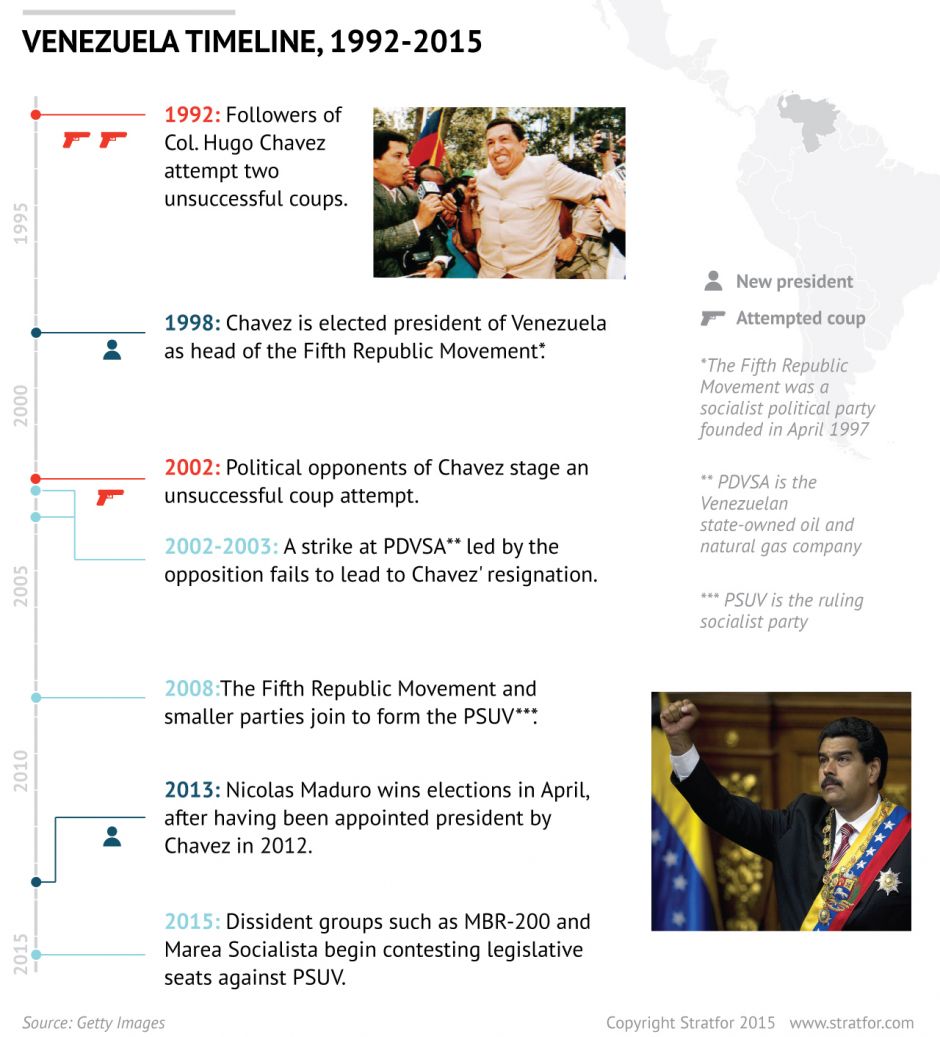
But the December elections could be a turning point in Venezuelan politics. If the PSUV retains its legislative majority and avoids major electoral losses, party members will have less incentive to break off and form their own political groupings. However, if the party suffers a significant defeat, members could perceive it as a harbinger of further electoral losses in 2019 that could imperil their political futures. If this happens, the party could splinter into separate factions composed of individuals determined to save their own positions. Maduro, Cabello and other party elite may still choose to keep control of government institutions in spite of a hostile legislature, but it will be important to watch whether they remain political allies or distance themselves from one another.
Some fissures have already formed within the ruling party. Earlier this year, the dissident Marea Socialista faction officially quit the PSUV. Though it professes adherence to Chavez's ideals, the faction has alleged that the ruling party's elite are corrupt and exclude other parties from power. In May, the National Electoral Council barred members of Marea Socialista from competing in the Dec. 6 elections, likely to limit the number of competitors challenging the PSUV for votes. Former Interior Minister Miguel Rodriguez Torres, who fell out of favor with the ruling party in October 2014, is also running independently for a seat in the National Assembly. While these breaks from the party are relatively minor, larger defections may occur after the upcoming elections if the opposition manages to make meaningful gains in the Venezuelan legislature.
Limiting the Opposition's Moves
The ruling party is already moving to mitigate some of the risks tied to the approaching elections. Party leaders are preparing to appoint 13 new justices to various tribunals within the supreme court in the wake of several justices' resignations. By making the appointments before the elections, the PSUV hopes to prevent an opposition-led National Assembly from naming the new appointees instead, which could have eroded some of the PSUV's influence over the judiciary. The ruling party still stands to lose its sway over the National Electoral Council, since the terms of two of the body's rectors will end after the December vote takes place; depending on election outcomes, the opposition may be able to influence who will fill the posts.
Venezuelan officials are also using the country's current state of emergency to disrupt political rallies for the opposition in regions on the Colombian border. The state of emergency was originally implemented as part of the partial closure of the Colombian border, which evidence suggests is partially intended to pressure Colombia not to extradite drug trafficking suspects with alleged links to officials in the Venezuelan government.
Meanwhile, regardless of the December vote's outcome, Venezuela's wider economic crisis will continue unabated. With reduced oil export revenues and no major fiscal adjustments on the horizon, the country's public finances will remain strained for the foreseeable future. The crisis will also raise the risk of demonstrations or social unrest as citizens become increasingly dissatisfied. Thus, Venezuela will likely continue to be a risky investment destination and a difficult operating environment for foreign firms until real economic reforms become more politically palatable to the Venezuelan government. In the meantime, whether the situation will worsen because of heightened political infighting will depend greatly on the results of the Dec. 6 elections.
