
The decision by Cencoex, a governmental body that administers disbursements of foreign exchange in Venezuela, reduced a longstanding travel subsidy for Venezuelan citizens. Venezuelans can access dollars to pay for expenses incurred while traveling abroad. The decision to reduce the subsidy could save Venezuela money — in the region of $2.8 billion according to a report by Barclays.
Auctions of foreign currency have long been a feature of Venezuela's currency controls, through which the government has historically regulated the amount of foreign currency provided to citizens. Under the United Socialist Party of Venezuela, these dollars were disbursed at the subsidized rate of 12 bolivars to the dollar, which is a heavily overvalued exchange rate. By comparison, the Marginal Foreign Exchange System — Venezuela's currency mechanism with the highest exchange rate — is auctioning minimal amounts of currency at around 190 bolivars to the dollar. Venezuela's middle and upper classes benefit the most from access to these lower-cost dollars.
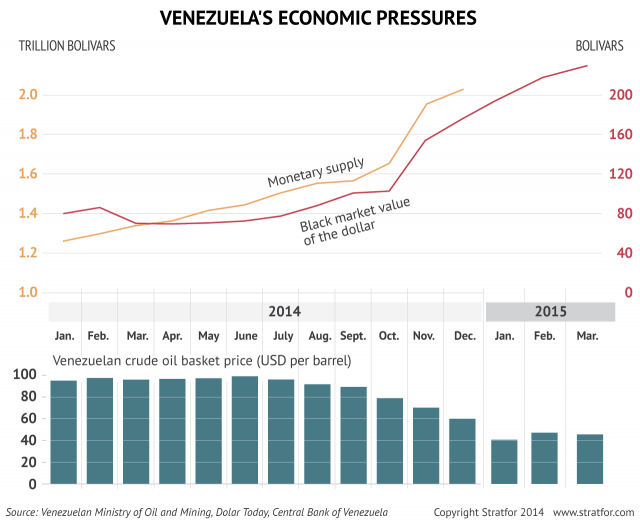
The reduction of dollar disbursements for travel expenses is part of the Venezuelan government's strategy to meet its financial obligations this year. The move — though likely unpopular — allows the government to save dollars without having to resort to more politically controversial measures such as a major fiscal adjustment, which would upset constituents ahead of a crucial legislative election.
The fact that Venezuelan President Nicolas Maduro resorted to cutting a subsidy rather than directly addressing major economic losses indicates how precarious the government's situation is. The implementation of socially disruptive economic measures, albeit intended to right Venezuela's major economic imbalances, is not politically viable for Maduro. Although the government incurs tens of billions of dollars in losses yearly by selling refined petroleum products at a loss, heavily subsidizing the cost of electricity and selling imported food at subsidized prices, any measures to increase their cost are politically unacceptable. With few options to address the economic crisis, other than a major rise in the price of oil, Maduro is trying to prolong the government's stable rule to the end of his term in 2019.
With so few options for economic maneuvering, the prospect of a negotiation with either the United States or the political opposition becomes a more likely scenario for the Venezuelan government. At the Summit of the Americas in Panama, Maduro met with U.S. President Barack Obama, who reportedly expressed interest in establishing a dialogue between the Venezuelan government and opposition political factions. Maduro made a statement April 11 that talks between Washington and Caracas on improving relations could begin in the next few days. Such a dialogue is likely intended to provide a channel of communication between the country's polarized political factions ahead of what could be an increasingly turbulent period in Venezuelan history. The U.S. State Department dispatched Counselor Thomas Shannon to Venezuela on April 7, and he held meetings with both the government and opposition, which indicates that Washington is likely to make a diplomatic move to engage Venezuela. Whether a dialogue is intended to pave the way for legislative elections or even for the formation of a coalition government remains to be seen. The ruling United Socialist Party of Venezuela is internally fragmented, and the United States and the opposition would have to engage different segments of the party for the ruling Venezuelan elite to accept any negotiated solution.
In the short term, Venezuela's drive toward financial cuts promises more hardships for the Venezuelan people and the domestic private sector. The vast majority of currency allocations appears to be awarded to the public sector, because the government's primary interest is in sustaining imports of food and consumer goods to prevent a major electoral defeat or protests. With the increasing scarcity of foreign exchange for private use, the black market value of the dollar likely will rise, and private firms will continue facing difficulties in acquiring foreign currency. Multinational businesses will therefore continue to encounter obstacles in repatriating profits from Venezuela.
