
Editor's Note: Stratfor closely monitors conflict zones from a geopolitical perspective. What is perhaps the most volatile conflict today can be found in the territories of Iraq and Syria that are controlled by the Islamic State. Though these areas are cartographically distinct, they are functionally linked: Sunni tribal structures, rebel operations, Kurdish interests, external influences and the suzerainty of the Islamic State bind them together as a single, coherent theater.
The Islamic State capitalized on the chaos of the Syrian civil war and the inadequacy of Iraqi security forces to take over a large swath of the Middle East. After making some impressive gains, including the taking of the Iraqi city of Mosul, the Islamic State now finds itself in an increasingly difficult position, against which a wide array of opponents are aligned. Nonetheless, the group is uniquely resilient and, as such, remains extremely dangerous and unpredictable.
In addition to examining the combatants inside the Syria-Iraq battlespace, Stratfor also tracks the political machinations, negotiations and goals outside the battlespace, including in Iran, Russia, the Gulf monarchies and the United States. For the first time, in routinely updated monthly installments Stratfor is covering the gains, losses and extent of the Islamic State's so-called caliphate.
Aug. 31
Syria
Russia could be in the process of greatly expanding its involvement in the Syrian conflict, according to sources from Israeli news source Ynet. An Aug. 31 report suggests that a Russian expeditionary force has already arrived in Syria, setting up camp in a loyalist air base near Damascus. If the reporting is accurate, it could be an early indication that Russia will throw its heft behind the Syrian air campaign against the Islamic State and the rebel-aligned factions in the country. According to Ynet, thousands of Russian military personnel are expected to arrive in Syria in the coming weeks, including military advisers and instructors as well as logistics and technical personnel. Additionally, members of the aerial protection division are expected, alongside pilots who will fly an unknown number of fighter aircraft and attack helicopters.
It is Stratfor's assessment that Russia is steadily increasing its support for Damascus. This assistance ranges from the provision of extra materiel, weaponry and equipment to the greater sharing of intelligence on rebel positions and dispositions. Russian pilots and aircraft mechanics also have a long history of serving in foreign air forces in conflict zones, either at the behest of the government or as private contractors. Evidence that Russia is taking a more combative role is already emerging. Stratfor identified Russian-language speakers in recent combat footage obtained from Syria, further corroborating the likelihood that either Russian military personnel or Russian-speaking private military contractors are now actively involved in the conflict.
Nevertheless, Stratfor has yet to see concrete evidence of expanded Russian participation in the Syrian conflict on the scale suggested by Ynet. In fact, cases of false reporting are common, especially where direct Russian support is concerned. Previous reports of MiG-31 interceptor transfers to Syria were never proved, leading to subsequent Russian denials.
When it comes to providing decisive support to Syria, Russia is torn. Moscow is trying to position itself as a credible power that can negotiate a political solution to the Syrian conflict, yet the Kremlin is also keen to bolster the forces of Syrian President Bashar al Assad. If it hopes to reach a favorable settlement, Russia must ensure that loyalist forces do not suffer devastating losses: A weak Damascus would make it harder for Russia to reach an understanding with the rebels and their backers that would safeguard its overall interests in Syria and the region. Thus, it makes sense for Moscow to bolster Syria's defenses, but a full military commitment is unlikely. Such an intervention in the conflict would undermine Russia's position as a strong mediator, calling into question Moscow's overall objectivity. Regardless, given the inherent volatility of the Syrian conflict, Stratfor will closely watch for any further signs of increased Russian involvement in the conflict.
Elsewhere in Syria, Islamic State fighters battling Syrian rebels moved closer than ever to central Damascus. Street battles reportedly raged in the Asali neighborhood of the capital's southern Qadam district over the weekend, killing at least 15 fighters as Islamic State militants seized at least two streets. The district had been relatively quiet since rebels and government forces reached a localized truce a year ago. Stratfor sources indicate that Moscow may finally have been able to get Damascus and the mainstream rebel opposition to broadly agree on elements of a political transition of power in Syria.
Aug. 29
Syria
Aug. 19
Syria
Stratfor receives insight from many sources around the world, along with reports not available for public consumption. It is important to caveat that many reports are unconfirmed or speculative in nature, though they provide valuable context. Interpreting information and compiling multiple data points to build a picture is part of intelligence analysis. Any and all reporting is carefully filtered before being disseminated by Stratfor, yet some insight is worth sharing on its own merits, such as this account from Syria, below.
Russia is heavily invested in the Syrian conflict and has a significant stake in shaping any enduring peace. Stratfor sources indicate that Moscow may have finally been able to get Damascus and the mainstream rebel opposition to broadly agree on elements of a political transition of power in Syria. Russia has long insisted that present Syrian President Bashar al Assad must remain in power during any transition. This is a sticking point for many of the rebel groups, but Moscow appears to have been able to negotiate a middle ground. As Stratfor previously noted Aug. 7:
A flurry of meetings is taking place as stakeholders in the Syrian conflict attempt to work out a power-sharing agreement to replace the government of Syrian President Bashar al Assad. Russia has been driving the negotiation, while Oman acts as a neutral mediator relaying messages to and from Iran, Syria, Saudi Arabia, Turkey, Russia and the United States. Though the diplomatic activity is picking up, it is still an outside effort divorced from the reality of the battlefield, where Syrian rebels are fighting the al Assad government on their own terms.
According to reports received by Stratfor, al Assad will remain in power during a transition, then cede his political responsibilities to Farouk al-Shara, who will assume the role of Syria's prime minister during the changeover period. In exchange for remaining as a politically neutered figurehead, al Assad will have to let go Syrian National Security Bureau chief Gen. Ali Mamlouk. The opposition will then choose a replacement for Mamlouk — a person that is acceptable to al Assad. The role of army chief of staff would be awarded to an unspecified Alawite and, in addition, the minister of defense portfolio would go to a former brigade commander from the Syrian Republican Guard, Manaf Tlass, who defected to the West in 2012. Stratfor had earlier received word from sources that Tlass, a Sunni, whose family has a long-standing alliance with the al Assad clan, was preparing to re-enter the political scene after spending much of the civil war in Paris.
After a highly publicized defection in 2012, Tlass has been in Paris, keeping a low profile and waiting for the right time to insert himself into negotiations. The Tlass family has a long history with the al Assad family: Manaf's father, Mustafa Tlass, helped rally strong military and Sunni support for al Assad when he took power in 2000. In 2012, we noted that the two families were likely to strike a deal to enable the Tlass family to leave Syria, and we forecast that Manaf Tlass would eventually return to play a role in a power-sharing arrangement. Given that Tlass is a Sunni with a military background who has also maintained close links with the al Assad administration, it is little wonder that he is now allegedly being proffered as a suitable candidate for defense minister in a new Syrian government.
Though Stratfor is unable to confirm the specificity of this insight, there is nothing that is particularly implausible. Farouk al-Shara is one of the more acceptable candidates for the opposition: He is Sunni Muslim, a known nationalist, and publically sought a negotiated solution to the crisis rather than a military one. He also has strong family ties to the rebel-dominated Daraa province. On the other hand, he is staunchly loyal to the al Assad government and is deeply embedded in the Baath Party. Tlass meets the criteria of being a Sunni, but it will be difficult for him to win the trust of the broader Sunni rebellion, which perceives him as being too close to the al Assads. He will also be regarded as out of touch with reality on the ground after spending years in Europe instead of joining the fight.
As Stratfor previously noted, any agreement between Moscow and the Syrian National Coalition is largely irrelevant if it does not have tacit support from fractious rebel groups. The Syrian National Coalition does not speak for the majority of rebel factions, many of which are achieving limited tactical success against Damascus and the Islamic State. This may influence the rebel's willingness to accommodate a political transition, or not. Stratfor closely monitors the behavior of all components of the Syrian conflict and is alert for any change in the political dynamic that could lead to a negotiated solution to the crisis.
Iraq
Muhammad Haji Mahmud, secretary general of the Kurdistan Socialist Democratic Party, said that U.S., U.N., and British representatives have asked Kurdish parties to allow Kurdistan Regional Government President Massoud Barzani to remain in office past the expiration of his term on Aug. 20 and to postpone political reform for two years. According to Mahmud, foreign officials are worried that the Kurds will not be able to undergo political transformation while also effectively fighting the Islamic State and dealing with other regional issues.
Aug. 17
Syria
A previously arranged cease-fire between Syrian rebels and loyalist forces, including Hezbollah elements, collapsed over the weekend. Originally scheduled to end Aug. 16, the cease-fire was in part mediated by Iran and Turkey four days earlier. Centering on the towns of Zabadani, Fuaa and Kafriyeh, the temporary cessation of hostilities showed promise when it was extended beyond the agreed-upon 48-hour duration. Ongoing negotiations seek an end to the conflict in Syria, and localized cease-fires provide important foundations on which to build. However, the collapse of the cease-fire amid entrenched disagreements and mistrust only serves to emphasize the deep divides that exist in Syria. Such divisions will make any comprehensive negotiated solution to the crisis extremely difficult to achieve.
Farther north, the Islamic State showed its determination to hold onto territory in Aleppo province, despite the overarching threat from U.S. and Turkish airstrikes. By continuing its attacks against rebel groups in the area, the Islamic States hopes to undermine a key component of the Turkish-American plan: to train and support certain rebel factions that can then be employed as proxy forces on the ground in Syria. The Islamic State made gains around the key town of Mare, undoubtedly assisted by the withdrawal of Jabhat al-Nusra forces from front-line positions against the Islamic State in Aleppo province.
Damascus recently launched its own offensive in Aleppo province, directed toward Kweiris Air Base, currently besieged by the Islamic State. The latest indications from the ground are that the offensive has already been halted, with little headway made against the extremist group. The loyalist forces simply could not muster enough combat power for a successful push against Kweiris, highlighting the precarious position the air base defenders find themselves in after years of being under siege.
Iraq
Iraqi Prime Minister Haider al-Abadi announced the cancelation of four ministries and the merging of four others on Aug. 17. Overall, according to a statement from al-Abadi, the Council of Ministers will be reduced from 33 members to 22, plus the prime minister. The cuts include three deputy prime minister posts, as well as the ministries of state for women’s affairs and provincial affairs. Kurdistan Regional Government President Massoud Barzani warned al-Abadi not to dismiss Finance Minister Hoshyar Zebari, a Kurd, Iraqi Arabic Sky Press reported. Entrenched sectarian interests in Iraq may prevent al-Abadi's reforms from being implemented or even plunge Iraq into deeper sectarian conflict.
Also in Baghdad, the Iraqi parliament referred to the judiciary a report calling for former Prime Minister Nouri al-Maliki and numerous other Iraqi officials to face trial for their roles in the fall of Mosul to the Islamic State. The report alleges that al-Maliki had an inaccurate picture of the threat to the northern city and that he chose and failed to hold to account corrupt commanders. Also implicated in the report were the governor of Mosul, a former defense minister, a former army chief and a lieutenant general in charge of Nineveh province, among others.
Al-Maliki arrived in Tehran on Aug. 16 for talks on bilateral ties and the regional fight against terrorism. It is unlikely that he will simply go along with al-Abadi's reform agenda without attempting to secure his own power. He also has outside support, namely from Iran: Tehran threatened to withdraw its support for Iraq’s fight against the Islamic State and turn its militias against the government in Baghdad if al-Maliki is put on trial for his role in the fall of Mosul. The office of Iranian Supreme Leader Ayatollah Ali Khamenei reportedly has been in contact with al-Abadi, as well as other senior Iraqi leaders, in an effort to preserve al-Maliki’s immunity.
Aug. 16
Syria
Jabhat al-Nusra, al Qaeda's affiliate in Syria, released seven members of the U.S.-backed rebel group Division 30 that were abducted last month. The group also said it hopes Jabhat al-Nusra will release its commander. Following the abduction, Jabhat al-Nusra attacked the Division 30 command in northern Syria, leading to the near-collapse of the group. Jabhat al-Nusra, which withdrew from its positions in northern Aleppo ahead of a U.S.-Turkish operation, said it abducted the rebels because the United States trained them.
Elsewhere, string of Syrian government airstrikes on a marketplace in Douma, a rebel-held town near Damascus, killed at least 58 people. The Syrian Observatory for Human Rights said that at least 200 people were injured in attack. The airstrikes follow fresh loyalist offensives against the Islamic State in Aleppo province.
Iraq
An Iraqi parliamentary panel found at least 30 security and political officials, including former Prime Minister Nouri al-Maliki, responsible for the fall of the city of Mosul to the Islamic State. In the panel's report, the committee also placed responsibility for the June 2014 defeat with former Mosul Gov. Atheel al-Nujaifi, former Defense Minister Sadoun al-Dulaimi and Nineveh police commander Khalid al-Hamdani.
Aug. 15
Syria
A representative of rebel group Ahrar al-Sham said that a cease-fire had ended with the government and Hezbollah in the towns of Zabadani, Fuaa and Kafriyeh. Neither Hezbollah nor the government of President Bashar al Assad have yet commented. The rebel group said that fighting resumed after negotiations brokered by Iran and Turkey broke down over rebel demands for prisoner releases. Ahrar al-Sham had been leading the rebel side of the talks, playing a key role in bringing about the cease-fire that began Aug. 12. Ahrar al-Sham is in the midst of an offensive east against the Islamic State in the buffer zone established by the United States and Turkey.
Iraq
A spate of bombings across Baghdad left 24 people dead. The blasts went off in Taji to the north, Jisr Diyala, Madaen, Iskan and other areas. The deadliest of these was carried out in the Shiite district of Habibiya and killed 15, wounding 35 others. Earlier, an Islamic State truck bombing in Sadr City killed 70 people Aug. 13.
Aug. 14
Syria
Forces loyal to Syrian President Bashar al Assad have launched an offensive in rural Aleppo province aimed at reaching the government-held Kweiris air base, which is currently under siege by the Islamic State. With the disastrous August 2014 loss of Tabqa air base fresh in their minds, the Syrian government is keenly aware that an Islamic State massacre of the Kweiris defenders could trigger another wave of popular discontent among the loyalist population. Indeed, over the last few days, there have been a few demonstrations in the government stronghold of Tartus calling on Damascus to break the siege and to get its soldiers out of Kweiris air base.
The air base is around 20 kilometers (12 miles) from the nearest loyalist lines. The government push to break the siege is a risky endeavor because it is being launched with hastily gathered forces at a time when the loyalists are under significant pressure across the country. The forces will have to contend with potential Islamic State attacks on both flanks and the possibility that the relief force might itself become cut off from assistance. For the defenders of the Kweiris air base, however, the relief force may be their last chance: They have been under siege now for years and are suffering from steady attrition.
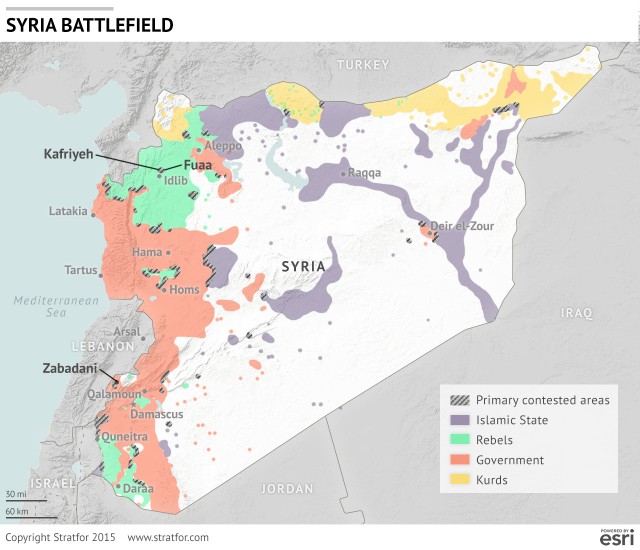
To the north of Kweiris air base, also in Aleppo province, Ahrar al-Sham is leading an offensive into Islamic State territory inside the buffer zone that United States and Turkey are trying to establish with airstrikes and allied rebel forces on the ground. The Ahrar al-Sham offensive has made considerable initial progress, seizing two border villages and a natural gas plant, although a successful Islamic State counterattack has complicated their advance. It is still too early to make a call on the outcome. One explanation for Ahrar al-Sham's push is that the group is trying position itself as a vital rebel force to occupy the buffer zone in a coalition operation against the Islamic State. However, Ahrar al-Sham is carrying out its most recent offensive alongside other rebel factions that maintain very close ties with Turkey, including the Nour al-Din al-Zenki battalions, meaning the group is more likely to be coordinating its efforts with Ankara.
Ahrar al-Sham is one of the most powerful rebel factions in Syria and has deftly maneuvered to increase its influence and position within the country. The group has especially benefitted from the increased flow of aid reaching the rebels in Syria. Ahrar al-Sham, alongside other key rebel factions such as Jaish al-Islam, has also sought to promote an image of pragmatism and willingness to cooperate with regional and international efforts. Ahrar al-Sham's leadership has aggressively pursued this public relations effort, even publishing op-eds in Western media including in the Washington Post. This is in spite of opposition from fellow Islamist group and ally Jabhat al-Nusra. Because of Ahrar al-Sham's strong links with Jabhat al-Nusra and its goals for a future Syria, the United States is still hesitant to engage with the group.
Islamist groups such as Ahrar al-Sham and Jaish al-Islam, however, simply must be part of any search for a solution to the Syrian conflict. The successful establishment of a cease-fire in the towns of Zabadani, Fuaa, and Kafriyeh illustrated the value of working with Islamist organizations, given Iran and Turkey mediated the agreement with the involvement of Ahrar al-Sham and Hezbollah. Involving such groups is especially important in northern Syria, where powerful Islamist factions overshadow groups that the United States favors. The United States will have to contend with this reality as it works with Turkey to push the Islamic State out of Aleppo province.
Aug. 10
Syria
Jabhat al-Nusra, the al Qaeda affiliate in Syria, will leave many of its major positions along the front line with the Islamic State. Over the weekend, the militant group declared that it would neither oppose nor aid the upcoming Turkish- and coalition-led effort against the Islamic State in Aleppo province. Jabhat al-Nusra understands that it risks heavy damage if it fights against the Turkish-U.S. operation and would rather see its Islamic State enemies be the full target of any upcoming operation.
A retreat by Jabhat al-Nusra from its positions in northern Aleppo, even if it loses territory directly under its control, is advantageous for the group in a number of ways. According to Stratfor sources, the United States has agreed to halt its attacks on Jabhat al-Nusra in exchange for the pullback, a major gain since persistent U.S. attacks over the past months have damaged the group's operational leadership. Furthermore, Jabhat al-Nusra can consolidate its forces on other fronts as Turkey, the United States and other rebel forces effectively secure its flanks from attacks by the Islamic State.
It is important to note that Jabhat al-Nusra has already made its mark with successful attacks on the first batch of the New Syrian Force. Having delayed and damaged the program, Jabhat al-Nusra has created more space and time to retreat from the Aleppo border with Turkey. Nevertheless, the Jabhat al-Nusra retreat does not herald an end to its conflict with the West or determine its future position in Syria. As part of al Qaeda and an enemy of the West, the United States will have to address Jabhat al-Nusra eventually, even if the Islamic State is now the priority.
Aug. 8
Syria
Aug. 7
Syria
A flurry of meetings is taking place as stakeholders in the Syrian conflict attempt to work out a power-sharing agreement to replace the government of Syrian President Bashar al Assad. Russia has been driving the negotiation, while Oman acts as a neutral mediator relaying messages to and from Iran, Syria, Saudi Arabia, Turkey, Russia and the United States. Though the diplomatic activity is picking up, it is still an outside effort divorced from the reality of the battlefield, where Syrian rebels are fighting the al Assad government on their own terms.
Following a trip to Tehran, Syrian Foreign Minister Walid al-Moallem, who has been leading the negotiations on behalf of the al Assad government, traveled to Muscat, where he met with his counterpart, Yusuf bin Alawi bin Abdullah. Though Saudi Arabia has preferred to keep these negotiations more private, the Syrian government is eager to telegraph its involvement in such meetings to boost its legitimacy after years of diplomatic isolation.
The discussion between al-Moallem and bin Alawi allegedly centered on an exit strategy for al Assad. The Syrian government knows that proposing elections in which al Assad runs is a non-starter for negotiations with the Sunni powers, but al Assad is still angling for a graceful exit. Negotiating amnesty for al Assad will be a challenge, however. It is still unclear just how flexible the United States will be on the subject, especially with charges against al Assad pending over his government's use of chemical weapons and other war crimes. Syria has signed but not ratified the International Criminal Court's Rome statute, the founding document for the International Criminal Court, which means the country falls outside its jurisdiction. Unless a future Syrian government ratified the Rome statute or somehow accepted the court's authority, the only way the ICC could bring suit against Syria would be if the United Nations Security Council referred the case to it. However, this is unlikely as long as Russia retains its veto power, which will come in handy during amnesty negotiations. The possibility of a subsequent government charging al Assad in the ICC will also complicate where he can take refuge as part of any deal.
Moreover, Stratfor has received word that Russia invited defected Syrian Brig. Gen. Manaf Tlass, a Sunni, to Moscow later this month. After a highly publicized defection in 2012, Tlass has been in Paris, keeping a low profile and waiting for the right time to insert himself into negotiations. The Tlass family has a long history with the al Assad family: Manaf's father, Mustafa Tlass, helped rally strong military and Sunni support for al Assad when he took power in 2000. In 2012, we noted that the two families were likely to strike a deal to enable the Tlass family to leave Syria, and we forecast that Manaf Tlass would eventually return to play a role in a power-sharing arrangement. Given that Tlass is a Sunni with a military background who has also maintained close links with the al Assad administration, it is little wonder that he is now allegedly being proffered as a suitable candidate for defense minister in a new Syrian government.
Meanwhile, the dialogue over the political transition continues. Iranian Foreign Minister Javad Zarif will head to Turkey on Aug. 11 and then to Moscow later in the month. Russia will also host another round of talks with the highly fragmented Syrian National Council opposition coalition. Multiple factors have been speeding up negotiations: loyalist forces in Syria are suffering setbacks, the United States is trying to avoid a power vacuum in Damascus, and Russia is trying to strike a diplomatic win over Syria. Our assessment remains, however, that these negotiations are largely disconnected from the reality on the battlefield. Sunni rebel forces have the momentum in the fight and are unlikely to agree to a deal at this stage, much less cede power to controversial Sunni figures such as Tlass who have lived comfortably in Paris while others continued the fight in Syria. For this negotiation to yield an effective outcome, it will be vital that Syrian rebel factions get involved.
Aug. 6
Syria
Two ongoing offensives in Syria, staged by Jaish al-Fatah and the Islamic State, are problematic for Damascus as it scrambles to contain multiple threats. Loyalist forces are spread thin across many fronts but still doggedly attempting to defend their positions and mount counterattacks.
Having largely secured Idlib province, Jaish al-Fatah is now channeling its efforts into pushing down through the strategic Sahl al-Ghab plain corridor in northwest Hama province. Securing the plain would improve rebel access to Latakia province while positioning them for a combined assault on the rest of Hama province alongside other rebels positioned close to the town of Morek.
Against considerable loyalist forces massed on the Sahl al-Ghab plain, supported by large numbers of artillery and armored units, fighting has devolved into fluid battles comprising numerous attacks and counterattacks. The overall advantage lies with the rebels, who are adept at using the heights around the plain to their advantage, relying heavily on anti-tank guided missiles to neutralize the government's superiority in armor. Over the last 48 hours, the rebels succeeded in taking the village of Bahsa, approximately 5 kilometers (3 miles) from Joureen. If they can maintain their progress and take Joureen itself, the rebels would be able to largely isolate the remaining loyalist forces, essentially securing control over the plain.
Meanwhile, the Islamic State capitalized on its inherent mobility and staged a successful surprise offensive, seizing the crossroads town of al-Qaryatayn, not far from Homs. The Islamic State is attempting to hold off a loyalist offensive to take back the ancient city of Palmyra. The militant group's offensive on al-Qaryatayn fundamentally undermines the loyalist advance toward Palmyra by hitting the outer lines of Damascus' forces on the flank and threatening essential supply lines feeding the loyalist advance. With al-Qaryatayn taken, currently the loyalists only have access to one road to reinforce their vital T4 Airbase and support the push on Palmyra.
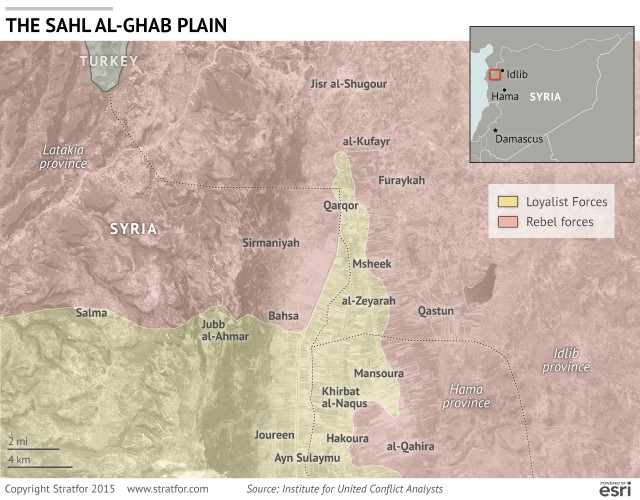
The recent gains against loyalist positions by the rebels and the Islamic State are, however, far from assured. The inevitable backlash from Damascus may restore its lost positions. But the dual offensives from the north and the east threaten key defended areas, highlighting the increasingly precarious situation of the Syrian government, which is trying to protect its core territories in Hama and Homs provinces.
In Aleppo province to the north, reports indicate that Jabhat al-Nusra is pulling back from some of its positions and handing them over to its allies. Stratfor sources suggest this may be a potential accord mediated by Turkey, whereby Jabhat al-Nusra would vacate northern Aleppo province in return for the cessation of airstrikes on its forces by the United States. Stratfor is watching carefully for any change in U.S. air activity to confirm this possibility.
Diplomatic Maneuvers
On the political front, diplomatic efforts to secure a solution to the Syrian crisis proceed. Multiple meetings, visits and proposals are underway, involving all the main countries with a stake in the crisis. U.S. Secretary of State John Kerry and Russian Foreign Minister Sergei Lavrov met for the third time this week. And the officials are making some headway. For example, the Russians have agreed to support a draft United Nations resolution to identify the perpetrators of chemical weapons attacks in Syria. With this agreement, Moscow could be setting itself up as a credible mediator by offering a way to secure more concessions from Damascus pending the outcome of the U.N. investigation, which will very likely identify loyalist forces as being the main offenders in the use of chemical weapons.
Syrian Foreign Minister Walid al-Moallem continues to engage in shuttle diplomacy with a trip to Oman, which marks his first visit to a Gulf country since the beginning of the Syrian conflict. Because of its more neutral stance, Oman is best positioned among the Gulf nations as a forum for al-Moallem to convey Damascus' position to the Gulf Cooperation Council countries. Iran has also announced it is about to present a peace plan for Syria to the United Nations, without going into further detail. But despite the considerable effort underway to mediate a solution to the Syrian conflict, it will be very difficult to reach a successful outcome given the widely disparate positions of the key actors.
Aug. 5
Turkey, Syria, United States
The United States launched its first airstrike in Syria from the Incirlik Air Base in southern Turkey. On July 23, leaks emerged that Turkey had agreed to allow the United States to use the air base to intervene in neighboring Syria. The U.S. mission in Syria against the Islamic State is complicated by the plethora of armed actors, each with their own intricate web of alliances and interests. U.S. aircraft and drones have been steadily arriving in Turkish air bases for a comprehensive battle against Islamic State militants, Turkish Foreign Minister Mevlut Cavusoglu said. The plans involve cutting off the Islamic State’s access to the Turkish border to cut off cross-border flows of weapons and militants, unnamed diplomats familiar with the negotiations said. Satellite images showing armored vehicles in defensive positions reveal Ankara's concern about retaliation following its recent intervention in Syria. Qatar has also given its full support for the ongoing Turkish campaign of airstrikes in northern Iraq, breaking ranks with the rest of the Arab League, according to a Qatari Foreign Ministry statement.
Analysis: Satellite images taken at the Turkey-Syria border corroborate what Stratfor predicted weeks ago: that Turkey, now partnered with the United States, will strike at Islamic State-controlled territory adjacent to the Turkish border. The Turks reportedly began to reinforce their southern border with troops and equipment as early as July 3. But according to these images, which were taken July 26, we now know that that equipment includes Turkish-made main battle tanks and support units poised in a defensive position on the Turkish side of the border.
The areas shown in the images are located near the Turkish town of Elbeyli, on the border with Syria. On July 23, just three days before the images were captured, Islamic State militants fired across the border from the Syrian village of al-Raaee and traded fire with Turkish forces, resulting in the death of a Turkish soldier and a Syrian militant. The next day, Turkish fighter aircraft bombed Islamic State positions in Syria. Soon after, Washington and Ankara came to an official agreement allowing the United States to use Incirlik Air Base to strike against Islamic State positions. Read the full analysis here: Bringing Turkey's Border Strategy Into Focus.
Aug. 4
Syria
The al Qaeda-linked Jabhat al-Nusra militant group captured five more U.S.-trained rebels in Syria. The fighters were captured during overnight raids in the village of Qah, near the Turkish border. On July 30, at least eight rebels from the same unit, known as the New Syrian Force, were also abducted by the jihadist group. Meanwhile, the United States confirmed Aug. 4 that it is providing air cover for the New Syrian Force, with the first airstrike carried out on July 31.
Analysis: The U.S. struggle to set up a viable Syrian rebel force on the ground were put in stark relief by recent clashes between the Western-backed New Syrian Force and the al Qaeda-linked Jabhat al-Nusra. Over the past weekend, the New Syrian Force was forced to withdraw from its headquarters in rebel-held northern Aleppo province to Afrin canton, controlled by the Syrian Kurdish People’s Protection Units, or YPG.
The plethora of armed actors in Syria, each with their own intricate web of alliances and interests, makes a unified effort against the Islamic State very difficult. This divergence is equally as strong, if not as hostile, at the Syrian combatant and the state levels, as reflected by the differences of opinion between the United States and Turkey regarding which factions to back. Though the Islamic State's presence in northern Aleppo is increasingly vulnerable, and though it almost certainly will be driven from the area, infighting among its various opponents will delay this eventuality. Read the full analysis here: In Syria, Jabhat al-Nusra Complicates U.S. Strategy.
Iraq, United Kingdom
The United Kingdom is extending its participation in U.S.-led airstrikes in Iraq against the Islamic State by another year to March 2017, British Defense Secretary Michael Fallon said. The extension is the second for the squadron of Tornado GR4 fighter bombers based in Cyprus. The United Kingdom is not taking part in the air operations in Syria, but British Prime Minister David Cameron is planning to ask lawmakers next month to vote on whether to join.
Aug. 3
Syria
Russian President Vladimir Putin may give up on Syrian President Bashar al Assad and withdraw the Kremlin’s wholehearted support for him in the future, Turkish President Recep Tayyip Erdogan said Aug. 3. Putin’s attitude toward Syria has become more encouraging, Erdogan said, and he no longer believes that Russia will support al Assad to the end. Erdogan was citing his impressions from his meeting with Putin in Baku on June 13. Russia has been facilitating a dialogue between the Syrian regime and Saudi Arabia.
The United States will allow airstrikes to back the rebel groups it is supporting against any attackers, including those loyal to Syrian President Bashar al Assad. Washington says the mission's goal is still to combat the Islamic State but that the U.S. airstrikes would be used against anyone inhibiting the U.S.-backed rebels from achieving their purpose. Russia criticized the decision, saying it would hinder Damascus from effectively fighting the Islamic State. The United States is hoping to advance the Syrian civil war to a position whereby a negotiated settlement could remove President Bashar al Assad from power.
