
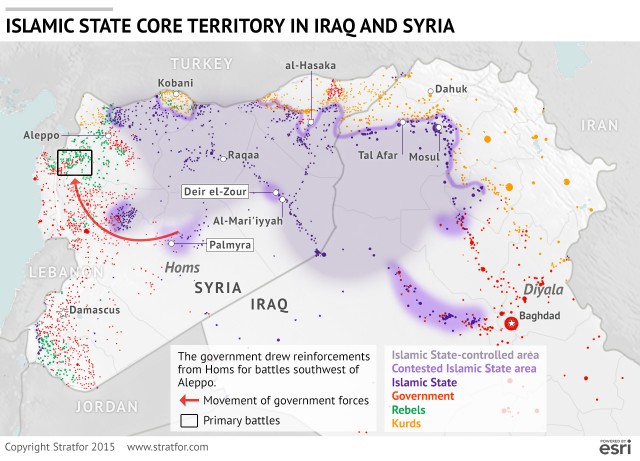
Editor's Note: Stratfor closely monitors conflict zones from a geopolitical perspective. What is perhaps the most volatile conflict today can be found in the territories of Iraq and Syria that are controlled by the Islamic State. Though these areas are cartographically distinct, they are functionally linked: Sunni tribal structures, rebel operations, Kurdish interests, external influences and the suzerainty of the Islamic State bind them together as a single, coherent theater.
The Islamic State capitalized on the chaos of the Syrian civil war and the inadequacy of Iraqi security forces to take over a large swath of the Middle East. After making some impressive gains, including the taking of the Iraqi city of Mosul, the Islamic State now finds itself in an increasingly difficult position, against which a wide array of opponents are aligned. Nonetheless, the group is uniquely resilient and, as such, remains extremely dangerous and unpredictable.
In addition to examining the combatants inside the Syria-Iraq battlespace, Stratfor also tracks the political machinations, negotiations and goals outside the battlespace, including in Iran, Russia, the Gulf monarchies and the United States. For the first time, in routinely updated monthly installments Stratfor is covering the gains, losses and extent of the Islamic State's so-called caliphate.
June 30
Syria, Turkey
Analysis: Numerous but unverified reports in the Turkish media say the Turkish military will soon intervene in Syria. Notably, high-level officials including Turkish Foreign Minister Mevlut Cavusoglu have not denied the claims, and Turkish President Recep Tayyip Erdogan has taken to Twitter to emphasize that the Turks will not allow terror organizations to take advantage of the chaotic environment along Turkey's borders. However, the operation discussed in the media, especially the possibility of a ground incursion, is unlikely. Still, it is worth highlighting the risks that will constrain Turkey in the off chance it decides to pursue such a course of action. Ready the full analysis: How Turkey Would Invade Syria.
June 25
Syria
The Islamic State launched two attacks in northern Syria on June 25. The first was a raid on the border town of Kobani, presently held by elements of the Kurdish People's Protection Units (YPG). Kobani was the focus of a major Islamic State operation in October 2014, which garnered major media attention despite its lack of strategic importance. The second attack was directed against the parts of al-Hasaka city still occupied by forces loyal to Syrian President Bashar al Assad. The mainstream media has largely focused on the Kobani attack, but the al-Hasaka operation in the northeast is more important by far.
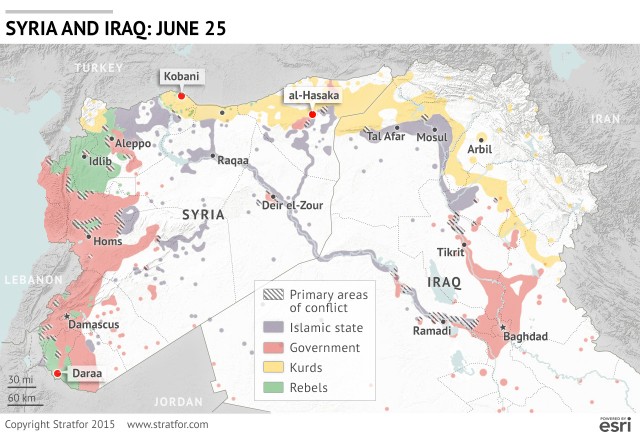
The strike on Kobani was essentially a suicide raid designed to achieve maximum shock and propaganda value. Around two dozen Islamic State fighters infiltrated the town by dressing in YPG and Free Syrian Army uniforms. Once inside, they spread out and began their attack, using the ensuing chaos to create as many casualties as possible. At least two small vehicle borne explosive devices were used to initiate the assault. The aim of the attack was to highlight the reach of the Islamic State, with Kobani being selected because of its high propaganda value. The raid also serves to tie-down YPG units in the rear, diverting manpower from the frontlines to guard against such attacks in the future. The prospect of having to secure major urban areas and setting up checkpoints along transit routes is a major difficulty for the YPG, which is already low on available manpower.
In comparison, the al-Hasaka assault is far larger in scale and more ambitious. After the Islamic State succeeded in assassinating the chief commander of loyalist forces in al-Hasaka city on June 24, the militants followed up with a premeditated attack involving hundreds of fighters. They swiftly penetrated the town's defenses and seized two neighborhoods in the process. The loyalist forces in al-Hasaka are now being heavily engaged as they attempt to repel the attack. It is not yet clear whether the YPG will intervene on the loyalist side when it comes to driving the Islamic State back, or whether they will hold their forces in anticipation of the opportunity to seize loyalist-held territory for themselves after the Islamic State upsets Damascus' forces in al-Hasaka.
June 22
Syria
With the help of the Kurdish People's Protection Units (YPG), Free Syrian Army forces continue to advance toward Raqaa, the Islamic State's de facto capital. On June 22, the Free Syrian Army announced its capture of the 93rd Brigade base near Ain Issa, only 55 kilometers (about 34 miles) north of Raqaa. The Islamic State has been reinforcing its positions in Raqaa and Aleppo provinces with fighters from other fronts in an attempt to counter rebel offensives in the area, weakening the group's hold elsewhere in Syria and allowing loyalist forces to make gains around the cities of Palmyra and Deir el-Zour.
June 17
Syria
The Southern Front rebel alliance publically refused to include Jabhat al-Nusra as part of its latest offensive in Quneitra governorate. The rebel group said that it does not share Jabhat al-Nusra's vision for the future of Syria. The ideological rift highlights not only the relative strength of Free Syrian Army units in the south, but the growing links that the Southern Front nurtures with outside benefactors, a ready source of battle-winning materiel and finance. The Southern Front, however, is unlikely to be pressured into directly fighting Jabhat al-Nusra: To do so would distract from the fight against Damascus. In addition, any open hostilities could result in revenge attacks against other Free Syrian Army-affiliated units in northern Syria, where Jabhat al-Nusra is more powerful.
In Quneitra, the Southern Front continues to advance on key locations, including the provincial capital of New Quneitra (Baath City). Though not formally integrated into the offensive, Jabhat al-Nusra established its own operations room and has participated in the fighting — mostly around Hadar, to the north — though it has been isolated from the Southern Front. Southern Front and Jabhat al-Nusra have worked together in the past, but that relationship has soured. Jabhat al-Nusra experienced a number of setbacks in the south in recent months, including major defections to other belligerents in the region that have sapped its available manpower.
June 16
Syria
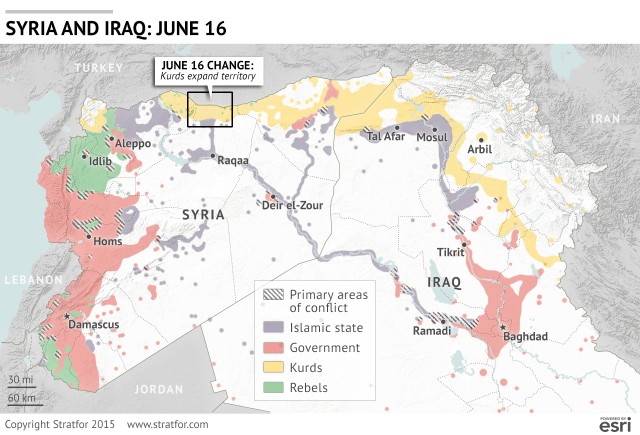
Kurdish People's Protection Units (YPG) continue to make significant gains in northern Syria. They now occupy the Turkish border town of Tal Abyad after Islamic State militants withdrew. Many Tal Abyad residents fled to Turkey, fearing airstrikes or the return of Islamic State fighters. Tal Abyad is the nearest border town to the Islamic State stronghold of Raqaa. To the northeast, the YPG are battling Syrian loyalist forces in Qamishli, with each side accusing the other of provocation.
Elsewhere, Southern Front rebels launched a new offensive to clear out forces loyal to Syrian President Bashar al Assad from their remaining positions in Quneitra province, located at the southwest edge of Syria. Jaish al-Fatah's offensive across the northern al Ghab plain in Hama is encountering tough resistance, reportedly because loyalist forces in the area are receiving reinforcements from external allies of Damascus.
June 15
Syria
Kurdish People's Protection Unit (YPG) fighters encircled the Islamic State-held town of Tal Abyad and seized control of the main road connecting Tal Abyad and Raqaa, the YPG militia said June 15. Tal Abyad is the nearest border town to Raqaa, an Islamic State stronghold, and the road connecting the two cities is an important supply route that the Islamic State uses to bring in foreign fighters.
Iraq
Hundreds of people displaced from Tikrit after the Islamic State seized the city have returned, three months after pro-government forces recaptured it. The city has largely been deserted since Shiite militiamen and U.S.-led airstrikes pushed the militants from the city in April. According to an unnamed official, the government chartered buses to transport more than 300 families from tent cities back to Tikrit.
June 14
Syria
Syrian Kurdish fighters are outside of Tal Abyad, a town held by the Islamic State on the Turkish border, Kurdish officials said June 14. A Kurdish spokesman also said that Islamic State fighters have fled from Suluk, southwest of Tal Abyad, and that Kurdish forces now hold the town. The advance on Tal Abyad could allow Kurds to cut off a vital route that the militant group uses to bring in new foreign fighters.
June 13
Syria
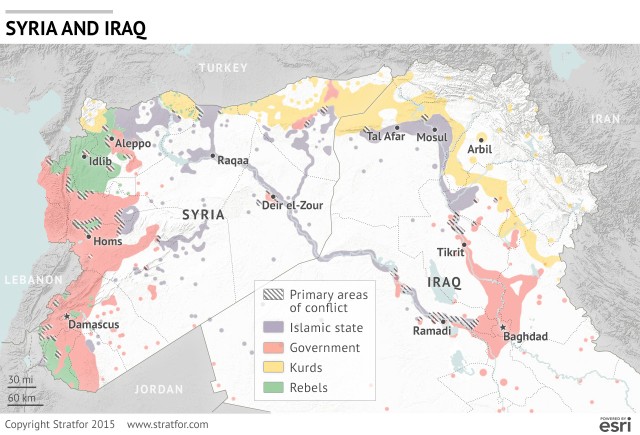
Kurdish People’s Protection Unit (YPG) fighters began to advance through Syria toward the Islamic State-held town of Tal Abyad on the Turkish border. Kurdish YPG units earlier blockaded the nearby town of Suluk also held by Islamic State. Tal Abyad is the nearest border town to the Islamic State stronghold of Raqaa.
June 12
Syria
The Syrian army drove rebels from parts of an air base in Sweida that the insurgents had recently seized. According to the Syrian Observatory for Human Rights, the rebels began to retreat from parts of al-Thala air base on June 10.
Members of Syria's Druze religious minority aided Syrian government forces in recapturing the al-Thala air base in the south from the Free Syrian Army. The Druze have tried to avoid committing to either side in the conflict. This has become more challenging since the Free Syrian Army's Southern Front launched an offensive in the Druze-dominated province of Swieda and partially captured the air base June 11. Some members of the Druze community mobilized against anti-government forces after the Islamist rebel group Jabhat al-Nusra killed 20 Druze villagers in northwestern Syria on June 10. Jabhat al-Nusra considers the Druze branch of Islam to be heretical.
Geopolitical Diary: Within the first year of the Syrian rebellion, a number of intelligence agencies and media outlets said the government of Syrian President Bashar al Assad had only months to live. Stratfor saw it differently. The battle was proceeding at a rapid pace, and things definitely looked dicey for the government at times, but we knew this would be a protracted fight. For one thing, the Alawites, while a naturally fractious lot, were facing an existential crisis against a Sunni majority and were not going to crumble easily. For another, the divisions within the rebel landscape (and among the rebels' foreign sponsors) were so great that both sides lacked the means to overwhelm and defeat the other. Read the full Geopolitical Diary: Considering a Post-Al Assad Syria.
June 11
Iraq
The Islamic State executed some 130 retired Iraqi soldiers and former security officers in Mosul during a weeklong purge of those suspected of spying on the group. In April, the group killed hundreds more former military and police officers, who had served under Iraqi leader Saddam Hussein. Meanwhile, Iraq's human rights minister updated the body count of those exhumed from sites in northern Iraq to nearly 600. Some reports suggest there could be as many as 1,700 bodies exhumed from the area where people were dumped after being massacred by the Islamic State at Camp Speicher, near Tikrit.
Syria
An American that joined Kurdish forces to fight the Islamic State was killed in a battle in Syria, the U.S. State Department confirmed June 11. The man, Keith Broomfield, is believed to be the first U.S. citizen to die alongside Kurdish troops while fighting the militants. He was killed in Qentere, near the border town of Kobani, after joining the People's Protection Units in February under the name Gelhat Raman. Kurdish fighters say they will hand over Broomfield's body to his family in Turkey.
June 10
Iraq
U.S. President Barack Obama authorized the deployment of 450 additional military specialists to Iraq to train forces in Anbar province. There are currently 3,000 troops stationed in Iraq to train the Iraqi military. The United States is also leading airstrikes against Islamic State militants in Iraq and Syria. According to reports, the troops would be based in Al Habbaniyah.
Syria
The Free Syrian Army's Southern Front has finally launched a long-anticipated offensive in southern Syria following months of preparation. The rebel forces swiftly overran the loyalist 52nd Mechanized Brigade on June 9 and are now headed for al Th'alah air base in Sweida province. The success of this offensive highlights the deteriorating position of President Bashar al Assad's forces. It also brings Syria's minority Druze population closer to the center of the conflict.
Analysis: The government in Damascus was broadly aware of an impending assault on their southern positions and had been preparing defenses for months. The fact that the 52nd Mechanized Brigade collapsed quickly despite advanced planning indicates the degree to which the Syrian military has been weakened. The rebels seized considerable equipment and weaponry from the base, including at least seven BMP-1 infantry fighting vehicles and several T-72 tanks, as well as weapons and munitions. This new materiel will enable continued rebel attacks against the al Assad government. Loyalist forces will find themselves in an increasingly difficult position as they seek to defend against multiple rebel offensives in the north and south in addition to Islamic State attacks from the east, across the desert. Read the full analysis: In Southern Syria, a Rebel Offensive Begins.
June 9
Iraq
In May, the Iraqi government sent around 500 billion dinars ($430 million) to fund the June budget of the Kurdish autonomous region, approximately half the normal monthly payment, Iraqi Finance Minister Hoshyar Zebari said. In December, Baghdad and Arbil reached a deal on contentious oil exports under which the Kurds would supply 550,000 barrels per day in exchange for a return to budget payments that Baghdad cut in 2014. Baghdad has accused Arbil of failing to supply the agreed-upon amount of oil, while Arbil says Baghdad has not paid the 1.2 trillion dinars per month promised.
Elsewhere, three Islamic State militants dressed in military uniforms killed at least eight people and wounded another 17 in an attack on a government office in Amiriyat al-Fallujah in western Iraq. One of the attackers blew himself up and the remaining two are still at large. Amiriyat al-Fallujah is located on the western fringe of Baghdad and is one of the few areas in Anbar province still under government control.
June 8
Iraq
U.S. President Barack Obama said at the G7 summit in Germany that he was confident that the Islamic State would be driven out of Iraq and defeated, but there would be setbacks along the way. Obama went on to say that Islamic State success in Ramadi would be short-lived and that the United States would increase its training and assistance role. At the same summit, Iraqi Prime Minister Haider al-Abadi called on the international community to help curtail Islamic State revenue from oil smuggling.
June 7
Iraq
Iraqi forces recaptured Beiji city from Islamic State fighters, a spokesman for the Iraqi Defense Ministry said. The spokesman also said Iraqi forces cleared the city's center, government complex, main mosque and surrounding neighborhoods. The spokesman credited the United States with supporting Iraqi ground forces in the assault as well, but did not provide specifics on what kind of U.S. support they received. Islamic State forces fled back toward Mosul and were under air attack while retreating.
Syria
Syrian loyalist forces repulsed a major Islamic State offensive in the northeastern city of al-Hasaka, the Syrian army said June 7. Army officials also said government troops had retaken an electricity station, a juvenile prison and two villages held by the Islamic State on the southern edge of the city. Northeastern Syria, which links areas controlled by Islamic State in Syria and Iraq, is of strategic importance to the militant group as its advances continue to shape the Syrian civil war.
June 5
Iraq
According to Iranian news agency Press TV, a U.S. drone on its way to Anbar province crashed in southern Iraq. An Iraqi security official confirmed the reports that said the unmanned aerial vehicle crashed because of a technical failure.
Syria
Islamic State suicide bombers detonated explosive-laden trucks at army checkpoints around al-Hasaka more than a dozen times over the past five days, the city's governor said June 4. Syrian forces have maintained control of the city, though Islamic State militants have moved within 0.5 kilometers (0.3 miles) of al-Hasaka's southern entrance, according to a representative from the Syrian Observatory for Human Rights.
Analysis: A survey of the Syrian battlefield quickly reveals that the Syrian government is under enormous stress. Loyalist forces are clinging to the Alawite-concentrated coastal region and the core of Damascus as the approaches to both strongholds are looking more precarious. In the north, the rebels have all but taken Idlib province and are increasingly threatening the government's hold on Aleppo. In the critical central corridor, the rebels look set to advance on the government-held Hama from the north while the long-isolated rebel pocket north of Homs has become increasingly active. Furthermore, the rebels in Daraa and Quneitra continue to push up from the south toward Damascus. Meanwhile, the Islamic State is staging powerful attacks against government forces to the east of the Homs-Hama corridor after having consolidated its gains in the eastern desert. Read the full analysis: Outside Powers Weigh Their Options in Syria.
June 3
Iraq
The Ministry of Natural Resources in Iraq's Kurdish region denied reports that it ceased oil shipments to the national government's State Oil Marketing Organization June 3. Earlier in the day, Reuters reported that Arbil was no longer transferring crude to the state-owned company. The Kurdish regional government confirmed that it was abiding by its previous energy agreement with Baghdad, which dictates that it export an average 550,000 barrels per day through Baghdad. The semi-autonomous region has made moves toward energy independence in the past, but the shared opposition to the Islamic State has brought Kurds into closer cooperation with the Iraqi government.
June 2
Iraq
At a meeting of Middle Eastern and Western Powers in Paris on June 2, Iraqi Prime Minister Haider al-Abadi will outline a plan to recapture the city of Ramadi from Islamic State militants. Twenty ministers from Iraq's coalition partners, including from the United States, Britain, France, Saudi Arabia and the United Arab Emirates, are meeting to discuss strategies for countering the Islamic State. Al-Abadi has said Iraq's allies need to provide more support in the fight against militants, in particular to prevent foreign fighters from traveling to Iraq to join the Islamic State. At the meeting in Paris, he will present a plan to retake Ramadi, which will include mobilizing more Sunni tribal elements in Anbar province while ensuring that Shiite militias answer primarily to Baghdad and not to Tehran. Though the Iraqi government has relied on Shiite militias to counter Islamic State militants, the United States has expressed concern that the strategy could exacerbate sectarian tensions in the heavily Sunni Anbar province.
Syria
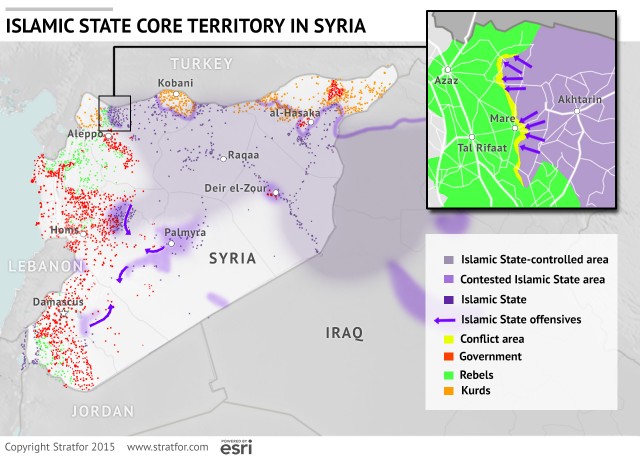
Analysis: In a display of considerable flexibility on the battlefield, the Islamic State managed to take rebel forces in northern Aleppo by surprise with a large-scale offensive aimed at securing more territory along the Syria-Turkey border. After drawing down its forces in the area, the Islamic State's sudden tactical shift resulted in considerable initial gains against the rebels. Islamic State fighters seized Sawran and are advancing near Mare. But thanks to reinforcements from Aleppo city and other provinces, Syrian rebel forces have already begun to mount powerful counterattacks against the Islamic State. For now, the outcome of the battle hangs in the balance as both sides move to bolster their ranks. Read the full analysis: How Islamic State Victories Shape the Syrian Civil War.
June 1
Iraq
Islamic State militants attacked Kurdish forces on May 31 in the town of Bashiqa, near Mosul, according to a peshmerga commander. The peshmerga forces reportedly repelled the offensive after an hour and a half of fighting. No Kurdish fighters were killed, and it is unclear whether any Islamic State militants died in the fighting.
