
Editor's Note: Stratfor closely monitors conflict zones from a geopolitical perspective. What is perhaps the most volatile conflict today can be found in the territories of Iraq and Syria that are controlled by the Islamic State.[collapsed title=more] Though these areas are cartographically distinct, they are functionally linked: Sunni tribal structures, rebel operations, Kurdish interests, external influences and the suzerainty of the Islamic State bind them together as a single, coherent theater. The Islamic State capitalized on the chaos of the Syrian civil war and the inadequacy of Iraqi security forces to take over a large swath of the Middle East. After making some impressive gains, including the taking of the Iraqi city of Mosul, the Islamic State now finds itself in an increasingly difficult position, against which a wide array of opponents are aligned. Nonetheless, the group is uniquely resilient and, as such, remains extremely dangerous and unpredictable. In addition to examining the combatants inside the Syria-Iraq battlespace, Stratfor also tracks the political machinations, negotiations and goals outside the battlespace, including in Iran, Russia, the Gulf monarchies and the United States. For the first time, in routinely updated monthly installments Stratfor is covering the gains, losses and extent of the Islamic State's so-called caliphate.[/collapsed]
May 28-29
Iraq
The Islamic State claimed credit May 29 for the bombings of two five-star hotels in Baghdad on May 28. According to a statement, a suicide bomber parked a car carrying explosives outside the Ishtar Hotel, then drove another car to the Babylon Hotel, detonating the explosives around the same time the other car exploded. At least 15 were killed and 42 wounded in the attacks, which come after Iraqi government forces lost control of Ramadi, a major city 130 kilometers (81 miles) west of Baghdad, to Islamic State militants in March.
Elsewhere, the remains of 470 people believed to have been executed by militants near Tikrit in 2014 have been exhumed, the Iraqi health minister said May 28. The Islamic State is believed to have killed the victims last year in what is known as the Speicher massacre.
Syria
Syrian rebels opposed to the government of President Bashar al Assad captured the town of Ariha in northwestern Idlib province the night of May 28 and four nearby villages the following day. The advances come after the same militant groups, which include al Qaeda-affiliate Jabhat al-Nusra and another Islamist group, Ahrar al-Sham, captured the provincial capital from Syrian government forces in March. As rebels have captured more territory in Idlib, the Syrian government has withdrawn troops from the province to focus on defending Latakia province as well as the cities of Homs and Damascus. The Syrian army has been stretched thin in its fight against the various rebel factions and Islamic State militants making gains in central Syria.
May 26
Iraq
Iraq announced the beginning of a military operation May 26 to retake Anbar province from Islamic State militants. The Islamic State seized the provincial capital, Ramadi, last week; now, pro-government forces are reportedly massing west of Ramadi in preparation for an offensive to win back the city. According to reports, troops have cut the Islamic State supply lines south of the capital. Meanwhile, an estimated 13 militants were killed when government forces bombarded their position in eastern Ramadi.
Writing in Global Affairs, Stratfor contributor Ian Morris considers why Iranian power is not inevitable.
Also on May 26, Islamic State suicide bombers attacked Iraqi forces outside Fallujah and in the nearby town of Karmah, killing at least 47 troops. Using a sandstorm as cover, militants sent three suicide car bombs into the Iraqi army's 1st Division headquarters, five kilometers (3 miles) east of Fallujah, killing 17 soldiers. In Karmah, 16 kilometers to the northeast, four more car bombs killed more than 30 members of Iraqi security forces. Though Islamic State militants control Fallujah, Iraqi forces were able to maintain control over Karmah in clashes following the bombings. The suicide attacks come as Iraqi forces are beginning an offensive to recapture Anbar province from militants, who captured Anbar's regional capital, Ramadi, two weeks ago.
Syria
Turkish President Recep Tayyip Erdogan said May 26 that Turkey, Saudi Arabia and Qatar had agreed on the necessity to enforce a no-fly zone in Syria despite a lack of commitment from the United States. Although the United States and Turkey recently began a joint operation to train and equip Syrian opposition fighters, Erdogan said that Republicans and Democrats in the U.S. Congress were unable to agree on the implementation of a safe zone and no-fly zone in northern Syria. Erdogan went on to say that, as a fellow NATO ally, the United States had an obligation to assist Turkey in Syria. Turkey and Saudi Arabia announced an alliance May 7 to provide logistical and financial support to Syrian opposition fighters.
May 24
Syria
Islamic State fighters executed at least 400 people in Palmyra since capturing the Syrian city on May 20, Syrian state media said May 24. The account was not immediately verifiable, though the Syrian Observatory for Human Rights said that some people were beheaded but has not given an estimate for the death toll among civilians. The capture of Palmyra, along with the recent capture of Ramadi in western Iraq, shows that the Islamic State still poses a threat to Damascus and Baghdad.
May 22
Iraq
The Iraqi government and its allies will launch a mission to retake the city of Ramadi from Islamic State militants, a Popular Mobilization Force representative said May 22. The Popular Mobilization Force, a grouping of primarily Shiite militias, is currently focused on obtaining more modern weaponry and says that its forces will then attempt to stop the Islamic State advance.
May 21
Iraq
Government forces and allied militias recaptured the western part of Beiji, Salahuddin province, from Islamic State militants and freed 300 soldiers who had been trapped in the Beiji refinery, the secretary-general of the Shiite League of the Righteous militia said.
Iraqi Prime Minister Haider al-Abadi and Russian Prime Minister Dmitri Medvedev agreed on the need to expand military, economic and diplomatic cooperation between Russia and Iraq. In particular, al-Abadi emphasized a desire for Russia and Iraq to share military technology, cooperate to combat terrorism and work together in the oil and natural gas sector. Al-Abadi is attending a series of talks in Moscow and will meet with Russian President Vladimir Putin later in the day.
Syria
The Islamic State controls more than half of Syria's territory now that it has seized Palmyra, an activist group said. The capture of the city May 20 was the first time the militant group was able to seize such a densely populated area from Syrian pro-government forces. Most of the area the Islamic State controls in Syria is sparsely populated. The international community has been particularly concerned about the fall of Palmyra because of the ancient ruins located there. According to BBC, militants have entered the ancient part of the city, which is designated a UNESCO world heritage site, but no damage has been reported yet.
A shell exploded at a Syrian army checkpoint near the Russian Embassy in Damascus, leaving an unknown number of Syrian troops dead or wounded, an embassy spokeswoman said. No embassy workers were injured. The Russian Embassy was last targeted by mortars May 19.
Cross-Border
Islamic State militants seized al-Tanf, the last Iraq-Syria border crossing held by forces loyal to President Bashar al Assad. The Islamic State now controls the entire border except for a small northern section held by Kurdish militias. The al-Tanf seizure follows the May 20 Islamic State capture of Palmyra, Syria. Despite recent gains, the Islamic State will struggle to maintain its offensive on two fronts simultaneously.
May 20
Iraq
Iraqi forces have fought back an overnight attack by Islamic State fighters east of militant-controlled Ramadi. The militants attacked government troops in Husaiba al-Sharquiya, located between Ramadi and the Al Habbaniyah military base, where Shiite militias have gathered. The Islamic State is trying to consolidate its control over Anbar province.
Syria
Islamic State militants took over the northern section of Palmyra on after a week-long push toward the central Syrian city. Jihadists seized a state security building before spreading through northern neighborhoods that they had previously overtaken May 16 and had held for less than 24 hours. If Islamic State fighters make their way to the southwestern part of the city, locals worry they will destroy Palmyra's ancient ruins, which are designated as a UNESCO world heritage site. Despite recent gains, however, the Islamic State has been stretched thin by its attempts to advance in both Syria and Iraq.
Analysis: In the past week, the Islamic State seized the ancient city of Palmyra from Syrian President Bashar al Assad's forces. The city's capture adds to the many defeats Damascus has suffered over the past six months, compounding its problems as it faces threats on multiple fronts.
The Islamic State's victory in Palmyra is notable for two reasons. First, it has completely isolated loyalist forces in Deir el-Zour province, including the 137th Mechanized Brigade and the elite 104th Republican Brigade. Though these units could still receive supplies by air, the Syrian air force is heavily committed to other areas of the conflict. It would be nearly impossible for the government to adequately sustain the encircled forces over the long term. Second, Palmyra's location — a critical crossroads in the center of Syria — gives the Islamic State a strategic base from which it can launch attacks on key locations in the surrounding area. Because loyalist forces hold nearly all of the important targets in Palmyra's vicinity, the Islamic State's new advantage does not bode well for al Assad's overstretched forces. Read the full analysis: The Capture of Palmyra: A Big Win for the Islamic State.

May 19
Syria
Two mortar rounds landed on the premises of the Russian Embassy in Damascus on May 19, causing damage but no injuries, an embassy spokeswoman said. One mortar fell near the main entrance, and the other hit an administrative building. A similar attack targeted the embassy in January.
Iraq
A new Islamic State propaganda video confirms the group's control over Ramadi and claims militants will next target the cities of Baghdad and Karbala. The video, called "Islamic State Controls Ramadi," shows militants celebrating in the provincial capital after capturing it May 17. However, Iraqi troops and allied tribal elements, bolstered by newly arrived Shiite militias, have contained the Islamic State's advance and are attempting to surround the city in preparation for a counterattack.
May 18
Syria
The Islamic State took full control of the al-Hail and Arak gas fields May 18, located 40 and 25 kilometers (25 and 15 miles) respectively northeast of Palmyra. The two gas fields were a vital source of energy for the territories controlled by Syrian President Bashar al Assad. The Islamic State has been fighting in and around the ancient city of Palmyra since May 13; at one point the group controlled a majority of the city's north before being pushed out by government forces. Approximately 364 people have been killed in Palmyra, including 62 civilians, according to the Syrian Observatory for Human Rights.
Iraq
Shiite militiamen gathered May 18 at the Al Habbaniyah military base, located approximately 30 kilometers (19 miles) from Ramadi, in preparation for a counteroffensive against the Islamic State. The Islamic State seized Ramadi, the largest city in Anbar Province, on May 17, in what is considered one of the most significant losses for the Iraqi government since the fall of Mosul last summer. The U.S.-led coalition conducted 19 airstrikes over 72-hours in and around Ramadi but was unable to stop the Islamic State from seizing the city. Reports now suggest that the Islamic State is advancing on the Al Habbaniya military base in order to stop Shiite militias from conducting a counteroffensive.
May 17
Iraq
Islamic State militants claimed full control of Ramadi, the provincial capital of Anbar province, western Iraq, the militant group said in a statement. The statement comes after Prime Minister Haider al-Abadi authorized a deployment of Shiite militias to take back the area. Islamic State militants previous drove security forces from the Anbar Operations Command in western Iraq on the same day, Iraqi troops said. It is the biggest gain for Islamic State in Iraq since security forces and Shiite militias began pushing the group back in cities like Tikrit.
Syria
Loyalist forces regained control of Palmyra on May 17 after Islamic State militants seized the northern part of the town May 16, a Syrian official said. Gov. Talal Barazi of Homs province also said Syrian troops recaptured two hills from the militants and that army reinforcements have been sent. Syrian opposition activists confirmed that Islamic State fighters withdrew from a government building they had taken in the northern part of the town, though fighting between the two sides continued.
May 16
Syria
Amid ongoing clashes May 16, Islamic State fighters pushed forces loyal to President Bashar al Assad out of much of the northern part of Palmyra, Syria, according to the Syrian Observatory for Human Rights. The Islamic State offensive on the city began May 13. In another blow to Damascus, Turkish military jets engaged and brought down a Syrian aircraft May 16 after it entered Turkey’s airspace without authorization. The identity and type of the Syrian aircraft are both still unclear.
Elsewhere in Syria, a U.S. Special Forces operation in al-Amr, Syria ordered by President Barack Obama has killed Abu Sayyaf, an Islamic State commander in charge of oil and natural gas sales, Defense Secretary Ashton Carter said May 16. U.S. troops captured Abu Sayyaf’s wife, Umm Sayyaf, and detained her in Iraq. This is the first special operations raid inside of Syria since the 2014 failed attempt to free Islamic State hostages.
May 15
Syria
Fighters from the Syrian army and Hezbollah gained full control of the strategic Jabal al-Barouh mountain range on May 14. The territory overlooks an important highway that runs along the Lebanese border and connects Damascus to Homs. In a separate incident May 14, Hezbollah and the Syrian army defeated a contingent of Jabhat al-Nusra fighters in west Qalamoun. The victory is the most significant win for Syrian President Bashar al Assad since fighting broke out in Qalamoun on May 3.
Iraq
Islamic State militants captured the government complex in central Ramadi after launching an overnight offensive on the city May 15. Militants captured the government buildings following intense fighting throughout Ramadi, during which six suicide car bombs were detonated and at least 50 Iraqi military personnel were killed. Coalition forces have responded by launching airstrikes in the area.
Soon after, Islamic State militants captured the town of Jubah — a town northwest of Ramadi — where hundreds of U.S. advisors are stationed. Earlier May 15, the Islamic State secured territory east of Fallujah, killing 200 Iraqi soldiers and capturing at least 59 others, Al-Quds Al-Arabi reported. Recent reports indicate militants are continuing their westward push, attacking a residential area in Baghdadi and beseiging 700 families.
May 14
Syria
Fighting between the Islamic State and Syrian troops threatens the ancient Syrian city of Palmyra, a UNESCO world heritage site, the Syrian Observatory for Human Rights said. According to reports, the fighting is about 2 kilometers (slightly more than a mile) from the site. The reports come as an international conference is held in Cairo addressing the destruction of the Nimrud and Hatra historical sites in Iraq by the Islamic State.
Middle East, United States
Geopolitical Diary: U.S. President Barack Obama's Camp David retreat for Sunni Gulf leaders will not be remembered for the diplomatic snubs, defense deals or even the nuclear proliferation threats. It will be remembered as the most vivid illustration of a changing balance of power in the Middle East after three and a half decades of acrimonious U.S.-Iran relations
The last major shift in the U.S. relationship with the Persian Gulf states took place in the 1970s, in the thick of the Cold War. The 34-year-old deputy crown prince, Mohammed bin Salman, and the 55-year-old crown prince, Mohammed bin Nayef, may be too young to fully understand what their royal elders struggled with in trying to ensure that the global hegemon would not sacrifice the House of Saud to its Persian allies. After all, an entire generation has only known a world in which U.S. support for Saudi Arabia and hostility toward Iran were a given. But the mandate of King Salman's successors at Camp David was clear: to prevent history from repeating itself. Read the full Geopolitical Diary: Camp David and the U.S. Power of Choice in the Middle East.
May 13
Syria
After a conflict that killed some 48 soldiers and militants and wounded at least 100 others May 12, the Islamic State captured the strategic town of Al-Sukhnah, located in Syria's Homs province, according to an activist group. The town is located near the highway that leads from Islamic State stronghold Deir el-Zour province to the regime-controlled ancient town of Palmyra. Deir el-Zour is located in the desert region east of Homs and is a part of the Islamic State's self-described caliphate in Syria and Iraq.
Hezbollah fighters and Syrian forces gained control on May 13 of Talit Moussa, the highest peak in the Qalamoun region. The strategic position will help the Syrian army and its allies to monitor rebel movements and defend the large swathes of territory it gained in recent advances. Regime forces took control of at least nine rebel positions May 13, the latest in a series of gains over the past week, as part of broader offensive against rebel militants that began in May.
Iraq
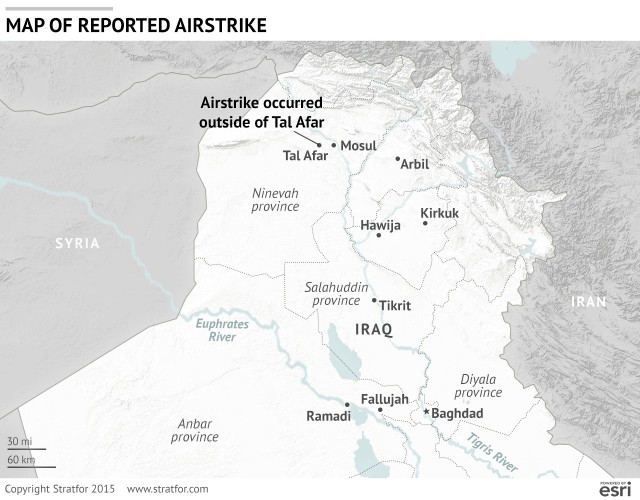
According to Iraqi Defense Ministry Spokesman Brig. Gen. Tahsin Ibrahim, Islamic State second-in-command Abdul Rahman Mustafa Mohammad, known as Abu Alaa al-Afri, was killed along with dozens of militants in an airstrike on a Tal Afar mosque. Unconfirmed reports in recent weeks have alleged that al-Afri had taken command of the group after the injury of leader Abu Bakr al-Baghdadi.
Analysis: The Iraqi government previously reported that Islamic State leader Abu Bakr al-Baghdadi was wounded in a March 18 airstrike in Ninevah's al-Baaj district and that al-Afari had assumed operational control of the group. The United States has denied that report. However, even if the worst case scenario for the Islamic State is true, with al-Baghdadi seriously wounded and al-Afari killed, it is unlikely to have any significant and immediate impact on the battlefield in Iraq and Syria.
If al-Baghdadi was wounded and incapacitated in March, the Islamic State's operations have shown no signs of it. The organization is large and highly institutionalized, containing sufficient redundancies and practicing extensive division of labor. It has also prepared for decapitation strikes and has weathered them in the past. For example, in the months following the June 2006 airstrike that killed Abu Musab al-Zarqawi, there was actually an increase in the attacks targeting coalition troops instead of a decrease. The group also survived an April 2010 airstrike that killed its two top leaders, Abu Omar al-Baghdadi and Abu Ayyub al-Masri. Even since the United States and its partners began airstrikes against the Islamic State in September 2014, several of the group's regional emirs have been killed but were quickly replaced. Moreover, al-Afari is a cleric, not a military leader, and the men planning and conducting the group's military operations are still largely intact. Read the full analysis: Could the Islamic State Survive Losing Its Leaders?
May 12
Syria, Iraq
The Iraqi government reprehended Hungary in a statement released May 12 for allegedly supporting Kurdish independence, Rudaw reported. The statement followed a joint press conference held by Hungarian Prime Minister Viktor Orban and Kurdistan Regional Government President Massoud Barzani, during which Orban said Hungary supports nations striving for independence. The Iraqi government called the statements interference and asked that countries respect Iraq's sovereignty.
May 11
United States, Russia
U.S. Secretary of State John Kerry will travel to Sochi on May 11 to meet with Russian President Vladimir Putin, Foreign Minister Sergei Lavrov and other Russian officials, the U.S. State Department said in a statement. Kerry is expected to discuss bilateral and regional security issues, including the conflicts in Ukraine and Syria and nuclear negotiations with Iran. After visiting Russia, Kerry will travel to Turkey to attend a NATO meeting, before joining U.S. President Barack Obama in Washington to meet with Gulf Cooperation Council leaders.
Iraq
Iraqi security forces, Shiite militias and Peshmerga fighters repelled two Islamic State attacks against the Ajeel and Beiji oil fields on May 10 and 11. Iraqi special operations forces and Shiite militiamen reportedly killed 73 Islamic State fighters at the Ajeel oil field, located to the east of Tikrit. In Beiji, Iraqi security forces and Peshmerga fighters killed 40 Islamic State fighters and destroyed six vehicles while also gaining control over two strategic towns to the south of the oil field.
May 10
Iraq
Fighting between Iraqi security forces and Islamic State militants in Fallujah on May 10 killed at least 20 people and wounded at least 19, security sources said. During the battle, three suicide bombers blew up their explosive-laden vehicles, leaving at least 10 security members killed and eight others wounded. Meanwhile, U.S.-led coalition warplanes provided air support at the battlefield near Fallujah, killing at least seven Islamic State militants and wounding 11 others. The intense fighting comes as security forces and their allies continue to battle the militant group across Iraq.
May 7
Syria
Khaled Khoja, president of the National Coalition for Syrian Revolution and Opposition Forces, asked the United States on May 7 to provide air support so that rebel soldiers could establish a safe zone and transitional government within Syria. The request came after the Washington Post reported that regional powers, Saudi Arabia and Turkey, had confirmed that they would coordinate their efforts to support rebel units and defeat Syrian President Bashar al Assad. Rebel groups, including the Islamic State and Jabhat al-Nusra, have recently made gains in western Syria and on the outskirts of Damascus, threatening al Assad's hold on power. However, Hurriyet Daily News also reported that Turkey's Energy Minister, Taner Yildiz, said that Turkey has no plans for immediate military intervention in Syria.
Geopolitical Diary: While the war in Yemen remains inconclusive, Saudi Arabia is escalating its intervention in Syria. Unlike the Yemeni theater, where the Saudis are the largest military force, the Syrian battleground will be more complex for Riyadh. The Saudis will be partnering with Turkey, and Riyadh and Ankara are not in complete agreement. Iran's support for the Syrian government will also complicate matters, as will U.S. nervousness about jihadists filling any vacuum left in Damascus if the government falls. Moreover, the U.S.-led coalition operations against the Islamic State in Syria will not make the situation simpler.
Nevertheless, Saudi Arabia and Turkey have reportedly agreed on a deal to greatly enhance support for rebels fighting Syrian President Bashar al Assad's government forces. Separately, AFP reported that Syrian opposition forces had said the Saudi kingdom wants to unite most of Syria's rebel factions and is organizing a gathering in mid-June to this end. Meanwhile, Turkish and Qatari foreign ministers are meeting to discuss Syria and other regional issues. Read the full Geopolitical Diary: In Turkey, Saudi Arabia Finds an Unlikely Partner Against Syria.
May 6
Syria
Syrian President Bashar al Assad said May 6 that he was sending reinforcements to Jisr al-Shughour. Jabhat al-Nusra and other rebel groups captured the town on April 24, but some government soldiers remain in the city. Jisr al-Shughour is strategically significant and, if completely captured by rebels, would facilitate offensives into al Assad's coastal strongholds.
Also on May 6, Islamic State fighters attacked a base in the northeastern Syrian province of al-Hasaka, killing at least 16 members of Syrian Kurdish security forces. According to the Syrian Observatory for Human Rights, the militants detonated a bomb using a car and then opened fire on a building housing Kurdish security forces.
A new book by Xavier Panon alleges that French President Francois Hollande admitted in a private interview to providing Syrian rebels with weapons in 2012, despite an embargo being in place. According to the book, France delivered cannons, machine guns, rocket launchers and anti-tank missiles to the rebels opposing Syrian President Bashar al Assad. The European embargo on weapons was in place from June 2011 to May 2013. Before now, France had only admitted to providing rebels with non-lethal aid.
May 4
Syria
Thousands of Islamist militants led by Jabhat al-Nusra forces attacked Syrian army and Hezbollah positions along the Lebanese border May 4. Militants fired rockets, surface-to-surface missiles and mortar shells on troops near the Syrian towns of Kfeir, Zabadani, Serghaya and Hreira, inflicting heavy losses. The attacks came after Syrian and allied forces advanced into strategically important sections of the western Qalamoun mountain range. Syrian forces have destroyed militants' vehicles and held their positions, but clashes are ongoing. Hezbollah's military participation has been integral to the Syrian army's advances over the course of the conflict.
Also on May 4, mortar rounds fired from Syria landed in the Golan Heights, injuring a pair of U.N. peacekeepers. The two soldiers' wounds were minor and they were taken to Israel for medical care. The Israeli army said the mortar shells were stray fire from the conflict in Syria. Competing rebel groups have been clashing near the cease-fire line along the Israeli-occupied Golan Heights for the past week.
May 2
Turkey, Syria
A U.S.-led initiative with Turkey to train and equip a force of 15,000 Syrian rebels will begin May 9, Turkish Foreign Minister Mevlut Cavusoglu said May. Around 120 U.S. soldiers arrived at Turkey's Incirlik air base May 1. Of these troops, 40 will travel onward to the Hirfanli military training center in Kirshr province.
Iraq
Iraqi forces east of Islamic State-controlled Garma, Anbar province killed 17 militants May 2, according to anonymous sources. Also on May 2 suicide bomber near Garma killed 12 Iraqi troops at a military base. Iraqi forces took control of the al-Theilah district of Anbar's capital, Ramadi, from Islamic State militants.
May 1
Iraq
Iraq's crude oil exports for the month of April were the highest they have been since the 1980s the Iraqi Oil Ministry announced May 1. A total of 92.3 million barrels were exported during the month, amounting to approximately $4.8 billion in revenue. An estimated 2 million barrels per day were exported at prices that reached $51.70 per barrel.
