
Though successful, the Tikrit operation was costly for Iraq in terms of manpower. Rapid gains were made in the first two weeks of the battle but the attack stalled as fighting reached the city proper — until coalition airstrikes broke the stalemate. Precision bombing hit fixed Islamic State strongholds, enabling ground forces to regain momentum for the final push. Several deductions can be made from what was seen during the offensive.
First, Iraqi security forces, particularly the army, are still reeling from their collapse last year, suffering a shortage of manpower and morale. By incorporating Shiite militias, Baghdad was able to make up this shortfall, but using comparatively unsophisticated forces with a lack of professional training proved problematic. The Shiite militias provide ground power through sheer volume, but their shifting loyalties — which waver between local and external religious leaders, Tehran and Baghdad — are a liability. In addition, Shiite fighters exacerbate existing sectarian tensions in Iraq when operating in Sunni areas.
Second, the anti-Islamic State coalition is fragile at best. U.S.-led airstrikes on Tikrit were contingent on Shiite militias letting the Iraqi security forces assume a lead role in the final push into the city. Most of the militias initially refused to participate at all once the United States entered the fray, even though it was in a supporting role. Only a portion of the Shiite militias returned to combat after the U.S.-led coalition ended airstrikes. Even then, some of the better-trained militias with strong ties to Iran reportedly withdrew from any further fighting. Evidence suggests some of these forces have gone to fight in Syria instead.
Similarly, Iraqi air assets lack the capacity to conduct precise airstrikes against point targets, despite the addition of combat aircraft from Iran and Russia, some perhaps even flown by foreign pilots. This lack of precision in offensive support is further hampered by Iraq's limited intelligence, surveillance and reconnaissance capabilities. In addition, from a combat engineer perspective, the Iraqi army continues to need training and equipment to support extensive improvised explosive device clearance and explosive ordnance disposal.
The Fight Ahead
There are bigger battles than Tikrit looming on the horizon for Baghdad, and most are in large urban areas; namely Fallujah, Ramadi and Mosul. In addition to reminding Iraqi planners of the tactical weaknesses of the security forces, the conclusion of the Tikrit operation forced Baghdad to make a strategic decision.
In the immediate term the various forces in the region seem to agree on clearing out the remainder of Salahuddin province, perhaps even sections of Kirkuk province around Hawija, a militant bastion northeast of Beiji. The choice for Baghdad, however, is whether to concentrate north along the Tigris River Valley toward Mosul, which is the single-largest seat of power for the Islamic State, or to focus instead on clearing out Anbar province. Striking Mosul attacks the heart of the Islamic State, while clearing the Euphrates River Valley — especially those areas around Fallujah and Ramadi — addresses the greatest threat nearest to Baghdad. On April 8, various Anbar provincial council members announced the start of an offensive around Ramadi and Fallujah, meaning Baghdad may have set its priority.
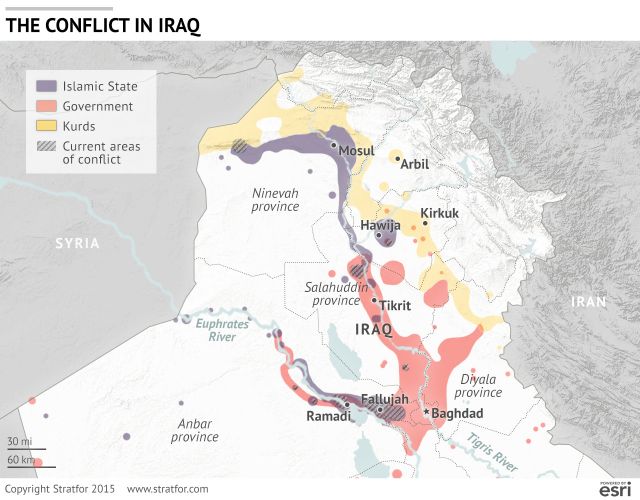
Regardless of the decision, the fragility and failings exposed in Tikrit are still present. Baghdad, along with its various partners, is trying to shore up its forces as best it can in preparation for the fight ahead. In Anbar, the manpower dilemma appears to have two possible answers. One possibility is using specially selected elements from Shiite militias believed to be disciplined enough to follow Baghdad's orders. This would hopefully prevent the looting, reprisal attacks and atrocities some militias are accused of, or known to have done in Diyala province and in Tikrit. In a Sunni bastion such as Anbar, the use of a force believed to be a sectarian revenge tool will only stoke more local resistance.
This factor plays into — and is not necessarily mutually exclusive of — the alternative option available to Baghdad. The other way to make up the shortfall in manpower is by fully arming Sunni tribal elements already opposing the Islamic State, similar to how Baghdad used the Anbar awakening movement. The fighting in Iraq is not cleanly divided along sectarian and ethnic lines, but it can easily devolve in that direction, especially when there is inherent paranoia over the other side's intentions and motivations.
The Sunni tribes are suspicious of Baghdad's intent, thanks to previous marginalization at the hands of successive governments. The price for working against the Islamic State has been the provision of small arms and pay. Anbar provincial council members said April 8 that up to 10,000 Sunni tribal members would receive money and arms. If Baghdad follows through with its promises, and if the Shiite militias and Iraqi security forces behave appropriately, the forces arrayed against the Islamic State could swell quickly, helping create a legitimate buffer between Baghdad and militant positions in the Euphrates River Valley.
Along with everything else, as Baghdad inevitably considers pushing north, it must take into account the Kurdistan Regional Government and its indigenous security forces, or peshmerga. The peshmerga are a relatively competent ground force, already heavily engaged fighting the Islamic State in defense of Kurdish territory. Considering that Mosul will likely be the hardest urban fight in the war against the Islamic State, any operation by Baghdad against this city must include the cooperation of the Kurds.
In some ways this has already happened. Peshmerga fighters have already contained the northern and eastern flanks of Mosul, putting them in a perfect position to act as the "anvil" for the hammer of the Iraqi security forces as they advance up the Tigris River Valley from the south. Additionally, the peshmerga have steadily cut major Islamic State supply lines from Syria, running to the west of Mosul. But further cooperation will cost Baghdad because the Kurdistan Regional Government continues to attempt to solidify its share of oil revenues and disputed territory. There are old scores to be settled between the Kurds, Baghdad, the northern Sunni tribes and various other stakeholders in the region. The localities in and around Kirkuk are the epitome of this dynamic.
No Quick Victory
There is no easy step after Tikrit to fighting (and finishing) the Islamic State. Baghdad must continue to build and equip its army, relying heavily on the U.S.-led coalition to fund, supply and train this force, while also desperately needing coalition air power to support Iraqi ground forces. Those ground forces are stretched to their limit by protecting the Shiite core in southern Iraq, clearing out Islamic State positions north and west of Baghdad along the river valleys and holding any reclaimed territories. To supplement these ground forces, Baghdad must rely on an unwieldy coalition of partners; a league that could easily devolve into infighting, and whose cooperation is dependent on Baghdad making concessions to their various interests.
This necessary alliance is stressing every single resource Baghdad has available. The campaign to remove the presence of Islamic State from Iraq — from portions of Anbar province first and then eventually from Mosul — will look much like the battle of Tikrit. It will be messy and muddled as all these disparate and disjointed elements fumble onward, pursuing their various offensives. There will be setbacks as Islamic State forces counter, and there is the possibility that the war effort breaks down for indefinite periods of time because of all the existing constraints. In the end, however, a numerically superior force is massed against the Islamic State. If these outfalls can be avoided, the reduction of Islamic State power in the region is a certainty, if not an immediate one.
